Top 7 Challenges Software Development Companies Solve with Last Mile Delivery Management Solution
Table Of Content
Published Date :
28 May 2026
Key Takeaways
- Last mile delivery is the most expensive and operationally complex stage of logistics, making efficient delivery management critical for profitability and customer satisfaction.
- Last mile delivery management software helps logistics companies improve route planning, dispatching, driver tracking, customer communication, and proof of delivery through one centralized system.
- Real-time delivery visibility enables logistics teams to identify delays early, optimize driver assignments, reduce operational blind spots, and improve decision-making across delivery operations.
- Automated dispatching, optimized routes, and live tracking help businesses reduce fuel costs, failed delivery attempts, overtime expenses, and manual coordination challenges.
- Better customer communication through live tracking links, ETA notifications, and delivery updates improves customer trust and reduces support workload significantly.
- Custom last mile delivery solutions integrated with AI, IoT tracking, and supply chain systems help logistics companies build scalable, data-driven, and more predictable delivery operations.
The last mile has become the most expensive, complex, and also customer-visible part of the whole logistics chain in Canada. Lately, as e-commerce keeps surging, Canadian logistics firms and retailers are getting squeezed with unprecedented pressure to deliver quicker, more transparently, and more profitably than ever before.
Customers now expect accurate ETAs, flexible delivery windows, and real-time updates. At the same time, logistics teams are dealing with fuel price pressure, driver shortages, traffic delays, failed delivery attempts, and manual coordination gaps.
According to a study by the Capgemini Research Institute, last mile delivery makes up 41% of total supply chain costs, so it ends up being the costliest section of the shipping process.
A last mile delivery management solution helps businesses bring more control into this final stage by improving route planning, dispatching, tracking, delivery proof, and customer communication without adding unnecessary operational complexity.
What Is Last Mile Delivery Management Solution?
A last mile delivery management solution is basically a software that helps logistics firms handle the final movement of goods, like from a warehouse, a hub, a store, or a distribution centre all the way to the customer’s doorstep. It’s often considered the briefest slice of the whole delivery route, but in actual day to day operations, it tends to be the hardest piece to keep under control.
Imagine a courier operation managing 1,200 deliveries in a single city on a Monday morning. Some customers want things early, a few addresses are incomplete, traffic feels different every hour, and yes, some drivers might get in touch late. Without a good system, dispatchers are left doing all kinds of juggling, phone calls, spreadsheets, messages on WhatsApp, and plain guesswork too. That’s where last mile delivery software really starts to matter and makes things less messy.
It helps logistics teams manage tasks such as:
- Planning delivery routes based on location, priority, and capacity
- Assigning jobs to the right drivers
- Tracking drivers and parcels in real time
- Sending delivery updates to customers
- Collecting digital proof after delivery
- Monitoring delivery delays, failed attempts, and driver performance
In simple terms, last mile delivery management software gives businesses a central view of delivery operations. Managers can see what’s moving, what’s delayed, which driver is overloaded, and where customer communication may be falling short.
For growing logistics companies, this matters because the final delivery stage is no longer just an operational task. It directly affects customer trust, repeat orders, support workload, and profit margins. A good system doesn’t just move packages faster. It helps teams make better delivery decisions before small issues turn into expensive problems.
Want Better Visibility Across Delivery And Fleet Operations?
Create intelligent last mile delivery systems that improve tracking accuracy, fleet coordination, and delivery performance through real-time operational insights efficiently.
Why Last Mile Delivery Has Become Major Business Challenge
Last mile delivery has become harder because customer expectations have moved faster than many logistics systems. A few years ago, customers were comfortable with broad delivery windows. Today, they want live tracking, accurate arrival times, quick updates, and fewer excuses. For logistics companies, that means every delay is visible and every missed delivery can turn into a complaint.
The challenge is not only speed. It’s control.
A logistics company may have enough vehicles, drivers, and orders to run profitably, yet still lose money because the final delivery process is not planned well. Small issues don’t look serious on paper, but across hundreds or thousands of daily orders, they become expensive.
Manual processes make the problem worse. When dispatchers rely on spreadsheets, phone calls, or basic maps, they often make decisions with incomplete information. They may not know which driver is closest, which route is delayed, or which delivery should be reassigned before the customer starts calling.
Modern delivery operations need better visibility and faster decision-making. That is where delivery route planning software, driver tracking, automated dispatching, and customer notifications become valuable.
For top management, this is more than a logistics issue. It affects operating cost, customer retention, brand reputation, and scalability. A company cannot keep adding people to fix every delivery problem. At some point, the process itself has to become smarter.
7 Critical Logistics Challenges Solved with a Last Mile Delivery Management Solution
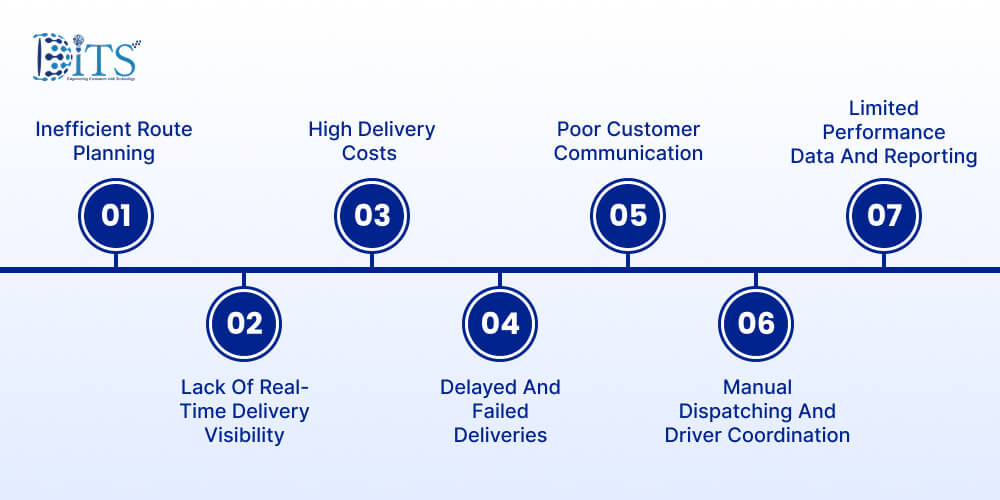
Every logistics business reaches a point where delivery problems stop feeling like small operational gaps and start affecting profit, customer loyalty, and team productivity. The issue is rarely one big failure. More often, it’s a mix of inefficient routes, unclear driver status, rising delivery costs, poor communication, and weak reporting.
A last mile delivery management solution helps companies fix these problems by bringing delivery planning, dispatching, tracking, proof of delivery, and performance data into one connected system. For executives, the value is simple: fewer surprises, better control, and more predictable delivery outcomes.
Inefficient Route Planning
Route planning gets weird fast when the delivery volume ramps up. Like, a dispatcher can still juggle 50 deliveries by hand, but when it jumps to 500 or 5,000 it’s a whole other deal. Poor order, repeat travel, missed delivery windows, and drivers getting uneven workloads all stack together and you end up paying more in fuel, plus longer delays.
Solution: Some kind of delivery route planning software helps logistics teams sketch out more intelligent routes, not just “good enough” ones, based on where stops are, delivery priority levels, traffic conditions, driver availability, and the vehicle’s carrying capacity. For logistics companies, that usually translates into fewer wasted miles, tighter delivery density, lower fuel spending, and more completed deliveries using the same fleet.
Lack of Real-Time Delivery Visibility
Logistics managers can’t correct the situation if they can’t actually see it. When driver locations, parcel status, and route progress aren’t clear, dispatch teams start leaning on phone calls and guesses. Decisions get slowed, and customers feel it too, which is not great.
Solution: Last mile delivery software gives teams live insight into driver movement, delivery status, delays, and route progress. Managers can catch issues sooner, reroute or reassign jobs when things change, and notify customers before complaints pop up. For growing logistics companies, this kind of real-time tracking brings a big advantage: fewer blind spots during the busiest delivery stretches.
Real-time visibility also becomes stronger when logistics companies connect delivery platforms with IoT tracking and GPS asset management, especially for fleet-heavy operations where vehicle location, parcel movement, and asset usage need closer monitoring.
High Delivery Costs
Last mile costs climb in a quiet way. Extra fuel, overtime, repeat delivery attempts, not-so-great vehicle use, and long idle stretches all squeeze margins. One failed delivery seems small, but if hundreds of missed tries show up each month it can hit profitability hard.
Solution: Last mile logistics software helps companies control these expenses with improved route planning, smarter dispatching, better load distribution, and delivery performance monitoring. It gives managers a clear picture of where money is being drained, so they can adjust the workflow instead of jumping straight to more drivers or vehicles. That’s a steadier path for scaling, honestly.
Delayed and Failed Deliveries
Delays usually come from issues that sound familiar: wrong addresses, traffic waves, missed delivery windows, weak driver coordination, or customers who are not available. Those problems feel routine at first, but they erode trust fast when people are waiting.
Solution: A delivery platform can cut failed attempts by using automated alerts, optimized schedules, live shipment status updates, and digital confirmations. Proof of delivery software also creates solid records for completed shipments, including signatures, photos, timestamps, or even location specifics. This reduces arguments later and helps customer support teams reply with confidence, instead of guessing what happened.
Poor Customer Communication
Customers don’t like waiting without updates. When they don’t know where an order is or when it will arrive, they usually contact support, cancel future orders, or leave poor feedback.
Solution: Automated notifications, live tracking links, ETA updates, and delivery alerts help reduce that uncertainty. A good system keeps customers informed without forcing support teams to answer the same “Where is my order?” question all day. Better communication also makes delays easier to manage because customers are less frustrated when they’re informed early.
Manual Dispatching And Driver Coordination
Manual dispatching works only up to a point. Once order volume grows, phone calls, spreadsheets, and message threads become slow and messy. Drivers miss updates. Dispatchers lose time. Managers struggle to see who is available.
Solution: Delivery dispatch software helps assign tasks automatically based on driver location, route, capacity, and delivery priority. Drivers receive jobs on a mobile app, while managers track progress from one dashboard. This reduces confusion and helps the same team manage more deliveries without adding unnecessary admin work.
Limited Performance Data And Reporting
Lots of logistics companies know deliveries are late, but they don’t always really know why. Maybe it’s route planning, driver workload, traffic patterns, or those failed first attempts. Still, weak reporting makes these questions hard to settle, because you just don't see the full picture.
Solution: Modern delivery setups can give managers clear information about delivery time, route efficiency, missed attempts, driver performance, fuel usage, and customer feedback. That helps leadership choose better steps rather than guessing, and I guess it reduces the whole “we think it’s X” cycle. Over time, this data also supports smarter staffing, more accurate delivery planning, plus steadier service-level results.
Business Benefits of Building Last Mile Delivery Management Solution
For logistics firms, better delivery management is not just about pushing parcels faster, it’s more like building a delivery operation that stays profitable even while order volume grows, customer expectations get stricter, and service areas expand again and again.
A solid delivery setup gives leadership more control over everyday operations in a few real, practical ways.
| Business Benefit | Operational Impact |
| Faster delivery completion | Drivers follow better routes and complete more stops in less time |
| Lower operational costs | Fuel use, overtime, and repeat trips are reduced |
| Better fleet utilization | Vehicles and drivers are assigned based on capacity and location |
| Improved customer experience | Customers receive timely updates, ETAs, and delivery alerts |
| Reduced failed delivery attempts | Teams can confirm availability, update schedules, and collect delivery proof |
| Higher team productivity | Dispatchers spend less time on calls and manual coordination |
| Better decision-making | Managers can review delivery data instead of relying on guesswork |
For companies planning connected fleet operations, IoT software development can also support live vehicle tracking, sensor-based alerts, route monitoring, and better control over mobile delivery assets.
The main upside is predictability. When managers can view route progress, driver workload, delivery delays, and customer updates all in one place they can adjust decisions before minor issues turn into expensive problems.
For instance, a courier provider expanding from one city to three might not need to triple the dispatch crew if the underlying system is correct. Automated assignments, real time tracking, and performance summaries can let the same team manage more shipments with fewer mistakes.
How DITS Can Help Logistics Companies Build Custom Last Mile Delivery Management Solution
Every logistics business has a different delivery model. That’s why many companies eventually need custom software instead of forcing their operations into a ready-made platform.
DITS helps logistics companies build custom last mile delivery management software around their actual workflows, delivery rules, customer expectations, and growth plans. The solution can include features like route planning, driver apps, admin dashboards, real-time fleet tracking, customer notifications, order management integration, digital proof of delivery, and performance analytics.
For businesses already using supply chain management software, DITS can also help connect last mile delivery operations with existing systems, so teams don’t have to manage disconnected data across multiple tools. This is especially useful when orders move from warehouse planning to dispatch and final delivery.
At DITS, we also use AI for software development, quality assurance, maintaining code quality, and customization. We integrate AI into every software we develop, where it adds practical value, such as smarter delivery assignment, route suggestions, operational alerts, and performance insights.
Businesses exploring the use cases and benefits of AI in logistics can also work with DITS to identify where automation, predictive alerts, smarter dispatching, and delivery analytics can create measurable value.
For logistics companies planning long-term digital transformation, working with an AI software development company can help turn delivery operations into a more intelligent, scalable, and measurable business function. The goal is not to add technology for the sake of it. The goal is to make daily delivery decisions faster, clearer, and easier to control.
Need Smarter Delivery Management Solutions For Logistics Growth?
Build scalable logistics platforms with real-time tracking, automated dispatching, and route optimization for efficient delivery operations successfully.
Conclusion
Last mile delivery problems rarely stay only in the logistics team. A delayed parcel can turn into a support ticket. A missed drop can become a refund. Even poor route planning can quietly raise fuel bills. Over time these little issues touch customer trust, they compress operating margins and make scaling more complicated.
A last mile delivery management solution helps logistics firms bring some order into this final stage that’s often unpredictable. By improving route planning, setting up automated dispatch, using real time tracking, sending customer updates, collecting proof of delivery, and publishing performance reports businesses can lower day to day friction and keep delivery operations more manageable, honestly less stressful.
For leadership teams, the payoff is control. Not only quicker shipments, but clearer decisions, fewer blind spots, and stronger accountability across drivers, dispatchers, and customer support crews.
And as competition keeps getting sharper in logistics, the companies that put time into smarter delivery operations will be better positioned to guard margins and meet what customers expect. Faster, cleaner, more consistent deliveries aren’t some optional extra anymore. They are part of how modern logistics firms stay relevant.
FAQs
What is a last mile delivery management solution?
A last mile delivery management solution is a software that logistics companies use to handle the final part of the journey like from a warehouse or store, maybe a hub or distribution center, right up to the customer’s door. It normally covers route planning, dispatching, driver tracking, plus those customer updates, then proof of delivery, and reporting. For companies the big benefit is more control over delivery timing, spend, visibility, and honestly, the customer experience too.
How does last mile delivery software cut delivery costs?
It tends to lower costs by refining route planning, cutting down on repeat trips and stop-and-go reroutes, plus avoiding unnecessary fuel use. It also makes dispatching more organized, so deliveries get assigned in a more efficient way. On top of that, it helps spot failed attempts, monitor driver performance, and measure delays. When you can see where things break down, it’s easier to figure out what part is draining money. Over time, these smaller upgrades can help defend margins, without needing to grow the fleet size.
Can a last-mile delivery management solution really improve customer experience?
Yes, generally it can. Customers often feel frustrated when they don’t know where their order is or when it shows up, and frankly not having visibility is annoying. A delivery system helps the customer experience by pushing out automated updates, sending live tracking links, showing ETAs, and delivering confirmation receipts. That usually cuts down on those support calls too, and gives customers more trust, especially when things get busy and volume spikes.
What features should logistics companies pay attention to in delivery management software?
Logistics companies should look for route optimization, automated dispatching, driver mobile apps, real-time GPS tracking, customer notifications, proof of delivery, order integration, and delivery analytics. Also, it needs to be flexible, so it can match the company’s delivery rhythm, whether the business is doing local parcels, retail drop-offs, time-window routes, or bigger enterprise logistics workflows.
Does DITS provide custom last mile delivery management development services?
Yes. DITS’ Last Mile Delivery Management Development services help logistics companies build custom delivery platforms based on their workflows, delivery rules, fleet structure, and customer communication needs. DITS can develop features such as route planning, driver apps, dispatch dashboards, fleet tracking, proof of delivery, customer notifications, order system integration, and analytics for better delivery control.

Dinesh Thakur
21+ years of IT software development experience in different domains like Business Automation, Healthcare, Retail, Workflow automation, Transportation and logistics, Compliance, Risk Mitigation, POS, etc. Hands-on experience in dealing with overseas clients and providing them with an apt solution to their business needs.
Recent Posts
Explore how prior authorization software uses AI to automate workflows, reduce administrative effort, improve request accuracy, streamline approvals, and minimize treatment delays for healthcare organizations.

Discover how AI to improve patient experience in hospitals streamlines scheduling, communication, triage, queue management, and personalized care while enhancing operational efficiency.

Learn how IoT powers smart factories with connected devices, automation, predictive maintenance, and analytics.