Use Cases & Benefits of AI in Logistics Business
Table Of Content
Published Date :
27 Apr 2026
Key Takeaways
- Artificial intelligence delivers real-time operational intelligence to logistics functions.
- Companies achieve cost reductions through improved scheduling and process automation technologies.
- Organizations achieves better operational results when staff members make decisions at a quicker pace.
- Forecasting accuracy reduces risks associated with maintaining inventory stock.
- Better visibility strengthens supply chain control.
- Customer experience improves with timely and transparent deliveries.
- Scalable systems support long-term business growth.
- Early adoption creates a strong competitive advantage.
Logistics now handles more complex operations than simply transporting products between two locations. They process large amounts of information where any operational defect above two to three percent will result in financial losses worth millions. Companies that adopt AI in supply chains can reduce logistics costs and improve service levels significantly.
The shift requires business leaders to develop new operational management methods. The planning process needs to change because organizations now face challenges which require real-time data access to make timely decisions. This is where the benefits of AI in logistics start to become apparent.
AI functions as more than an enhancement for existing systems. The new system alters all aspects of logistics operations which include decision-making processes, risk management procedures, and business growth capabilities.
According to a report by Global Market insights use of AI in logistics and supply chain market size was valued at $20.1 billion in 2024 and is projected to grow upto $196.58 billion by 2034.
What Is AI In Logistics
The term AI in logistics describes how intelligent systems operate to process data while identifying patterns and making autonomous decisions. The system does not substitute for existing operations. The system operates through enhanced processing speed which improves operational accuracy and establishes higher levels of operational predictability.
AI operates from a hidden position because it functions. The program analyzes historical shipment data together with delivery schedule information and traffic flow patterns and customer shopping activities. The system develops the ability to distinguish between successful and unsuccessful processes while detecting operational faults which standard systems fail to identify.
Key Technologies Behind It
The essential technologies which enable this function appear below:
- Machine learning that improves forecasting accuracy over time
- The system uses predictive analytics to identify future delays and demand surges and operational interruptions
- The system implements automation tools which decrease the need for staff to perform manual tasks in both warehouses and operational activities
- The system delivers real-time data processing capabilities which enable organizations to make decisions at a faster rate.
These technologies integrate directly with existing systems like transportation and logistics software, enhancing their capabilities without requiring a complete overhaul.
Are Your Logistics Operations Ready for AI Transformation?
Evaluate inefficiencies across routing, forecasting, and fleet performance to identify where intelligent automation can immediately improve cost control and delivery outcomes.
Key Use Cases of AI In Logistics Business
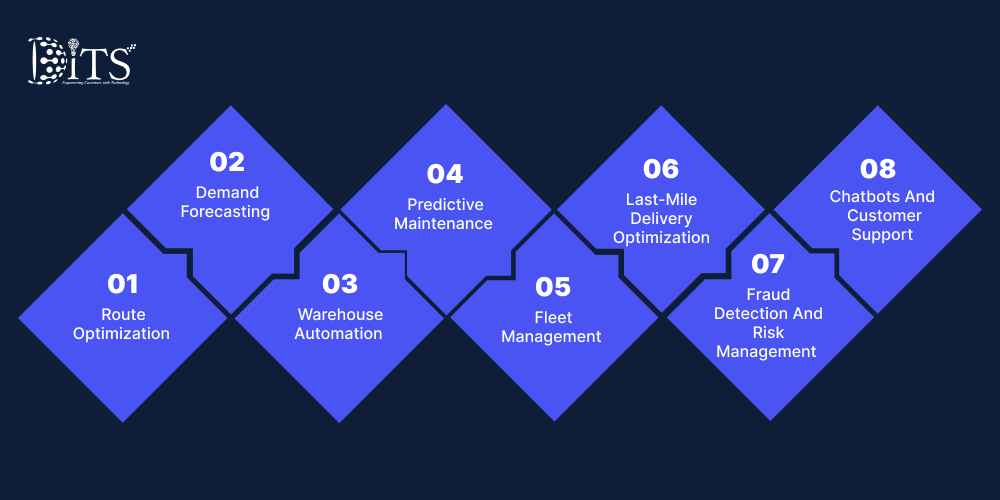
When executives explore AI use cases in logistics, the discussion quickly moves from concepts to outcomes. Where does it actually make a difference? Which areas see measurable improvement?
AI helps optimize operations, quietly improving decisions, reducing waste, and tightening control where it matters most.
Route Optimization
Think about a fleet operating across congested city routes. Delays pile up, fuel costs rise, and delivery timelines stretch.
AI brings structure to that chaos.
- Real-time route planning based on live traffic conditions
- Dynamic adjustments during unexpected disruptions
- Identification of fuel-efficient paths to reduce costs
What once depended on manual judgment now becomes data-driven. Deliveries get faster. Costs begin to stabilize.
Demand Forecasting
Forecasting demand has always been a balancing act. Too much stock ties up capital. Too little creates missed revenue opportunities.
AI makes this far more precise.
- Analysis of historical trends and buying patterns
- Identification of seasonal demand fluctuations
- Optimization of inventory levels to avoid shortages or excess
This is where operations start feeling more controlled. Planning becomes less guesswork and more strategy.
Warehouse Automation
Warehouses often reflect the efficiency of the entire logistics chain. Disorganized storage or slow picking processes ripple across operations.
AI changes how warehouses function.
- Intelligent inventory tracking with higher accuracy
- Guided picking and packing processes to reduce errors
- Optimized storage layouts for faster movement
When paired with warehouse management software, the improvements are noticeable. Turnaround times shrink, and operational bottlenecks start disappearing.
Predictive Maintenance
Unexpected breakdowns are expensive. They disrupt schedules, delay deliveries, and increase repair costs.
AI introduces a more proactive approach.
- Continuous monitoring of vehicle performance
- Early detection of potential mechanical issues
- Scheduled maintenance before failures occur
This shift reduces downtime significantly. Operations become more reliable, and disruptions become less frequent.
Fleet Management
Managing fleets at scale is no longer just about tracking location. It’s about understanding performance at a deeper level.
AI provides that visibility.
- Analysis of driver behavior and driving patterns
- Monitoring of fuel usage and efficiency
- Optimization of vehicle utilization
Over time, these insights lead to smarter allocation of resources. Fleets don’t just operate. They evolve.
Last-Mile Delivery Optimization
Last-mile delivery often shapes customer perception. Even minor delays can impact satisfaction and retention.
AI improves precision at this critical stage.
- Accurate prediction of delivery timelines
- Optimization of delivery sequences
- Better coordination between dispatch teams and drivers
Here’s what many businesses notice. As delivery accuracy improves, customer trust follows.
Fraud Detection and Risk Management
Logistics operations involve multiple touchpoints, which increases exposure to risks.
AI helps in identifying those risks early.
- Detection of unusual shipment or transaction patterns
- Identification of potential fraud or theft scenarios
- Strengthening compliance monitoring
Instead of reacting after an issue occurs, businesses gain the ability to prevent it. That changes the entire risk equation.
Chatbots and Customer Support
Customer expectations are no longer limited to delivery. They expect visibility, updates, and quick responses.
AI-driven systems support this shift.
- Instant shipment tracking updates
- Automated handling of routine customer queries
- Continuous support without operational delays
Support teams become more efficient, while customers experience faster and clearer communication.
These AI use cases in logistics industry don’t operate in isolation. They build on each other, creating a system where every decision is backed by data and every process becomes more refined over time.
Benefits of AI In Logistics Business
Once businesses start implementing AI across operations, the impact doesn’t stay limited to one function.
What begins as a small improvement to routing and forecasting functions develop into comprehensive changes that affect the whole logistics network. And that’s where the benefits of AI in logistics become impossible to ignore.
Cost Reduction
Logistics executives need to focus on maintaining control over their expenses. Fuel prices experience continuous changes. Labor costs experience ongoing increases. The business faces ongoing challenges to maintain desired profit levels.
AI helps bring those costs under control in a structured way.
- The system creates efficient routes that decrease fuel usage.
- The system automates repeated operational processes.
- The system uses predictive maintenance to stop expensive equipment failures from happening.
Unexpected expenses create problems for people because they disrupt their work schedule through unanticipated times. AI technology reduces the number of unexpected costs which helps businesses spend their money more effectively.
Improved Efficiency
Logistics efficiency consists of more than just fast delivery. The process requires people to complete their tasks at the same standard every time.
AI technology enables businesses to enhance their operational processes through improved project management.
AI supports this by tightening operations.
- The system decreases delivery times because of incomplete scheduling.
- The system improves team communication which enables better system synchronization.
- The system decreases errors that occur when people perform essential tasks.
The combination of these minor enhancements demonstrates measurable progress over time. The organization now operates with greater efficiency through established systems which handle tasks and responsibilities.
Better Decision-Making
Logistics decision-making requires evaluation of several different factors. The process requires evaluation of demand changes together with routing modifications and stock levels and all outside disturbances.
AI simplifies this complexity.
- The system provides current operational information through continuous data collection.
- The system detects patterns which human analysts cannot see.
- The system enables users to make decisions with greater speed and higher certainty.
Leaders can base their actions on hard facts instead of assuming outcomes. Operational strategy will undergo a major transformation because of this single adjustment.
Enhanced Customer Experience
Customer expectations have evolved. Delivery speed matters, but so does transparency.
AI helps meet both expectations
- Provides accurate delivery timelines
- Enables real-time tracking visibility
- Improves communication across touchpoints
When customers know what to expect, frustration drops. Trust builds. And that often translates into repeat business.
Scalability
Growth in logistics is not always linear. Demand spikes, seasonal peaks, and sudden expansions can stretch operations quickly.
AI brings flexibility into the system.
- Adapts to changing demand without major disruptions
- Supports higher volumes without proportional increase in resources
- Enables faster scaling of operations
This means businesses can grow without constantly rebuilding their infrastructure.
Increased Visibility Across Supply Chain
Visibility remains one of the biggest challenges in logistics. Without it, decisions slow down and risks increase.
AI improves this visibility significantly.
- Offers end-to-end tracking across shipments
- Enhances coordination between different stakeholders
- Provides a clearer picture of the entire supply chain
The combination of strong supply chain management practices and this level of visibility allows businesses to achieve faster response times and improved operational confidence.
The benefits of AI in logistics operations show their actual value through these improved business operations. The operational benefits create strategic advantages which enable businesses to achieve sustained development.
Struggling With Demand Forecasting and Inventory Planning Accuracy?
Leverage AI-powered predictive analytics to eliminate guesswork, improve inventory control, and align supply chain decisions with real-time demand patterns.
How To Implement AI In Logistics Business
Logistics organizations need to develop their artificial intelligence capabilities through incremental technological advancement rather than immediate technological deployment. The process requires organizations to develop their technology systems through specific steps which build toward their ultimate business objectives.
Companies that implement new systems too quickly without understanding their power first experience difficulties when trying to connect different parts of their system. The solution requires an approach which proceeds through gradual steps according to specific requirements.
Identify Business Needs
Start with clarity. What exactly needs improvement? The delivery delays and rising fuel costs and inventory inefficiencies require examination. Identifying specific problems enables organizations to spend their money effectively. The process ensures that artificial intelligence solves actual business challenges instead of being used only for technological advancement.
Choose Right AI Solutions
Organizations need to select artificial intelligence solutions which match their particular operational needs. The selection process requires organizations to assess their operational capacity and their current technological infrastructure and their planned future development.
- Route optimization tools for fleet-heavy operations
- Forecasting systems for demand-driven businesses
- Automation tools for warehouse efficiency
Organizations need to select which solution suits their operations most effectively instead of focusing primarily on product characteristics.
Partner With Development Experts
This partnership gives businesses their competitive advantage. The employment of experienced partners brings more effective integration processes together with quicker deployment times.
For instance, companies offering AI software development and AI consulting services can help design solutions tailored to your workflows rather than forcing generic tools into your system.
At DITS, AI serves as an essential component which combines with various software development processes together with quality assurance and code optimization. The method guarantees that each solution achieves operational capability while it undergoes ongoing enhancement.
Follow Gradual Implementation Approach
People who attempt to change everything at once create major disruptions. A phased approach works better.
- Start with one area, such as route optimization or forecasting
- Measure performance improvements
- Expand AI adoption across other functions
Why Choose DITS For AI-Powered Logistics Software
Selecting the right technology partner often determines whether AI delivers results or becomes another underutilized investment. Many businesses have learned this the hard way. The tool works, but it doesn’t align with operations.
That’s where the approach matters.
The DITS organization uses artificial intelligence as a core component which operates through all development phases from planning to deployment. The system verifies that its solutions deliver both intelligent capabilities and practical functionality needed in actual logistics operations.
What Sets DITS Apart
- Deep expertise in building scalable AI solutions for enterprise that adapt to evolving business needs.
- The organization provides strong customization capabilities which allow clients to create systems that precisely match their particular operational processes.
- The process of developing and testing code includes artificial intelligence which helps to sustain system performance throughout its entire lifecycle.
- The organization provides complete support which starts with consultation and continues through system deployment and system performance improvements.
Here’s something many decision-makers appreciate. Instead of offering generic platforms, DITS builds solutions that grow with your business.
When AI is implemented this way, it doesn’t just improve operations. It becomes part of how the business runs, adapts, and scales. Getting it right can define how effectively AI delivers value across your logistics operations.
Need Scalable AI Solutions for Growing Logistics Operations?
Implement flexible AI systems that adapt to increasing demand, support operational expansion, and ensure long-term efficiency without rebuilding your infrastructure.
Conclusion
Logistics has transitioned from being a background operational function to its current role as a strategic element that drives profit results and customer satisfaction and business expansion. The traditional systems of the past no longer provide better advantages than the current system requirements of the industry.
AI changes that equation. The technology delivers speed to operations which had previously experienced delays and it provides users with the ability to control situations which had required constant efforts to handle emergencies. The organization achieves measurable results through its route optimization and forecasting improvements and visibility enhancements.
But here’s the reality. The real value doesn’t come from adopting AI alone. Successful application requires execution in suitable situations through appropriate methods. Businesses that understand this tend to see faster returns and stronger operational stability.
FAQs
What are the most common AI use cases in logistics?
The most common ai use cases in logistics show their presence through five main applications which include route optimization, demand forecasting, warehouse automation and predictive maintenance and last-mile delivery optimization. These applications help businesses reduce costs, improve efficiency, and enhance customer experience.
How does AI improve logistics operations?
AI enhances logistics operations through its capability to analyze extensive data sets at present time which enables it to detect problems and support quick decision processes. The system helps organizations by optimizing their workflows and decreasing mistakes while establishing effective cross-organizational partnerships throughout their supply network.
Is AI suitable for small and mid-sized logistics businesses?
Small and mid-sized businesses now find AI to be more accessible than ever before according to current market conditions. With the right implementation strategy, companies can start with specific use cases like route optimization or forecasting and scale gradually based on their needs.
How is AI used in logistics for better decision-making?
Businesses often explore how AI is used in logistics to gain actionable insights from operational data. AI systems analyze patterns, predict outcomes, and support leaders in making faster, data-driven decisions that improve overall performance.
How can DITS AI software development for logistics help improve operations?
DITS AI software development for logistics creates customized solutions which succeed in solving particular operational problems that arise from route inefficiencies and demand changes and visibility constraints. Through AI system integration with primary business operations, organizations can achieve decision automation, enhanced accuracy, and improved logistics process management.
Why should businesses choose DITS AI software development for logistics over generic solutions?
DITS AI software development for logistics offers customized, scalable solutions designed to align with unique business workflows rather than applying one-size-fits-all tools. This ensures better integration, faster adoption, and long-term performance improvements, making AI implementation more effective and result-driven.

Dinesh Thakur
21+ years of IT software development experience in different domains like Business Automation, Healthcare, Retail, Workflow automation, Transportation and logistics, Compliance, Risk Mitigation, POS, etc. Hands-on experience in dealing with overseas clients and providing them with an apt solution to their business needs.
Recent Posts
Explore how prior authorization software uses AI to automate workflows, reduce administrative effort, improve request accuracy, streamline approvals, and minimize treatment delays for healthcare organizations.
Discover how AI to improve patient experience in hospitals streamlines scheduling, communication, triage, queue management, and personalized care while enhancing operational efficiency.
Learn how IoT powers smart factories with connected devices, automation, predictive maintenance, and analytics.