How IoT Works in Smart Factories Solutions
Table Of Content
Published Date :
17 Jul 2026
Key Takeaways
- IoT solutions allow manufacturers to get rid of manual monitoring and get real-time insight into the status of machines, production, energy consumption, inventory, and equipment.
- The process of IoT implementation consists of sensor data collection, industrial data transfer, edge/cloud processing, and insights generation through analytics/AI.
- One of the best use cases of IoT implementation is predictive maintenance, which allows detecting abnormalities in machine operation and reducing machine failuresdetects abnormalities in machine behavior and predicts failures before they occur, helping reduce unplanned downtime.
- Some key challenges associated with implementation are integration with legacy machinery, security concerns, significant upfront cost, integration problems, and too much data.
What if your factory could tell you when a machine is slowing down, when energy consumption is rising, or when a production issue is about to affect product quality?
This is precisely what can be done by implementing the Internet of Things technology in the smart factory.
Modern manufacturers can't afford to rely on manual checking, reports, and maintenance. To see what is happening on the floor, manufacturers should have the ability to access real-time information on machines, production lines, equipment, inventory, and overall factory performance.
IoT for manufacturing connects all the necessary sensors, machines, devices, and software systems to help factory personnel receive valuable, real-time data from the floor and use it to make important decisions.
According to Grand View Research Canadian IoT devices market size is expected to be USD 12,730.2 million by 2030 whereas in 2024, it was USD 5,253.3 million. Moreover, the CAGR is anticipated to grow at a CAGR OF 15.5%.
In other words, IoT acts as the digital communication layer connecting factory assets of a smart factory, connecting all key assets and receiving continuous data streams from them.
Transform Your Factory with IoT Solutions
Connect your machines, monitor operations in real time, and reduce downtime with customized IoT smart factory solutions designed for your business.
How IoT Implementation Works in Smart Factories?
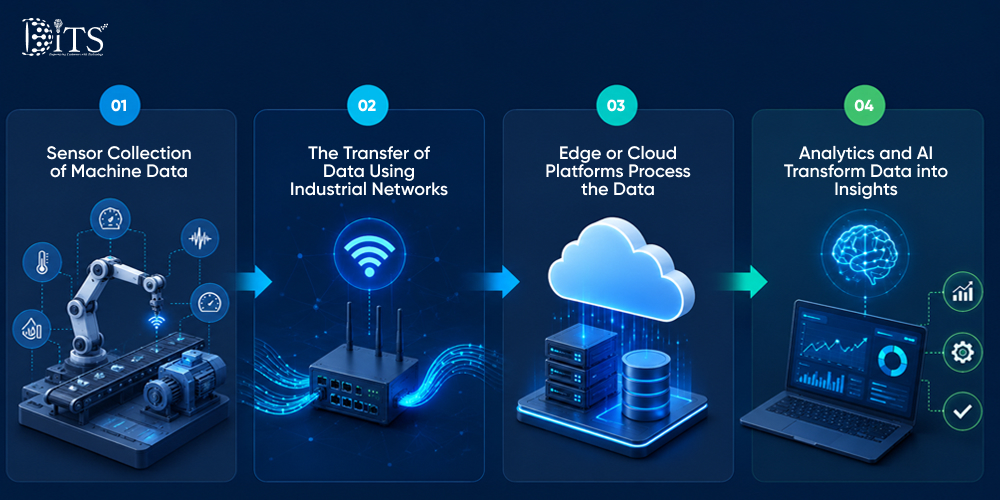
IoT is implemented in smart factories through the establishment of an intelligent connection between machines, sensors, production lines, and software. This will enable manufacturers to access live factory data, monitor machines' performance, minimize downtime, and take fast decisions.
1. Sensor Collection of Machine Data
The IoT sensor technology will begin with the installation of IoT sensors in all machines, equipment, tools, and production lines. The sensors are able to collect real time data from the machines and production lines. This will allow the manufacturer to monitor the performance of the machines.
This data collection includes:
- Temperature
- Pressure
- Vibration
- Energy consumption
- Machine speed
- Production volumes
- Equipment conditions
- Downtime occurrences
For Example:
In an automotive manufacturing facility, vibration sensors attached to robotic arms can detect abnormal vibrations. The moment the vibration exceeds safety limits, it may be treated as an early warning sign of malfunction or misalignment.
2. The Transfer of Data Using Industrial Networks
After collection, the data is sent via wired or wireless industrial networks. These are networks through which data is transmitted to gateways, edge computing devices, cloud-based platforms, or on-premises systems for additional analysis.
Some typical connectivity methods include:
- Ethernet Wi-Fi
- 5G
- Bluetooth
- LPWAN (Low Power Wide Area Network)
- Industrial gateways
- Machine-to-Machine (M2M)
For Example: At a food processing facility, temperature data from the cooling machines is transferred via industrial gateways to a dashboard for monitoring purposes.
3. Edge or Cloud Platforms Process the Data
Once the data is collected by the system, the data is processed using the edge computing, cloud computing or hybrid approach. Edge computing aids in faster response, whereas cloud computing helps in analyzing the large amounts of factory data. Edge computing processes data close to the machine, reducing latency and enabling faster responses. Both approaches are commonly used in many smart factories.
The processing layer often involves:
- Edge computing for faster local response
- Cloud computing for scalable storage and analysis
- Hybrid approach for speed and scalability
- Real-time filtering of data
- Historical analysis of data
For Example: In a chemical manufacturing plant, edge computing helps in processing changes in pressure or temperature around the machinery in real time. Once the safety threshold is surpassed, an alert can be generated.
4. Analytics and AI Transform Data into Insights
Data generated by machines gains value once it undergoes analysis. Analytics, artificial intelligence (AI), and machine learning assist in discovering patterns, spotting anomalies, making predictions about possible failure, and turning factory data into actionable insights.
The analytics layer assists manufacturers in:
- Predictive maintenance
- Anomaly detection
- Production performance monitoring
- Quality problems detection
- Real-time dashboards
- Automated alerts
- Improved decision making
For Example:
At an electronics manufacturing facility, AI will discover patterns AI models can identify patterns of defects in production data and conclude that some machine setting leads to quality problems. The process will be adjusted before another batch of defective products is manufactured.
Use Cases of IoT in Smart Factories
Smart factories have identified opportunities for utilizing IoT to provide manufacturers the ability to monitor their equipment, have improved visibility into their production processes, control the quality of produced goods, reduce unplanned downtime, and use resources more effectively.
Predictive Maintenance
One of the most valuable ways that IoT can be utilized in the smart factory environment is through predictive maintenance. By using IoT sensors to periodically track the operating conditions of equipment, including vibration, temperature, pressure, electrical current, and noise, a manufacturer can continuously monitor the health of their machinery. If an unusual operating pattern is detected, the system will alert the relevant maintenance teams before equipment failure.
Real-Time Production Monitoring
The Internet of Things (IoT) allows companies in the manufacturing industry to see how their systems are performing, when they are operating at full capacity, and where problems occur. Managers throughout a factory can access the central dashboard from a desktop, laptop, or mobile device to monitor output by machine type, production line type, and time period. This type of real-time data enables managers to identify problems more quickly so that they can take corrective measures without having to wait for manual reports to be generated.
Quality Control Automation
Manufacturers can use IoT technologies to identify quality problems sooner in their production process and prevent defects through the integration of sensors/cameras/inspection equipment with their production systems. The devices enable continuous monitoring of product size, temperature, pressure, humidity, machine functioning, process variations, etc.
Energy Monitoring and Optimization
In factories, energy is consumed across various systems, including machines, production lines, utilities, lighting, HVAC, and storage areas. Real-time energy consumption will be tracked through use of IoT devices, allowing you to see where your energy is being wasted or overused.
Inventory and Asset Management
The IoT is used to monitor raw materials, finished products, tools, machines, pallets, and mobile assets throughout the factory/warehouse. Technologies like RFID tags, GPS, beacons, and sensor technology help monitor the location of assets.
Remote Equipment Monitoring
IoT technology provides manufacturers with a way to monitor their equipment’s performance at different sites, including plants, production units, or locations, simultaneously from one centralized place. By doing so, teams will have the ability to monitor machine status, uptime, downtime, performance, alerts, and maintenance needs without being physically present at every location.
Unlock Smarter Manufacturing Operations
Leverage IoT, AI, and real-time analytics to optimize production, improve equipment performance, and lower operational costs.
Benefits of IoT in Smart Factories
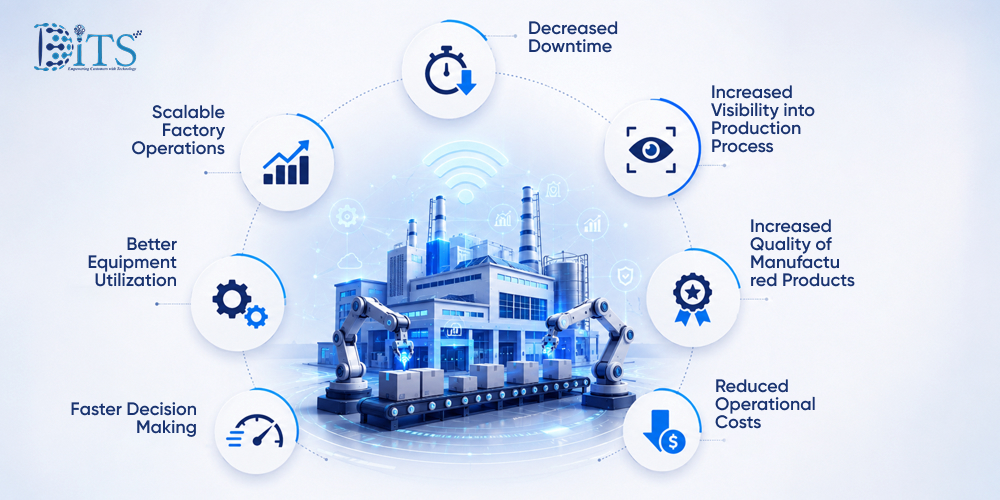
Besides automation, there are numerous benefits of implementing IoT technologies in manufacturing that include improving the visibility of operations, reducing downtime, controlling costs, and making quicker decisions based on the live data.
Decreased Downtime: By detecting any problems with the machines ahead of time, IoT enables maintenance personnel to deal with these problems immediately and avoid downtime.
Increased Visibility into Production Process: Through IoT technologies, manufacturers have an opportunity to see live status of machines, production lines, shifts, and the entire plant.
Increased Quality of Manufactured Products: Using IoT sensors, companies can detect any defects, deviations from the process, and other issues that may affect product quality during the production process.
Reduced Operational Costs: IoT helps reduce the waste of energy, costs related to unscheduled maintenance, manual work, and inefficient production process.
Faster Decision Making: IoT dashboards and alerts provide managers with live data from production and machines. This means that instead of waiting for manual reports, teams can make faster decisions regarding maintenance, quality, inventory and scheduling.
Better Equipment Utilization: With IoT manufacturers can see how machines are being used on the production floor. This allows teams to identify equipment that is idle, underutilized, or overloaded, enabling teams to create better production plans.
Scalable Factory Operations: IoT-based solutions can scale across machines, production lines, departments, and multiple plants. Manufacturers are able to initially start with one use case and gradually scale up as their needs for a smart factory increase.
Challenges in Implementing IoT in Smart Factories and How Canadian Businesses Can Solve Them
Manufacturing with IoT will allow companies in Canada to enhance productivity, minimize downtime, manage costs effectively, and develop more interconnected operations in their factories. Nevertheless, it can be difficult for manufacturers who use old machinery, need data security, face difficulties finding workers, and have factories in different provinces. It is important to focus on a relevant use case, create a strong IoT infrastructure, and expand gradually based on business value.
Legacy Machine Integration
Most manufacturers in Canada use old machines, PLCs, and production systems that did not have IoT integration from the beginning. Replacement of everything can become expensive and difficult for the manufacturer, particularly a small one.
Solution:
A company can integrate their legacy machines using industrial gateways, retrofitting sensors and PLCs, and middleware. A step-by-step plan is the optimal way; first, the company should integrate critical machines or places with high downtime.
Data Security and Privacy Risks
With the increase in connectivity among machines, sensors, dashboards, and cloud in the factories, there will be an increased threat to cyberattacks and intrusions. In the case of the Canadian business, the threat of data security is more critical as the data related to operations, employees, suppliers, and customers has to be kept safe.
Solution:
The manufacturers have to ensure the security of IoT systems right from their installation. The companies have to ensure secure device authentication, encryption, role-based access controls, network segmentation, patching, and monitoring. The businesses have to ensure that their IoT systems are compatible with Canadian standards for privacy and cybersecurity.
High Initial Investment
The high initial investment for IoT implementation is often seen as a significant obstacle to many manufacturers in Canada, primarily SMEs. The total investments required for IoT implementation can include sensors, industry-specific gateways, cloud technology and infrastructure, edge device technology and infrastructure, AI integration technology, cybersecurity technology and tools, and training of employees.
Solution:
To mitigate the risk associated with this large investment, it is advisable to start with a single high-value use case for the initial phase of the IoT implementation or smart factory transition, such as predictive maintenance, energy monitoring, production tracking or inventory visibility, rather than doing an entire factory-wide rollout of IoT.
Integration with ERP, MES, and Other Systems
The IoT data is much more valuable if it integrates with other existing systems like ERP, MES, WMS, SCM, inventory management, and maintenance systems. Otherwise, there will be no connections between factory-floor data and business processes.
Solution:
It is recommended for Canadian manufacturers to adopt API integration, middleware, and scalable IoT technology to unite their production data with enterprise processes. It would help them integrate their manufacturing, inventory, procurement, maintenance, quality control, and supply chain management within one single solution.
Data Overload
Smart factories generate a wealth of data from machinery, production line operations, quality control, energy measurement systems, and all their connected devices. A lack of a plan to capture relevant data can lead a manufacturer in Canada to generate so much information that they cannot use it to make their best business decisions.
Solution:
Before moving into IoT, the business must define specific KPIs, such as downtime reduction, energy savings, production volume, defect rate, machine utilization, and maintenance response time. Dashboards must be easy to read, based on role, and provide the user with actionable insight, rather than providing the user with useless amounts of data.
Top Industries in Canada Using IoT-Based Smart Factory Solutions
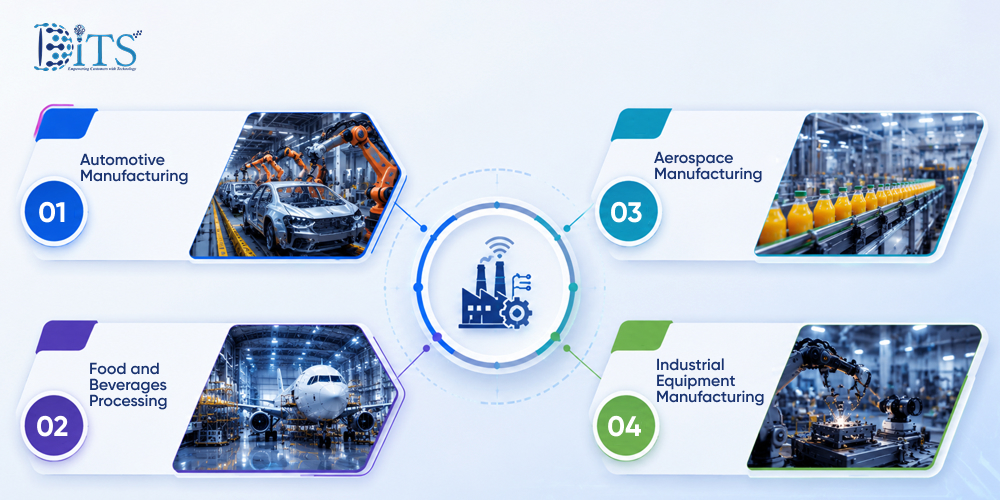
Canadian industries that use IoT-based smart factory solutions are those whose performance depends heavily on their production efficiencies, equipment uptime levels, quality control measures, energy usage, and supply chain visibility. We have mentioned the topmost industries as under;
Automotive Manufacturing
Uses IoT technologies to monitor each automated device or piece of equipment that comprises the assembly line, including robotics, assembly lines, welding systems, paint shops, and final testing equipment.
Food and Beverages Processing
Food and beverages companies can leverage IoT for tracking temperatures, humidity levels, refrigerators, packaging lines, and storage environment. It would help them to ensure that the quality of their products is maintained, spoilage is minimized, energy consumption is optimized, and there is increased visibility in all manufacturing and storage activities.
Aerospace Manufacturing
In aerospace manufacturing industry, accuracy, traceability, and rigorous quality control is required. IoT enables tracking of machinery, tools, inspection process, manufacturing environment, and equipment performance.
Industrial Equipment Manufacturing
IoT can be applied by industrial equipment manufacturers to monitor CNC machinery, assembly equipment, test equipment, energy consumption, and production lines.
Build a Future-Ready Smart Factory
From legacy system integration to predictive maintenance, we help manufacturers implement scalable IoT solutions that deliver measurable ROI.
Conclusion
The use of IoT technology in manufacturing is becoming a concrete path towards achieving more intelligent and connected factories. For Canadian businesses in this field, it is evident that there is no other option but to use it to achieve higher levels of production visibility, decrease downtime, monitor their machinery's health, manage energy consumption and make decisions based on timely data.
Smart factories are not only about installing sensors or making machines automatic. It is about establishing connections between all these elements, people and processes to react to changing conditions faster and scale the production process successfully.
Under increasing pressure of competition, costs and production needs, Canadian companies should consider using IoT smart factory solutions.
FAQs
How is IoT used in manufacturing?
IoT technology is being utilized in manufacturing to connect machinery, sensors, devices, and other software applications, which will allow for real-time monitoring of production. When considering manufacturing in Canada, IoT is utilized in order to ensure monitoring of machinery condition, decrease downtime, increase product quality, monitor energy consumption, and make quick decisions.
In what ways can IoT be used by Canadian factories to cut down on operational costs?
IoT will enable reduced energy wastage, reduced unforeseen machine breakdowns, minimized manual monitoring, improved machine usage, and less production time delays. It offers insights regarding where there is an unnecessary utilization or lack of use of certain resources.
Which sectors in Canada would be able to leverage the use of IoT technology in their factories?
The sectors that could take advantage of IoT in their factories include the automotive manufacturing sector, food and beverages manufacturing sector, aerospace sector, pharmaceuticals sector, electronics sector, industrial equipment manufacturing sector, packaging sector, and metal fabrication sector.
Which devices do smart factory IoT solutions utilize?
Smart meters, RFID labels, sensors, edge devices, and PLCs are the most common devices that are used in smart factory IoT solutions.

Dinesh Thakur
21+ years of IT software development experience in different domains like Business Automation, Healthcare, Retail, Workflow automation, Transportation and logistics, Compliance, Risk Mitigation, POS, etc. Hands-on experience in dealing with overseas clients and providing them with an apt solution to their business needs.
Recent Posts
Explore how prior authorization software uses AI to automate workflows, reduce administrative effort, improve request accuracy, streamline approvals, and minimize treatment delays for healthcare organizations.

Discover how AI to improve patient experience in hospitals streamlines scheduling, communication, triage, queue management, and personalized care while enhancing operational efficiency.
Explore health insurance software development in Canada, covering claims automation, policy management, AI, compliance, integrations, costs, and scalable platform development for insurers and insurance businesses.