How Medical Inventory Management Solutions Cut Costs and Improve ROI
Table Of Content
Published Date :
21 Apr 2026
Key Takeaways
- Inventory inefficiencies silently increase operational costs
- Overstocking and stockouts directly impact financial performance
- Real-time visibility improves control and decision-making
- Automation reduces manual workload and administrative overhead
- Better tracking minimizes expired and wasted supplies
- Data-driven procurement leads to consistent cost savings
- Scalable systems support multi-location healthcare operations
- Strategic inventory management improves overall ROI
Across Canada healthcare systems, operational costs continue to climb, yet one area quietly drains margins more than expected inventory. Hospitals and clinics often invest heavily in medical supplies, but without structured control, a large portion of that investment either sits unused or goes to waste.
A missing surgical item during a procedure, or expired stock discovered during audits, isn’t just an inconvenience. It translates into financial leakage, compliance risks, and disrupted care delivery. Many organizations still rely on spreadsheets or fragmented tools, which creates blind spots.
This is where a medical inventory management solution becomes essential for healthcare businesses. It moves inventory from a reactive function to a controlled, data-driven process. And once that shift happens, cost optimization follows naturally.
What are Medical Inventory Management Solutions
Medical inventory management solutions are software systems that track, manage, and optimise the flow of medical supplies, pharmaceuticals, and equipment across healthcare facilities. Powered by AI, they forecast demand, prevent stockouts or overstocking, automate reordering, and ensure regulatory compliance. These solutions integrate with hospital systems like EHR and ERP to provide real-time visibility, expiry tracking, and usage analytics. The result is reduced waste, controlled costs, improved patient care, and efficient supply chain operations.
At its core, it brings together:
- Real-time tracking of medical supplies across departments
- Automated forecasting based on historical consumption
- Alerts for low stock, overstock, and expirations
- Centralized reporting for decision-makers
Ready to Reduce Waste and Improve ROI?
Discover how structured inventory systems can minimize losses, optimize procurement, and deliver measurable financial impact across your healthcare operations.
Business Benefits of Medical Inventory Management Solutions
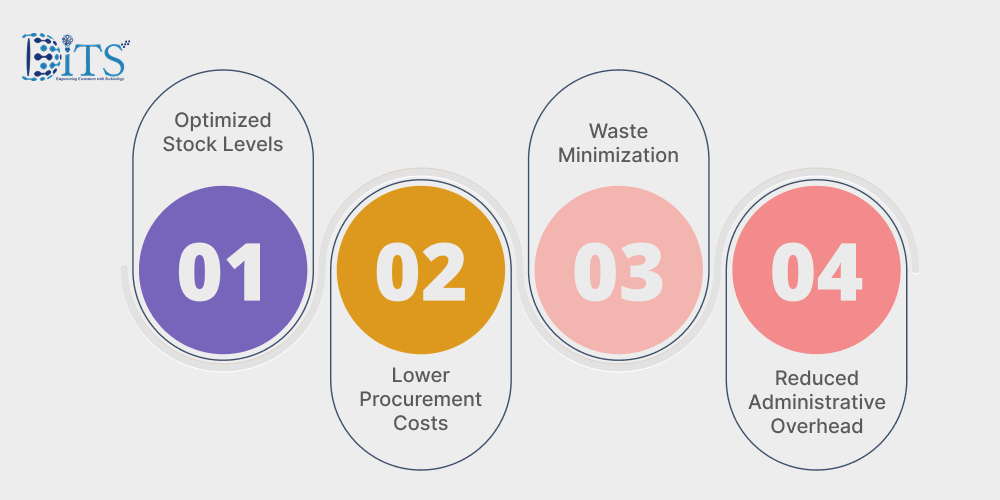
When organizations shift to a structured system, cost control becomes measurable. The impact shows up quickly, often within the first few quarters of implementation.
Optimized Stock Levels
Demand patterns in healthcare are rarely static. Flu season, elective procedures, emergency cases, all influence consumption.
A system-driven medical inventory management enables:
- Accurate demand forecasting based on usage trends
- Balanced stock levels across departments
- Reduction in unnecessary bulk purchasing
Instead of “just in case” stocking, organizations move toward “just enough with buffer.” That alone can release significant tied-up capital.
Lower Procurement Costs
Procurement becomes smarter when backed by data rather than urgency.
- Vendor performance tracking highlights cost-effective suppliers
- Bulk purchasing decisions are aligned with actual demand
- Automated reordering avoids last-minute, high-cost purchases
Over time, this creates consistency in pricing. And consistency leads to predictable budgets, something every CFO values.
Waste Minimization
Expired inventory is one of the most visible losses, yet one of the easiest to control.
With structured medical supplies inventory management, organizations gain:
- Expiry tracking with automated alerts
- First-expiry-first-out inventory movement
- Better visibility into slow-moving items
Reduced Administrative Overhead
Manual inventory processes consume time, and time translates directly into cost.
Automation helps by:
- Eliminating repetitive data entry
- Reducing need for frequent manual audits
- Streamlining reporting for compliance and finance teams
Staff who once spent hours counting stock can now focus on higher-value tasks. And that shift, though subtle, improves operational efficiency across the board.
Each of these benefits may seem incremental on its own. But combined, they create a measurable reduction in operational expenditure.
How These Solutions Improve ROI For Healthcare Businesses
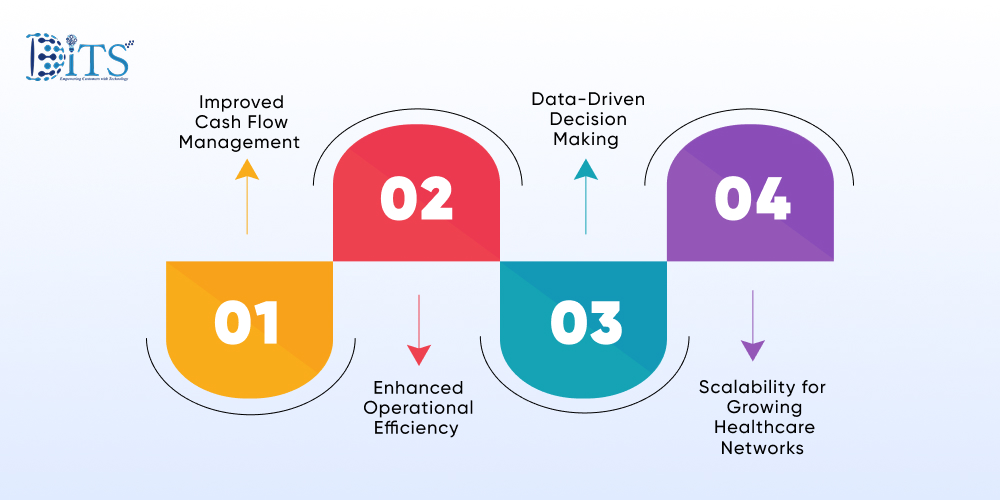
Cost reduction is only part of the story. The real impact shows up when those savings translate into measurable returns across operations.
Improved Cash Flow Management
Healthcare organizations often tie up a significant portion of their capital in unused inventory. Supplies sit on shelves for months, sometimes longer.
With structured control:
- Inventory holding costs decrease
- Capital gets freed for critical investments
- Budget planning becomes more predictable
Enhanced Operational Efficiency
Delays in care delivery often trace back to missing or misplaced supplies. And when teams scramble to locate items, productivity drops.
A centralized system enables:
- Faster access to required supplies
- Reduced dependency on manual coordination
- Smoother workflows across departments
Data-Driven Decision Making
Gut-based decisions still exist in many facilities. But they come with risks.
With analytics in place:
- Procurement decisions align with actual consumption
- Usage trends highlight inefficiencies
- Forecasting improves planning accuracy
Scalability for Growing Healthcare Networks
Expansion often exposes gaps in inventory control. What works for a single facility rarely scales across multiple locations.
A digital system allows:
- Centralized visibility across all units
- Standardized inventory processes
- Seamless coordination between facilities
Key Features That Drive Cost Savings And ROI
Not all systems deliver the same value. The difference lies in the features that directly influence efficiency and control.
Below is a snapshot of capabilities that typically create the highest impact:
| Feature | Business Impact |
| Real-time inventory tracking | Eliminates guesswork and improves accuracy |
| Automated alerts and replenishment | Prevents stockouts and overstocking |
| Integration with EHR, ERP, and procurement systems | Ensures seamless data flow across operations |
| Barcode or RFID-enabled tracking | Improves traceability and reduces manual errors |
| Advanced analytics and dashboards | Supports strategic decision-making |
Compliance And Regulatory Considerations In Canada
Inventory management isn’t just about cost. It plays a critical role in compliance and audit readiness.
Healthcare organizations must maintain:
- Accurate and traceable inventory records
- Documentation for procurement and usage
- Visibility into supply movement across departments
Regulatory audits often require detailed reporting. Without a system in place, pulling that data becomes time-consuming and error prone.
With digital systems:
- Audit trails are automatically maintained
- Reporting becomes faster and more reliable
- Traceability improves patient safety and compliance
This is where integration with systems like healthcare asset management software becomes valuable, as it extends visibility beyond consumables to equipment and high-value assets.
Need Expert Guidance for Inventory Transformation?
Connect with specialists to explore tailored solutions that align with your workflows, systems, and long-term healthcare growth strategy.
Why Choose DITS For Medical Inventory Management Solutions
Choosing the right partner determines how quickly and effectively these benefits materialize. Technology alone doesn’t solve the problem. Execution does.
At DITS, the focus stays on building systems that align with real healthcare workflows, not generic templates.
- Deep understanding of Canadian healthcare operations and compliance requirements
- Customized healthcare development services tailored to specific facility needs
- Scalable architecture supporting multi-location expansion
- Seamless integration with existing healthcare IT systems
And here’s where the approach stands apart. At DITS, we actively embed AI in healthcare solutions across development processes. From software development and quality assurance to maintaining code quality and enabling customisation, AI is integrated into every layer. Through structured AI integration, systems become more adaptive, responsive, and future-ready.
The goal is simple. Deliver solutions that not only work today but continue to evolve with the organization.
Conclusion
Inventory has traditionally been viewed as a backend function. Necessary, but not strategic. That mindset is changing. With the right systems in place, inventory becomes a source of control, efficiency, and measurable financial impact. Costs come down. Waste reduces. Decisions improve.
More importantly, organizations gain visibility. And with visibility comes confidence. For healthcare leaders navigating rising costs and operational pressure, investing in a structured medical inventory management solution is no longer optional. It’s a strategic move toward sustainable growth.
And once that shift happens, inventory stops being a liability. It starts becoming an advantage.
FAQs
What is a medical inventory management solution and how does it help healthcare organizations?
A medical inventory management solution helps healthcare providers track, manage, and optimize their inventory in real time. It reduces waste, prevents stockouts, and improves operational efficiency by providing accurate visibility into supply usage and demand patterns.
How does DITS Medical Inventory Management Software Development Services support healthcare businesses?
DITS Medical Inventory Management Software Development Services focuses on building customised systems tailored to specific healthcare workflows. These solutions help organisations reduce costs, improve inventory accuracy, and ensure seamless integration with existing systems such as EHR and procurement platforms.
Can small clinics benefit from an inventory management solution for medical offices?
Yes, even small clinics can significantly benefit. An inventory management solution for medical offices helps streamline stock tracking, reduce manual workload, and prevent overstocking or shortages, which directly impacts profitability and patient care efficiency.
What kind of ROI can healthcare providers expect from inventory management systems?
Most healthcare organizations begin to see measurable returns within a few months through reduced waste, optimized procurement, and better resource utilization. Over time, improved decision-making and operational efficiency further enhance ROI.
How does DITS medical inventory management software development services ensure scalability and long-term value?
DITS medical inventory management software development services builds scalable and flexible systems designed to grow with healthcare organizations. The solutions are developed with future expansion in mind, ensuring they can support multi-location operations, increasing inventory volumes, and evolving business needs.

Nidhi Thakur
With more than 19 years of experience - I represent a team of professionals that specializes in the healthcare and business and workflow automation domains. The team consists of experienced full-stack developers supported by senior system analysts who have developed multiple bespoke applications for Healthcare, Business Automation, Retail, IOT, Ed-tech domains for startups and Enterprise Level clients.
Recent Posts
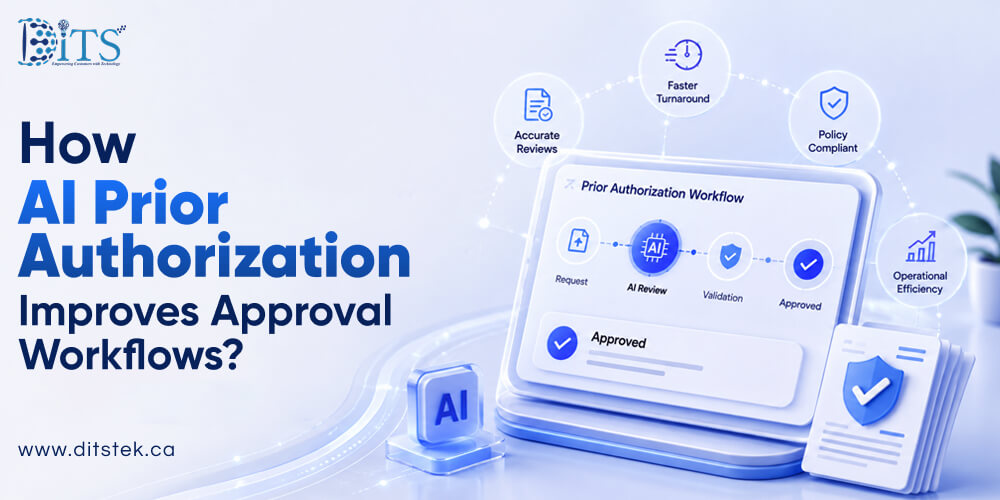
Explore how prior authorization software uses AI to automate workflows, reduce administrative effort, improve request accuracy, streamline approvals, and minimize treatment delays for healthcare organizations.

Discover how AI to improve patient experience in hospitals streamlines scheduling, communication, triage, queue management, and personalized care while enhancing operational efficiency.

Learn how IoT powers smart factories with connected devices, automation, predictive maintenance, and analytics.