Health Insurance Software Development in Canada: A Complete Roadmap for Insurance Businesses
Table Of Content
Published Date :
10 Jul 2026
Key Takeaways
- Connected systems are required for claim processing, policy management, billing, member management, provider management, and reporting by Canadian insurance companies.
- Outdated systems make insurance software difficult to implement, customize, and process faster.
- Data security and compliance are very important due to dealing with sensitive information.
- The core components of insurance software include policy management, claims management, billing, reporting, and document management.
- Artificial intelligence will help with claims automation, document processing, gap detection, and case routing.
- Fraud detection allows identifying duplication of claims, billing problems, and suspicious provider behavior.
Canadian insurance companies face increased pressure to transform their claim management, policy administration, billing, member services, provider communications, and compliance processes to be more efficient and secure.
A health insurance software solution helps automate platforms, assist insurance companies in managing claims, policies, members, providers, billing, reporting, and customer service, all from a single system.
For any business that wishes to develop a health insurance software solution in Canada, the main aim is not only to automate but also to create a connected system that improves the claims process, enhances data security, minimizes manual processes, and provides better process visibility.
In this guide, you will learn about the features, development steps, costs, time required, compliance issues, and advantages of developing health insurance software solutions for your business.
A Look at the Healthcare Insurance Market Stats
By 2033, Canada health insurance market size is projected to generate revenue of $136,466.6 million.
Moreover, the Canada market is anticipated to grow at a CAGR of 7.7% (2026-2033).
The key market players are UnitedHealth Group Inc, Aviva PLC, Allianz SE, Centene Corp, The Cigna Group, etc.
Why Health Insurance Software Development Matter in Canada?
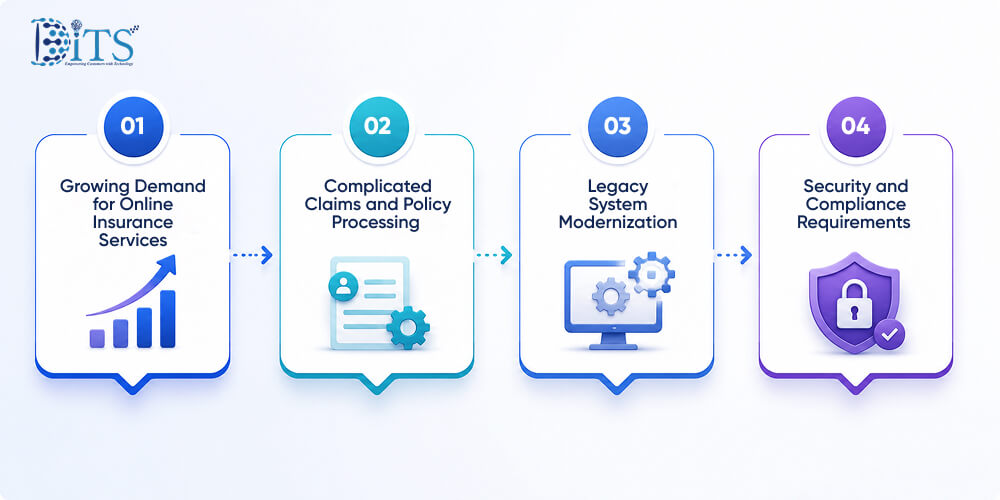
Insurance companies in Canada are required to develop more efficient and connected software solutions for handling claims, policies, members, providers, and other aspects. The increased number of complex tasks and high customer demands make it crucial to develop health insurance software in Canada.
Growing Demand for Online Insurance Services
Customers demand prompt submission of claims and notifications, and the use of online forms and self-service portals. Health insurance software helps to satisfy such demands through digital services provided by insurers.
Complicated Claims and Policy Processing
Insurance policies and claims processing involve many procedures, including approval, documentation, provider coordination, billing, and compliance. A custom platform allows you to unite such processes into one flow and reduce the time and effort spent on manual procedures.
Legacy System Modernization
Old legacy systems often become complicated to expand, connect, and customize. Modern health insurance software development enables the implementation of a system that can be easily integrated and scaled.
Security and Compliance Requirements
Personal, medical, and financial information is processed by insurance companies. Thus, it becomes necessary to develop safe software with encryption, role-based access control, audit trail functionalities.
Need Smarter Insurance Management Solutions Today?
Build scalable insurance platforms with automated claims processing, policy administration, and seamless healthcare system integrations.
Business Use Cases of Health Insurance Software in Canada
Health insurance software comes in handy for processes involving policy management, claims management, member information management, provider communications, billing, and many other compliance-focused functions. In Canada, it may be used by health insurance firms and other related business entities aiming to automate processes, increase efficiency, and make their insurance processes more interconnected.
Health Insurance Companies
Custom software is used by health insurance companies to manage their claims, policies, renewals, member approvals, billing, and reporting processes from a single platform.
Insurance Brokers
The brokers make use of health insurance software to manage customer information, plan comparison, policy management, renewals, and customer communications.
Third-Party Administrators
The third-party administrators use custom software platforms to manage claims management, eligibility verification, member services, provider management, and other administrative tasks.
Insurtech Startups
There is an opportunity for insurtech start-ups to develop digital platforms that provide solutions for online enrollment, claim automation, AI assistance, policy management, analysis, and self-service to members.
Enterprises Managing Employee Health Benefits
Companies can use the software to manage employee benefits, including plans, claim submissions, documentation, communications, and visibility into insurance providers.
Healthcare Networks Working with Insurers
There is the option for healthcare networks to utilize the software to check eligibility, submit claims, document, coordinate approvals, and communicate with insurance providers.
Common Challenges Health Insurance Software Solves
Daily activities performed by health insurance firms include handling a large volume of claims, member information, policy changes, communications, and approvals, among others. These activities can be slow, inefficient, error-prone, and unpleasant for customers when carried out manually or using disconnected software. The use of health insurance software enables health insurers to organize these activities into a well-defined process.
| Challenges | Solutions |
| Delays in claim processing | Automates the claim submission process, validation, routing, approval, and monitoring process to reduce the turnaround time. |
| Manual paperwork | Reduce manual paperwork through digital forms, AI medical scribes, smart data extraction, and EMR integration. |
| Disorganized data | Centralizes all member data, policy data, provider data, premium data, and claims data. |
| Poor member experience | Members have access to self-service portals with real-time claim updates, policy access, and faster support. |
| Compliance Risks | Role-based access; auditing; encryption; reporting; and secure handling of data. |
| Restricted Operational Visibility | Dashboards for tracking claim, policy, payment, renewal, approval and overall performance-related information. |
| Gaps in integration | Supports integration of insurance platforms with CRM, billing, EMR/EHR, payment systems, and other third-party applications. |
Top Features of Health Insurance Software
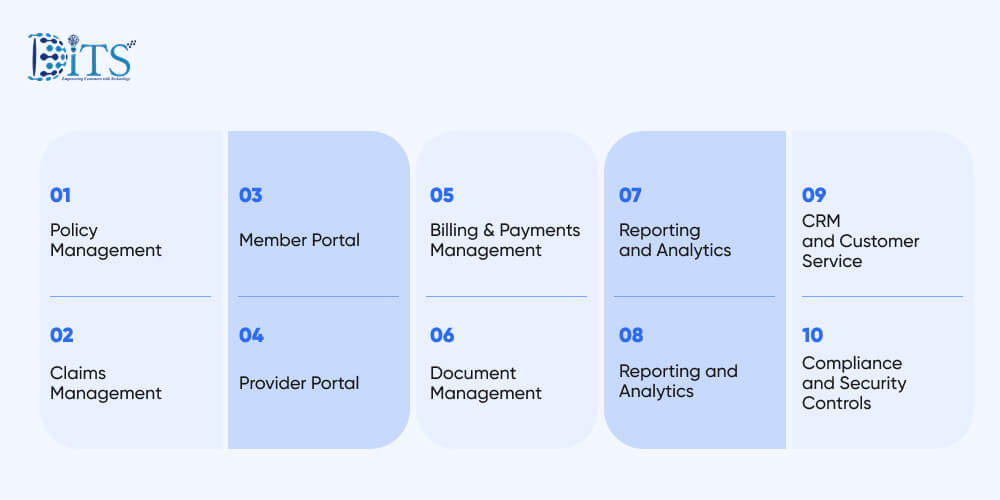
Health insurance software assists insurance companies in handling their policies, claims, billing, membership, reporting, and compliance in an integrated way.
Policy Management
Policy management enables insurance companies to handle their health insurance policies for their creation, renewal, modification, and management using one central system. It maintains all information regarding the policies and facilitates the process of handling policies.
- Policy creation and renewal
- Plan and coverage management
- Premium and benefit details
- Policy status management
- Member eligibility updates
- Policy endorsements
Claims Management
Claims management facilitates the whole life cycle of claims, which includes submission, validation, approval, and finally settlement. This will help minimize any delay, error, or follow-up work.
- Claims submission online
- Upload of documents and their verification
- Claim validation procedures
- Approval and rejection procedures
- Status tracking of claims
- Claim history and audit trail
Member Portal
Allows customers to access their insurance information directly, without relying on customer support for each query. It increases transparency and provides more convenience.
- Access to policy information
- History and status of claims
- Payment information for premiums
- Policy documents for downloading
- Submission of support queries
- Profile management
Provider Portal
Serves as an online communication channel for providers with insurers. This minimizes paperwork and increases efficiency between providers and insurance departments.
- Eligibility check
- Claim filing by providers
- Medical document uploading
- Claim status check
- Secure communication between providers and insurers
- Pre-authorization of claims
Billing & Payments Management
Enables insurance firms to consolidate premium collection, invoicing, refunds, and payment tracking into one place. The solution enhances financial precision and provides greater transparency to members.
- Premium payment tracking
- Invoicing generation
- Refund management
- Failed payment alerts
- Payment history tracking
- Payment gateway integration
Document Management
Keep all insurance-related documents secure and easily accessible to everyone. This assists in managing policy documents, claim forms, medical records, and their approval.
- Policy document storage
- Claim form management
- Medical file management
- Approval and rejection records
- Secure file access
- Searchable document repository
Reporting and Analytics
These activities assist insurance companies in understanding their business operations, claims trends, policy activities, and service gaps, enabling better decision-making and process improvements.
- Volume reports of claims
- Approvals process timing reports
- Performance analysis of policies
- Member activity reports
- Payment and income reports
- Operations dashboard reports
Reporting and Analytics
These activities help insurance companies understand their business operations, claims trends, policy activities, and service gaps, enabling better decision-making and process improvements.
- Claims volume reports
- Approvals process timing reports
- Performance analysis of policies
- Member activity reports
- Payment and income reports
- Operations dashboard reports
CRM and Customer Service
Features of CRM and customer service will enable insurance staff to coordinate member inquiries, complaints, follow-ups, and service history. This makes it possible for support staff to be more responsive and personal.
- Management of member inquiries
- Creation of support tickets
- Follow-up reminders
- Complaint tracking
- Communication history
- Customer service performance reports
Compliance and Security Controls
Help protect sensitive information about members, policies, providers, and claims. Compliance and security controls ensure that companies conduct their business safely and comply with privacy regulations.
- Role-based access control
- Data encryption
- Audit trail
- Login and authentication process
- Compliance reporting
- Consent and privacy controls
How AI Is Transforming Health Insurance Software
AI is transforming health insurance management software into smart, fast, and manageable. AI-driven solutions assist insurance companies in improving operational efficiency through automation, accuracy, and smarter decision-making.
AI-enabled Claims Automation
AI accelerates the process of claims handling by reading documentation, categorizing claims, and identifying any lack of information before the actual examination by people.
- Claim categorization
- Documentation data extraction
- Lack of information identification
- Routing of claims to the right department
- Claim review process optimization
- Minimized manual claims handling
Fraud Detection and Risk Scoring
AI and machine learning can help insurers identify suspicious activities before they turn into major financial losses.
- Duplicate claim detection
- Unusual billing pattern alerts
- Suspicious provider activity tracking
- High-risk claim scoring
- Fraud pattern recognition
- Early warning alerts for review teams
Predictive Analytics
Allows insurance companies to gain insights on future risks, claims patterns, and member behavior based on past and present data.
- Claim trends forecasting
- Behavior of members analysis
- Risk prediction of policies
- Workload planning
- Cost utilization insights
Smart Claim Processing
Aids insurers in automating the review of claims, minimizing manual work, and processing claims more efficiently and accurately.
- Automated claim submission
- Detection of missing data
- Claim validation assistance
- Fast approval routing
- Fewer manual errors
Predictive Underwriting
Enables insurers to assess risks using historical data, member profiles, health trends, and policy considerations.
- Risk profile analysis
- Helps in estimating premiums
- Evaluation of historical claims behavior
- Identifying fraud risks
- Improved underwriting decisions
Personalized Plan
Assists insurers in developing more personalized health insurance plans by identifying member needs, analyzing their usage habits, health statuses, and preferences for coverages.
- Usage-based insights
- Coverage suggestion
- Plan personalization assistance
- Enhances member engagement
- Increases customer retention
Chatbots and Virtual Assistants
Virtual assistants can assist members by answering frequently asked questions, the claim submission process, and offloading tasks from support staff.
- 24/7-member support
- Helping with claim submission
- Insurance policy-related FAQs
- Payment and document assistance
- Creating support tickets
- Quick answers to frequent questions
If you want to stand out from the rest of the competitors, then collaborate with a reliable AI software development company that will guide you in the right direction.
Want To Simplify Claims And Policy Management?
Implement custom insurance software that improves operational efficiency, customer experience, and data-driven decision-making across your organization.
Canadian Compliance and Interoperability Requirements for Health Insurance Software
Peek into the exclusive set of compliance and interoperability standards that help maintain transparency and privacy to data.
| Requirement | Type | Reason |
| PIPEDA Compliance | Federal privacy law | Broader applicability to private-sector personal information management in Canada. |
| PHIPA | Ontario health privacy | Healthcare relevancy; Ontario is a big healthcare market. |
| Quebec Law 25 | Quebec privacy requirement | Useful for companies processing personal information of Quebec individuals. |
| HL7 | Interoperability framework | Supports interoperability among insurer, provider, EHR/EMR, and third parties in healthcare. |
| FHIR | Interoperability standard | Maintains interoperability using modern APIs in healthcare. |
| HIA | Alberta health privacy law | Processes patient health information |
| PIPA | Provincial private-sector privacy law | Supports consent-based data handling, privacy protection |
| FSRA | Ontario financial services regulator | Assists in regulatory alignment for insurance-related workflows |
| BCFSA | British Columbia financial services regulator | Assists in compliance readiness, secure operations, and regulatory oversight |
| Capital Adequacy & MCT | Financial solvency requirement | Supports financial reporting, risk monitoring |
| OSFI | Federal financial institution regulator | Helps with financial soundness, reporting, governance |
| Provincial & Territorial Market Conduct Licensing | Insurance licensing and market conduct regulation | Focuses on financial soundness for federally regulated insurers and provinces |
Roadmap for Developing Health Insurance Software in Canada
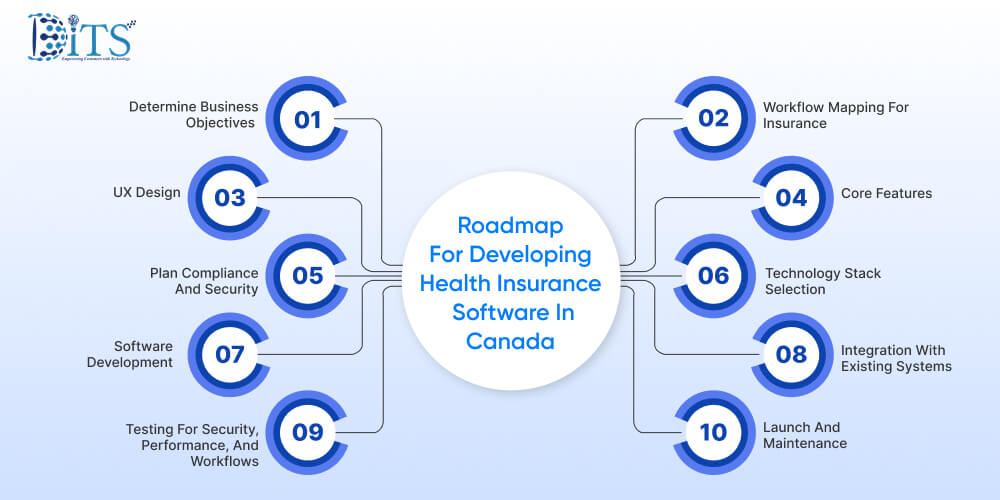
Building a healthcare software is a daunting task, but with the right development partner, you can achieve this without facing any complicacy.
Step 1: Determine business objectives
It is important to first determine the objective behind your health insurance software. Some possible options could be claims processing, policy administration, billing, patient interaction, etc.
Step 2: Workflow mapping for insurance
Map existing insurance processes like claims, policies, enrollment, provider approvals, billing, customer service, and reporting processes.
Step 3: UX design
Ensure simplicity in the design of dashboards, defining user roles, workflows, and navigation for all users to ensure that they will accomplish their tasks seamlessly.
Step 4: Core Features
Start off with the important modules, including claims management, policy management, member portal, billing, document management, and reports, before going to advanced modules.
Step 5: Plan compliance and security
Develop guidelines on how data is accessed, encrypted, tracked through audit trails, authenticated, backed up, managed privately, and stored.
Step 6: Technology Stack Selection
Choose technologies depending on scalability, performance, integration requirements, security considerations, and maintenance to allow future growth of the platform.
Step 7: Software development
Develop the frontend, backend, database, API, workflow, role, dashboard, logic, and administration as per the approved roadmap.
Step 8: Integration with existing systems
Ensure that the software is integrated with other systems such as CRM, payment gateway, accounting solutions, EHR/EMR solutions, physician directories, third-party API, and legacy systems.
Step 9: Testing for security, performance, and workflows
Conduct testing of claims processing, policies management, billing process, access control, integration, accuracy, performance, and security.
Step 10: Launch and maintenance
The developed software is finally deployed to the dedicated environment, and any bug fixes or performance issues are addressed through continuous improvement based on user feedback.
DITS Technology Solutions for Health Insurance Businesses
At DITS, we assist insurance companies in creating tailored health insurance software that solves operational challenges, modernizes legacy systems, streamlines processes, and builds AI-driven platforms. This includes learning about your workflow, problems, users' roles, integration capabilities, and requirements, followed by roadmap creation, architecture design, coding, testing, and further improvement.
Moreover, our team identifies potential areas for implementing AI, including automated claim processing, document handling, fraud prevention, analytics, eligibility checks, and chatbots. In addition to developing software, DITS serves as a technology consultant, advising on MVP development, legacy system updates, system integration, and digital transformation.
Tech Stacks used in health insurance software development
Explore the comprehensive suite of technologies that makes the software extremely robust and scalable.
| Aspects | Tech Stacks |
| Front-end | React, Angular |
| Back-end | .NET, Node.js, Java |
| Security | MFA, RBAC, encryption |
| Databases | PostgreSQL, MongoDB |
| Cloud | AWS, Azure, Google Cloud |
| AI/ML | Python, TensorFlow, OpenAI API's |
| Integrations | REST APIs, HL7, FHIR |
Ready To Modernize Your Insurance Business With Technology?
Transform insurance operations with custom software designed to improve efficiency, compliance, and member engagement at every stage.
Bottom Line!
Health insurance software development in Canada is now seen as necessary by those seeking to automate their claims process, minimize manual labor, ensure compliance, and provide a better user experience through digitalization. An effective platform will help to integrate policy management, claims processing, billing, member data, provider information, and reporting into a secure single system.
For insurance companies seeking digital transformation, the key strategy involves partnering with the top custom software development workflow analysis, prioritization of features, architecture design, and compliance requirements.
FAQs
What is the cost of developing health insurance software in Canada?
The cost of developing health insurance software in Canada can be from CAD 25,000 to CAD 300,000+ which is USD $18K- $200K. This depends on the level of the functionality of the software, its complexity, integrations, compliance requirements, AI capabilities, and the amount of work involved.
What is the time needed for building health insurance software?
Usually, it requires 3 to 15+ months to develop health insurance software depending on the type of the software being developed. For prototype it is 1 to 4 weeks and for MVP it is up to 3-4 months.
Can health insurance software be integrated with current systems?
The health insurance software can be integrated with CRM, ERP, payment gateways, accounting software, provider systems, EHR/EMR, third-party APIs, and old insurance systems.
What are the advantages of health insurance software?
Faster claims processing, improved data accuracy, better operational visibility, stronger compliance control and easier scalability are some of the benefits of the software.
Who needs healthcare insurance software?
Healthcare insurance software is used by health insurance firms, third-party administrators, insurance brokers, health payers, employee benefit administrators, or any organization dealing with health plans, claims, members, providers, or insurance processes.
Is AI applicable to healthcare insurance software?
Yes. AI is applicable to claims triage, fraud detection, document processing, risk assessment, customer service, predictive analytics, automated approval, and personalized member engagement.

Nidhi Thakur
With more than 19 years of experience - I represent a team of professionals that specializes in the healthcare and business and workflow automation domains. The team consists of experienced full-stack developers supported by senior system analysts who have developed multiple bespoke applications for Healthcare, Business Automation, Retail, IOT, Ed-tech domains for startups and Enterprise Level clients.
Recent Posts
Explore how prior authorization software uses AI to automate workflows, reduce administrative effort, improve request accuracy, streamline approvals, and minimize treatment delays for healthcare organizations.
Discover how AI to improve patient experience in hospitals streamlines scheduling, communication, triage, queue management, and personalized care while enhancing operational efficiency.

Learn how IoT powers smart factories with connected devices, automation, predictive maintenance, and analytics.