Best Health App Ideas for Business
Table Of Content
Published Date :
27 May 2026
The market for mobile health services is growing rapidly. Healthcare apps are revolutionizing the healthcare delivery in terms of consultations, treatments and prescriptions. According to surveys and studies, 52% of US population now prefer mobile apps to access healthcare. People now use apps to book appointments, consult doctors online, track fitness, manage medicines, monitor chronic conditions, and stay connected with their care providers.
Users have become so reliant on these applications for medical support and information. It's one of the reasons why healthcare businesses are focusing on building mobile apps for their users. A well-planned health app can help patients stay more involved in their care while giving doctors, pharmacies, wellness brands, and healthcare startups new ways to serve users.
At the same time, building a healthcare app only makes sense when the idea solves a real problem. Some apps focus on everyday wellness, while others support remote consultation, EMR integration, chronic disease management, medication reminders, or patient engagement. The right choice depends on the audience, business model, and the gap the app is meant to fill.
In this blog, we’ll look at some of the best health app ideas for businesses and how each idea can create value in today’s digital healthcare market.
Want to Turn Innovation Into a Working App?
Our healthcare app engineers turn bold ideas into compliant, performance-driven digital products.
Best Health App Ideas for 2026
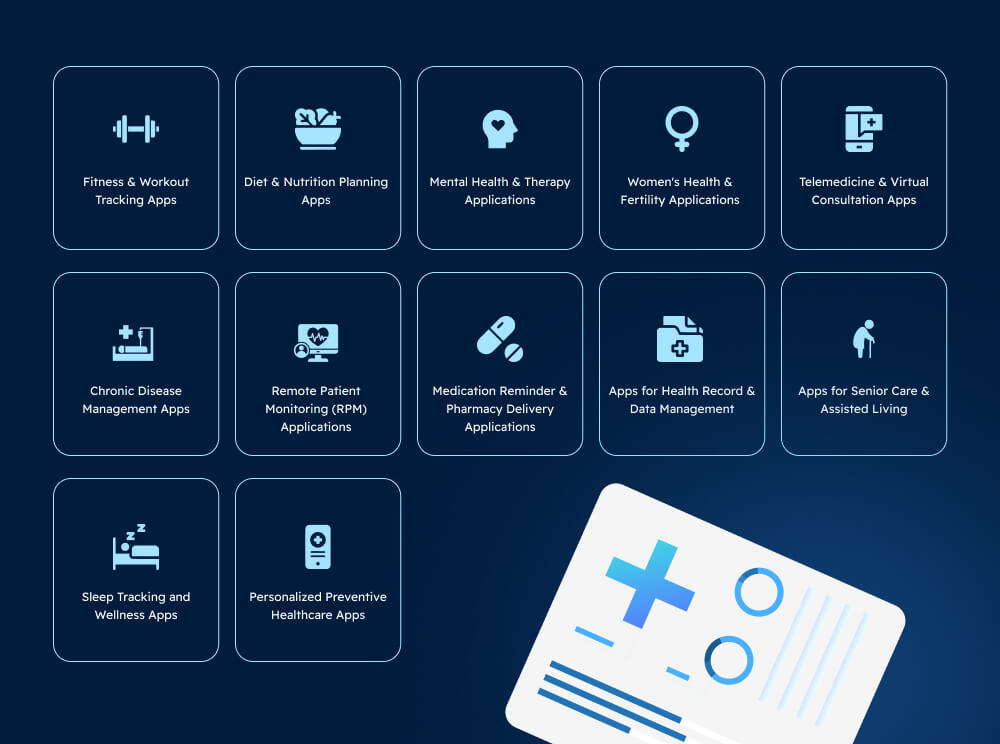
The world of mobile health apps is buzzing with innovation and progress. Let us explore the best health app ideas for healthcare businesses to consider.
Fitness & Workout Tracking Apps
Fitness industry is still the heartbeat of mobile health. These apps have come a long way since simple counting steps. The latest versions include features such as sleep pattern analysis, heart rate, and pulse rate. They use AI to adjust workout intensity and even recommend recovery plans based on the insights it generates.
They work like a gym in your pocket that learns from your habits and keeps you engaged and motivated every day! For companies today, this means high usage, engagement, and a subscription revenue stream that does not dry up.
Diet & Nutrition Planning Apps
Health and food are inseparable, and digital meal planners provide strong evidence of this. These apps allow users to log their meals, monitor their calorie intake, and receive food and diet plan suggestions based on AI algorithms that match their lifestyle or personal medical history. For example, a user who is diabetic might be presented with a week's worth of meal recommendations aligned with their glucose levels.
Startups and even large wellness brands are investing in this space because it provides community-based engagement. We all love to share our progress, diet plans, and stay engaged!
Mental Health & Therapy Applications
Technology is helping to ease mental health stigma, and a lot of that is due to the increasing therapy applications that connect users to licensed specialists or educate them through self-directed sessions.
These applications may include guided meditation, journaling resources, or simply AI chatbots to provide comfort in low moments. For business purposes, this is an area likely to foster long-term user trust and retention, something many digital products can't guarantee.
Women's Health & Fertility Applications
The fem tech sector continues to expand rapidly as more women seek technology-based solutions to their health problems. Application ideas are growing mainstream, such as period tracking, fertility forecasting, pregnancy support, and other apps designed and created considering women.
What makes them special is that these applications are highly personalized, learning from a woman's cycle, habits, and symptoms to tailor practical recommendations. Given the rapidly expanding demand in this sector, we expect these applications to cater to a highly loyal niche audience.
Telemedicine & Virtual Consultation Apps
A doctor's appointment no longer means waiting in a crowded waiting room. With virtual consultation apps, patients can communicate directly, instantly, and securely with a doctor via video call or messaging. Access to prescriptions and digital health records is all interconnected.
Healthcare providers also reap the benefits of apps, including reduced overhead costs, greater flexibility, and access to more patients. This direct consultation model is proving itself through better AI diagnostics and patient scheduling systems.
Chronic Disease Management Apps
Chronic diseases like diabetes, hypertension, or heart disease need to be monitored daily, not just at routine check-ins. Apps for chronic care are filling the gap. These apps are equipped with IoT sensors that monitor vitals and alert patients and doctors in real time when something is amiss. For the healthcare organization, this means better patient outcomes and more management of recurring cases.
Remote Patient Monitoring (RPM) Applications
This is where connected health is at its best. RPM applications use linked devices: from glucose monitors to pulse oximeters, to keep physicians informed of a patient's health and well-being outside hospital walls.
Remote patient monitoring applications are particularly important for the care of elderly patients, post-surgical monitoring, and/or patients with chronic conditions. From a business perspective, this concept exemplifies the future of scalable care delivery: lower readmission rates, more proactive disease management, and better resource utilization.
Medication Reminder & Pharmacy Delivery Applications
Non-adherence to medication is a significant and considerably costly problem. Medication reminder or pharmacy delivery applications that allow patients to reorder medications online are quietly but efficiently addressing this.
They are clearly convenient, and there is a confidence/trust factor; it's a difficult equation to oppose. Pharmacies and convenience retailers have iteratively developed these applications to retain customers and generate ongoing sales opportunities.
Apps for Health Record & Data Management
Access to data is key to the modern healthcare framework. These applications enable the secure storage and sharing of medical records among patients, doctors, and hospitals, typically via cloud-based platforms.
Health Record applications are often built with compliance features such as HIPAA that enhance safety and efficiency within the healthcare framework. For organizations, compliance applications and medical record applications are not just about records management, but a total health ecosystem that seeks to promote better collaboration.
Apps for Senior Care & Assisted Living
With the growing senior population, demand for digital apps that support seniors is also increasing. These applications share, in real time, data about the senior's experience with caregivers and families, including location, and alert concerned users in case of an emergency.
Users can be alerted instantly if a senior forgets their medication or has an unexpected fall. The solutions leverage compassion and technology to increase families' peace of mind and create business opportunities for service providers.
Sleep Tracking and Wellness Apps
Although sleep is foundational to good health, millions of adults struggle to sleep. Sleep applications are adding soundscapes, artificial intelligence-based analysis of sleep, and smart alarms to promote better sleep for users.
They are becoming a big vertical in the lifestyle wellness space, and are further enhanced when used in tandem with wearable devices. For app developers, sleep is interesting because it has a low cost of entry and a high engagement rate.
Personalized Preventive Healthcare Apps
Prevention, versus reaction, is quickly replacing modern healthcare. These apps use predictive analytics and data from wearable devices to identify early signs of illness before symptoms appear. The opportunity here is enormous. Insurance companies, hospitals, and diagnostic centers are eager to partner with organizations that can track health data and deliver preventative, personalized care through an app.
Ultimately, each of these ideas is about solving a problem in healthcare better than it has been done before. The winners in 2026 will be the teams who continue to build with a purpose, empathy, and intelligence.
What’s Holding Back Your Digital Health Launch?
We help healthcare providers and startups transform ideas into high-impact health applications built for 2026 and beyond.
How DITS Helps You Develop Your Health App
Building a great health app takes more than just a team of developers; it takes a partner who understands healthcare inside out. At Ditstek Innovations (DITS), we've spent almost a decade helping healthcare providers, startups, and enterprises bring their digital ideas to life.
We specialize in healthcare mobile app development that combines performance, compliance, and human-centered design. Whether it's a telemedicine platform, a chronic care management tool, or a wellness tracker with wearable integrations, our approach always begins the same way: with understanding.
The key to our success is smart engineering. DITS uses AI at every step of development: writing clean, efficient code, conducting advanced testing, ensuring data accuracy, and automating actions. Security and compliance are critical to our healthcare projects. Every solution we develop is built to meet HIPAA and GDPR standards, ensuring protected patient data at all times.
We are proud of our accomplishments: 97% client retention, global partnerships across many industries, and healthcare apps with measurable year-on-year business results.
If you are ready to step into digital health confidently, DITS is here to take you from concept to launch and beyond.
Conclusion
If you are a business owner, 2026 is the right time to invest in healthcare technology that counts in people's lives and well-being. Every idea you have produced — be it fitness tracking, teleconsultation, nutrition management, or preventative diagnostics — offers the same opportunity to make a difference. The important piece is creating something that not only looks good but also works securely, is scalable, and earns users' trust each day they engage.
DITS, being a custom software development company, understands that technology should adapt to healthcare, rather than the other way around. With our experience in developing custom healthcare experiences, IoT software, and AI and engineering design, we guide businesses in building thoughtful, human-centered applications that grow with users' needs.
FAQs
1. How long does it take to develop a healthcare app?
The time required to develop a healthcare app depends on its level of complexity. A simple wellness-tracking app can be ready in 2-3 months, whereas an advanced healthcare platform with IoT or telemedicine features will take 6-9 months or longer. A good team of professionals working together will ensure a quicker, higher-quality product delivery.
2. How much does it cost to build a healthcare app?
The cost depends on the project's functionality and scope. Generally speaking, simple apps cost around $30,000-$60,000, while complex healthcare solutions with integrations and analytics can exceed $150,000 and reach $300,000 or more. The final cost will be determined by design, platform, and compliance requirements.
3. Why choose Ditstek Innovations for healthcare app development?
DITS has almost 10 years of experience and is constantly developing new solutions. We apply AI technology for smarter coding, automated testing, and performance optimization without compromising strong compliance and transparency. Our knowledge in custom healthcare solutions and health app design will convert your idea into a trustworthy, scalable product.
4. Can DITS integrate remote patient monitoring features into apps?
Absolutely. DITS focuses on creating health applications that enable remote patient monitoring via connected devices, sensors, and secure data transfer. By this means, doctors can continuously monitor their patients' health, leading to better outcomes and fewer hospital readmissions.

Nidhi Thakur
With more than 19 years of experience - I represent a team of professionals that specializes in the healthcare and business and workflow automation domains. The team consists of experienced full-stack developers supported by senior system analysts who have developed multiple bespoke applications for Healthcare, Business Automation, Retail, IOT, Ed-tech domains for startups and Enterprise Level clients.
Recent Posts
Explore how prior authorization software uses AI to automate workflows, reduce administrative effort, improve request accuracy, streamline approvals, and minimize treatment delays for healthcare organizations.
Discover how AI to improve patient experience in hospitals streamlines scheduling, communication, triage, queue management, and personalized care while enhancing operational efficiency.

Learn how IoT powers smart factories with connected devices, automation, predictive maintenance, and analytics.