How AI and IoT Enhance Parking Lot Management Systems in Canada
Table Of Content
Published Date :
09 Jun 2026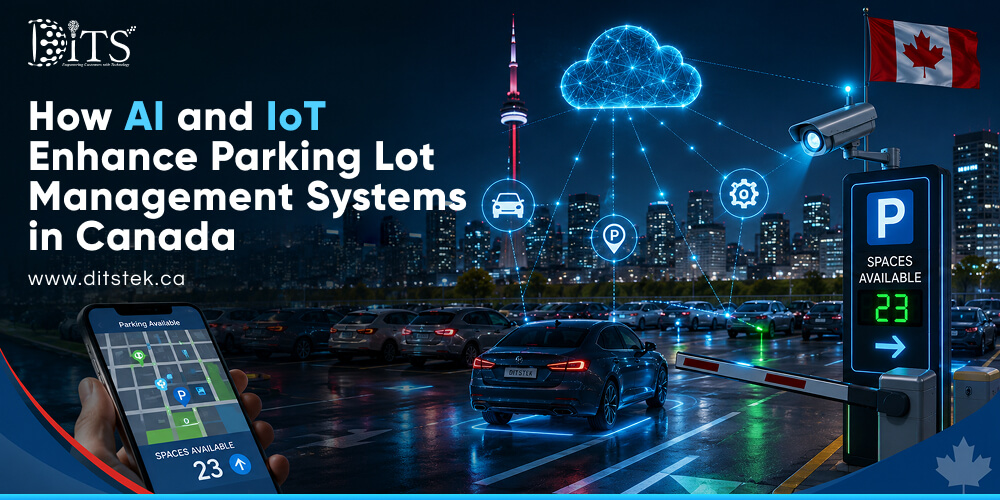
Key Takeaways
- AI and IoT transform parking lot management by providing real-time visibility, automated operations, predictive insights, and better control over parking infrastructure and customer flow.
- AI-powered features such as vehicle detection, license plate recognition, demand forecasting, and dynamic pricing help parking operators improve efficiency, security, and revenue generation.
- IoT-enabled sensors, connected devices, and smart infrastructure provide accurate occupancy tracking, remote monitoring, predictive maintenance, and energy-efficient facility management.
- Smart parking systems reduce congestion, shorten vehicle search times, improve space utilization, and create a smoother parking experience for customers across commercial and public facilities.
- Businesses can use parking data to optimize staffing, pricing strategies, capacity planning, security operations, and long-term property management decisions based on real usage patterns.
- Canadian organizations that invest in AI and IoT-powered parking management solutions can improve operational performance, increase revenue opportunities, strengthen security, and prepare for future smart city initiatives.
Organizations in Canada are facing mounting pressure to squeeze more value out of assets while keeping operational costs in check. Parking facilities, whether they’re tied to retail centers, office complexes, hospitals, or municipal holdings; are major real estate investments that often stall out under legacy management systems. In other words, inefficient parking processes quietly drain revenue, annoy customers, and build operational bottlenecks that spread through the entire organization.
As the population keeps increasing in Toronto, Vancouver, and Calgary, the push to maximize almost every bit of commercial floor space, even the parking infrastructure stuff, has never felt so urgent.
At the same time, the coming together of Artificial Intelligence (AI) and the Internet of Things (IoT) is changing the way organizations manage their parking spaces. For executives who care about operational discipline and return on investment, it’s a straightforward business opportunity.
According to a study by Global Infrastructure Hub, smart parking approaches can cut the time drivers spend hunting for spaces by as much as 30%, which in turn eases congestion, boosts customer confidence, and can raise parking income for facility operators.
In this blog, we dig into how AI and IoT technologies are being used across parking settings in Canada, and what that really means for your bottom line.
What Is a Smart Parking Management System?
The smart parking management system uses interconnected software, sensors, cameras, payment systems and real-time data to help parking businesses manage their daily operations through their various parking facilities. The system provides operators with live parking facility status updates which replace the need for guards, paper tickets, fixed-rate boards and manual counting methods.
The Toronto shopping mall experiences its highest visitor volume on weekends. The Calgary hospital parking lot experiences its highest demand during the morning hours of weekdays. Traditional systems start their response process only after they detect the first signs of traffic congestion. Smart platforms enable managers to identify trends sooner which allows them to make quicker choices about space management and pricing and security and staffing decisions.
At its core, this technology supports three business goals:
| Business Need | How Smart Parking Helps |
| Faster vehicle movement | Automates entry, exit, ticketing, and payment |
| Better space utilization | Shows real-time availability and occupancy trends |
| Improved revenue control | Reduces missed payments, manual errors, and misuse |
Difference Between Traditional And AI-Powered Parking Systems
Traditional parking operations usually work on fixed rules. A vehicle enters, receives a ticket, parks wherever space is available, pays at exit, and leaves. That model still works, but it doesn’t give business owners enough visibility.
An AI-enabled setup works differently. It studies occupancy, vehicle movement, payment behavior, camera feeds, and historical demand to help operators make informed decisions. The system can identify peak periods, suggest better pricing windows, detect unusual activity, and guide drivers to available spaces with less friction.
That’s where modern smart parking solutions in Canada are becoming valuable for commercial properties and public facilities. They don’t just automate parking tasks. They help businesses understand parking as a revenue-generating operation, not just a space-management problem.
Role of AI in Automated Parking Lot Management System
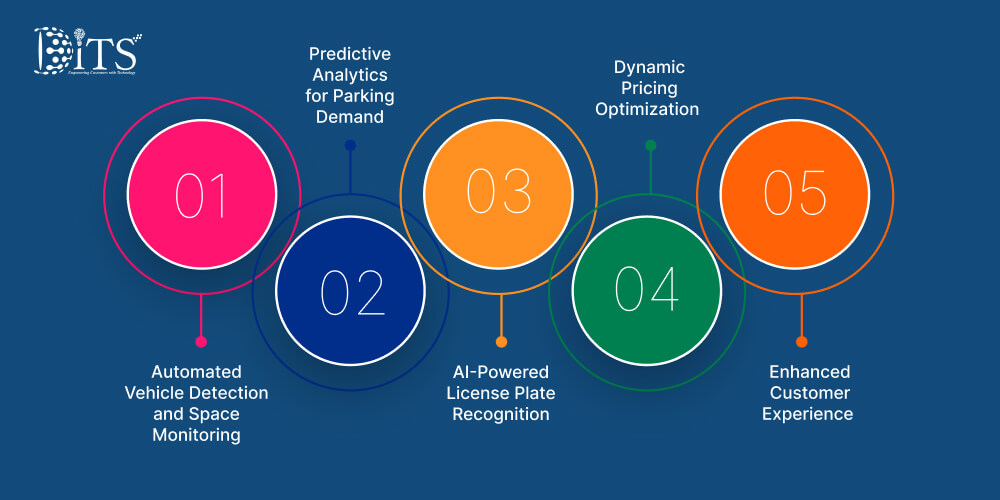
AI brings smarts into parking operations, helping organizations figure out demand patterns, automate the everyday choices, and cut down on waiting time across the daily flow of vehicles and spaces.
Automated Vehicle Detection and Space Monitoring
The AI system enables parking operators to monitor vehicle locations and available parking spaces through dynamic camera and sensor data along with vehicle entry and exit records. The system enables managers to monitor real-time zone occupancy, traffic patterns and space availability through automated data collection.
This system enables rapid parking assignment for busy malls, hospitals, airports and commercial lots while reducing waiting times and improving operational efficiency at peak times. Staff members can dedicate their time to assisting customers and managing special cases instead of performing standard counting duties.
Predictive Analytics for Parking Demand
Parking demand usually follows patterns. Office lots fill early on weekdays, retail parking gets busier during weekends, and event venues see sharp spikes before and after scheduled programs.
AI reads these patterns and helps businesses plan. Operators can adjust staffing, open extra lanes, reserve spaces, schedule maintenance during low-demand hours, and prepare pricing changes before congestion starts. That’s where AI parking management systems can help turn daily parking data into practical business decisions.
AI-Powered License Plate Recognition
License plate recognition systems enable vehicles to go through gates without the need for physical tickets because their system uses cameras to identify license plate numbers which the system then compares with authorized permits, payment records as well as access control regulations.
This system provides benefits to facilities which require monthly parking spaces and commercial areas which need security controls. The system enhances security while minimizing unauthorized access and provides operators with complete tracking of all vehicle movements throughout the facility.
Dynamic Pricing Optimization
The management of fixed pricing scenarios proves straightforward for businesses, yet this approach restricts their ability to generate income. AI enables operators to modify their pricing structure according to changes in customer occupancy patterns, current time, upcoming special events and existing demand conditions.
A downtown parking lot implements a pricing strategy which raises costs during peak office hours while reducing them during times when business activity decreases. This system enables vendors to achieve flexible pricing arrangements while maintaining their operational processes.
Enhanced Customer Experience
Drivers want parking to be quick, clear, and stress-free. AI supports that by guiding vehicles to available spaces, enabling faster payments, reducing exit delays, and sending helpful notifications.
Parking functions as the initial contact point and final contact point for customers at their business locations. A smoother parking experience can quietly improve the overall perception of the property.
Looking To Modernize Parking Management With AI And IoT?
Improve parking efficiency, reduce congestion, and deliver real-time visibility through intelligent parking management solutions.
How IoT Improves Parking Operations
IoT links the physical parking setup to digital platforms, so operators get real-time awareness of empty spaces, connected equipment, how cars move through the site, and how well the whole facility is doing
Smart Sensors For Real-Time Space Availability
Parking operators use IoT sensors to determine which parking spaces are currently occupied and which ones remain unoccupied. The sensors can be installed in three different ways which include underground installation, overhead mounting and integration with camera systems based on the parking facility's size and design.
Canadian businesses that operate high traffic lots now have this solution which eliminates all aspects of guesswork. The system enables drivers to locate available spaces more efficiently while it provides operators with precise occupancy information throughout the day.
Connected Parking Infrastructure
A modern parking facility operates through multiple systems which include entry gates, payment kiosks, cameras, mobile applications, lighting and access control systems. IoT establishes connections between these systems which enables them to operate as an integrated system rather than as separate entities.
This feature provides significant advantages to parking businesses that operate across multiple locations. A central team can monitor different sites, compare performance, and identify issues without visiting every location physically. The implementation of IoT parking lot management provides organizations with essential tools for both their daily operations and their strategic development needs.
For businesses planning connected parking apps, IoT app development plays a key role in linking sensors, gates, payments, mobile access, and admin dashboards into one usable system.
Remote Monitoring And Maintenance
Equipment problems are costly when they happen during peak hours. The combination of a broken gate with a faulty payment machine plus an offline camera creates a situation which leads to customer complaints and long waiting times.
The Internet of Things enables operators to receive equipment alerts that show them when their equipment needs servicing. The maintenance teams can detect problems before they reach customers through their system. Costly surprises lead to revenue losses which disrupt customer service.
Energy-Efficient Parking Facilities
The Internet of Things enables organizations to decrease their energy consumption through its operational capabilities. Smart lighting systems increase their brightness levels when people or vehicles enter a designated area while they decrease brightness when the area becomes unoccupied. Actual parking usage data enables parking facilities to operate their ventilation systems instead of following predetermined timing schedules.
These minor operational improvements become valuable for commercial spaces which include airports and malls and office buildings. Smart parking technology for commercial properties delivers operational benefits through reduced utility expenses and enhanced safety measures along with environmentally friendly business practices.
Benefits of AI and IoT For Canadian Parking Businesses
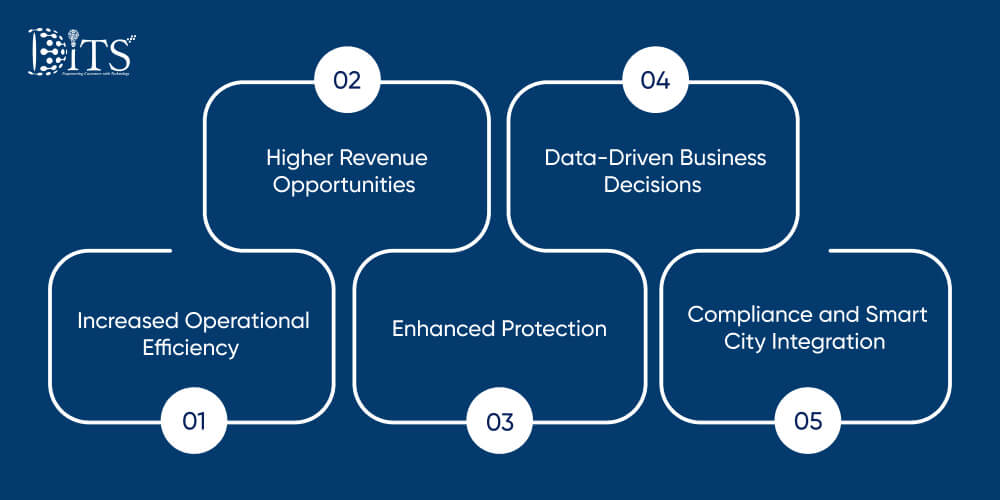
When AI and IoT go side by side, parking businesses can boost efficiency, guard income, reinforce safety, and also make more solid decisions for the long run, instead of guessing based on old info.
Increased Operational Efficiency
The combination of AI and IoT technology enables parking businesses to achieve operational flow because they eliminate all manual tasks that create delays during their daily operations. The connected systems enable users to handle entry logs, space checks, payment tracking, equipment monitoring, and reporting through integrated systems instead of using individual tools and spreadsheets.
For operators handling multiple lots, this makes a noticeable difference. A manager can review occupancy, revenue, alerts, and customer flow from one dashboard instead of calling different site teams for updates. The parking lot management software Canada solution enables facilities operating at commercial, healthcare, retail, and municipal locations to establish better management systems.
Higher Revenue Opportunities
Parking revenue leaks through various channels which include unpaid exits, incorrect ticketing, unused spaces, ineffective peak-hour pricing and the limited ability to monitor occupancy. The combination of AI and IoT work together to close operational gaps by delivering operators improved data insights and enhanced control methods.
A business can identify which hours produce the most demand, which zones remain underused, and where pricing needs adjustment. The business will experience revenue growth through these insights which will operate without requiring additional land or staff or equipment.
Enhanced Protection
The combination of smart cameras together with sensors and artificial intelligence alerts enables operators to identify three different security threats. This includes unrestricted area access and the presence of abandoned vehicles and the detection of suspicious activities. This security system proves most beneficial to hospitals, airports, corporate campuses and underground parking areas because it directly impacts their customer trust levels.
The business benefits from improved monitoring systems. Managers use digital records to investigate disputes and accidents and access problems instead of relying on manual reports.
Data-Driven Business Decisions
Parking data tells a useful story when it’s collected properly. It can show peak usage, repeat customer behaviour, seasonal demand, payment trends, and underperforming areas.
For top management, this helps with practical decisions such as:
- Whether to expand capacity or improve existing space usage
- Which locations need automation first
- When to adjust staffing
- How to plan monthly parking programs
- Where customer delays are hurting experience
This is where a parking management system becomes more than an operational tool. It starts supporting financial planning, customer retention, and long-term property value.
Compliance and Smart City Integration
Canadian cities are moving toward cleaner, more connected mobility systems. Parking facilities may need to support EV charging, digital payments, accessibility requirements, data security, and smoother traffic movement around busy areas.
Smart platforms make it easier to adapt. They can connect with city mobility programs, support cleaner facility operations, and help operators prepare for future transportation needs. For businesses working with municipalities or large commercial properties, this flexibility matters because parking expectations won’t stay the same for the next ten years.
Use Cases of AI and IoT for Parking Lot Management Across Canada
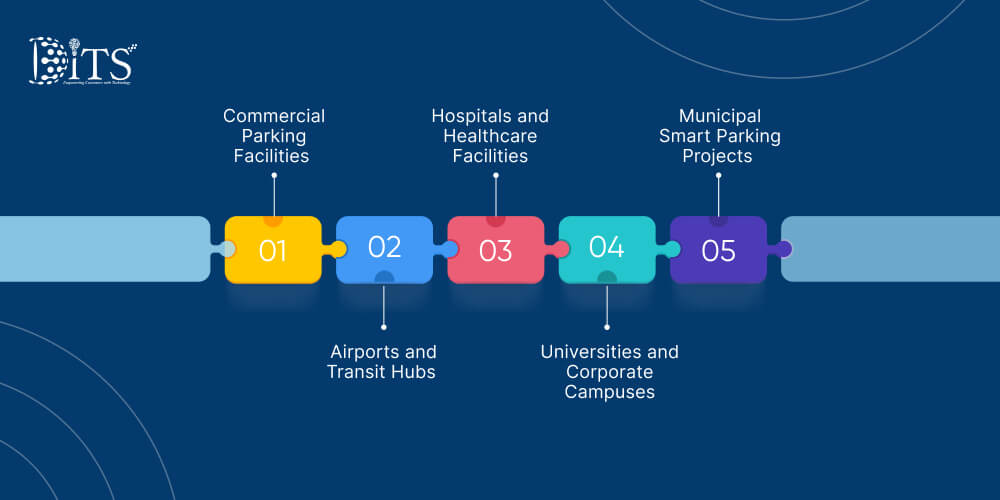
Across Canada, smart parking technologies are being adopted in different environments where traffic flow, customer convenience, and operational control are business priorities.
Commercial Parking Facilities
Different types of properties establish different methods to manage their parking demands which include retail plazas, shopping malls, office towers and mixed-use properties. A mall requires increased customer turnover during weekends whereas an office tower needs improved management systems which control access for its tenants and visitors and service vehicles.
Business operators use automated parking systems to decrease entrance waiting times while achieving precise control of paid parking operations and tracking which zones receive the highest daily traffic. The property owners use that knowledge to boost their earnings while controlling visitor flow through the site without creating an excessive management presence.
Airports and Transit Hubs
Airports and transit hubs require parking systems which must handle three types of parking needs which include extended stays, short pickups, and quick drop-offs. The system faces challenges because vehicle flow patterns undergo rapid changes during holidays and flight delays and bad weather conditions.
The combination of AI and IoT enables operators to monitor parking occupancy while directing drivers to open parking spaces and implementing license plate access control which helps to minimize traffic jams during exits. The airport parking teams experience better passenger satisfaction because every minute saved for vehicle processing leads to improved results.
Hospitals and Healthcare Facilities
Hospital parking serves a greater purpose than providing convenience to visitors. The available parking area becomes a battleground among patients, families, doctors, nurses, emergency visitors, and delivery vehicles during high-pressure situations.
Smart systems can reserve priority spaces, guide visitors to available areas, and help staff parking remain controlled during peak shifts. A hospital doesn’t need a complicated experience at the gate. It needs clarity, speed, and fewer complaints from people who already have enough on their minds.
Universities and Corporate Campuses
Campuses often manage permits, visitor passes, reserved zones, and seasonal traffic changes. Without a connected system, enforcement becomes inconsistent and reporting becomes messy.
AI and IoT can help automate permit checks, monitor restricted spaces, and show administrators where demand is increasing. For large corporate campuses, this also supports better employee experience because people don’t want to start their workday frustrated in a parking queue.
Municipal Smart Parking Projects
For cities, parking is connected to traffic flow, public convenience, local business access, and emissions from vehicles circling for spaces. Smart parking solutions for cities can help municipalities show real-time space availability, support digital payments, reduce congestion, and improve planning around busy streets.
This is where smart parking moves beyond one facility. It becomes part of a cleaner, more organized urban mobility strategy.
Choosing Right Smart Parking Solution Provider In Canada
Choosing the right smart parking solution provider in Canada can feel a bit tricky, because it’s not only “pick a vendor and move on”. If you choose wrong, it can show up fast in real life… like daily entry delays, messy payments, security headaches, and reporting that never quite matches what you need. It also might touch on city level mobility planning, which is another layer.
Working with a custom software development company can help parking businesses build features around their actual workflows, whether they manage tenant permits, visitor access, event pricing, or multi-location reporting.
For Canadian businesses, the practical stuff comes first, and you should check it early:
- AI capabilities: Does it actually deliver real-time insights, forecasting, automation, and alerts when exceptions happen.
- IoT integration: Can it connect with sensors, gates, cameras, kiosks, lighting, and mobile apps; all together, not as separate headaches?
- User experience: Is the dashboard clear enough that operations staff can use it every day, without constant training?
- Data security: Does it guard customer, vehicle, payment, and access information properly, like seriously properly.
- Support and maintenance: Will the partner keep helping after launch, or do they fade once the system goes live.
- Compliance readiness: Can it align with Canadian expectations around privacy, and accessibility, plus the business requirements you’re expected to meet.
This is exactly where working with an experienced AI software development company helps. Off-the-shelf platforms might cover the obvious cases, but many parking organizations still require custom rules for permits, tenant access, pricing logic, loyalty programs, validation flows, reporting, and multi-site operations.
Need Smarter Parking Operations For Growing Facilities?
Build connected parking systems with automation, predictive analytics, and real-time monitoring for better operational control.
Conclusion
AI and IoT are really reshaping how parking businesses across Canada manage space and money, guide the customer flow, and handle daily operations. A modern parking lot management system can watch occupancy in real time, reduce the boring manual chores, automate entry and exit, enable more flexible pricing, and give managers a clearer picture across one location or multiple locations at the same time.
For malls, airports, hospitals, office buildings, universities, and municipal parking programs, the big win is not only automation. It’s more control, basically like having a firmer hold on what’s happening inside the facility. When operators understand what’s going on, they can react faster, reduce revenue leakage, and deliver a smoother experience for drivers.
Also, this shift is already underway across Canada. If companies wait too long, they might pay more later, face slower operations, and start hearing customer complaints. Smart parking isn’t just piling on tech for its own sake. It’s about building a parking operation that feels simpler to run, scales more cleanly, and stays ready for the next decade.
FAQs
How can AI improve parking lot operations?
AI can look at how vehicles move, when the busiest hours tend to hit, how people pay, and how occupancy changes over time. With that, operators get better decision support. AI can also help with license plate recognition, predict demand, enable dynamic pricing, spot payment fraud, and speed up vehicle assignment, so the whole parking flow feels more fluid for managers and drivers, even during peak traffic.
Does DITS offer custom parking management software development?
Yes, DITS provides custom parking management software development services, mainly for businesses that want specific features instead of a rigid one-size-fits-all platform. Our team can build solutions for automated entry and exit, real time occupancy tracking, permit management, payment integration, reporting dashboards, AI based analytics, and IoT enabled parking infrastructure.
How much does parking management software development cost?
Like the IoT app development cost, the cost of parking management software depends on the project scope, number of locations, hardware integrations, AI features, IoT devices, payment systems, user roles, reporting needs, and customization level. A simple solution may cost less, while a full AI and IoT-enabled platform for multiple facilities will require a larger investment.
How does IoT support parking lot management?
With IoT, the physical setup like sensors, barriers, cameras, parking lighting, and payment equipment gets tied into the software system. That way, operators can watch space availability, check equipment health, understand customer movement, and spot maintenance needs in near real time. Overall, this reduces unexpected downtime and gives stronger operational control… sort of continuous visibility instead of guessing.
Does DITS use AI when developing parking management software?
Yes, DITS uses AI across software development, quality assurance, code quality upkeep, and customization. In the parking management context, we can add AI-based features too, for example predictive analytics, license plate recognition, smart reporting, automated notifications, and pricing that adapts based on demand. That combination helps businesses run smoother and boost revenue outcomes.

Dinesh Thakur
21+ years of IT software development experience in different domains like Business Automation, Healthcare, Retail, Workflow automation, Transportation and logistics, Compliance, Risk Mitigation, POS, etc. Hands-on experience in dealing with overseas clients and providing them with an apt solution to their business needs.
Recent Posts
Explore how prior authorization software uses AI to automate workflows, reduce administrative effort, improve request accuracy, streamline approvals, and minimize treatment delays for healthcare organizations.
Discover how AI to improve patient experience in hospitals streamlines scheduling, communication, triage, queue management, and personalized care while enhancing operational efficiency.
Learn how IoT powers smart factories with connected devices, automation, predictive maintenance, and analytics.