How AI is Transforming Modern Product Development Services
Table Of Content
Published Date :
08 Jan 2026
For Canadian companies, product decisions carry weight far beyond feature lists or delivery timelines. Every new product initiative represents capital at risk, brand reputation on the line, and an opportunity cost that cannot be recovered. In this context, product development services are undergoing a structural shift. Artificial intelligence is becoming a practical tool for improving decision quality across the entire product lifecycle.
Leadership teams have seen how quickly customer behavior changes, competition rises, and timelines compress once a product reaches the market. AI helps address this reality by introducing measurable signals into planning, design, and execution. It reduces reliance on instinct alone and replaces it with evidence-driven insights that support faster, more defensible decisions.
This article examines how AI is reshaping product development for Canadian businesses and the benefits of adopting it early.
Build smarter products with fewer surprises. Partner with DITS to embed AI across planning, development, and optimization.
Current State Of Product Development In Canadian Businesses
Across Canada, product teams are operating under tighter margins and higher expectations than ever before. Markets move quickly, customer tolerance for poor experiences is low, and global competitors are rarely far behind. Yet many organizations still rely on fragmented processes, delayed feedback loops, and static planning models that struggle to keep pace.
In boardrooms, the same concerns surface repeatedly. Too much time is spent on validating ideas, and too many launches meet delivery goals but miss commercial impact. For CIOs and founders, the problem is a lack of visibility and predictability.
Traditional development approaches were built for stability. However, today’s environment rewards adaptability. And it is precisely where AI-driven approaches begin to change the economics of product building.
How AI Is Reshaping Modern Product Development Services
AI is changing how decisions are made before cost and complexity escalate. In modern product development services, AI introduces a layer of intelligence that sits quietly behind planning, design, and execution, continuously refining direction as new data arrives.
Instead of locking requirements months in advance, teams can test assumptions early using predictive models. Market signals and usage patterns feed into more intelligent prioritization. This reduces the familiar cycle of build, pause, rework.
For executives, the value is straightforward. Better foresight and development budgets stretch further because effort is spent where impact is most likely to occur. Timelines become more credible because risks are surfaced earlier, not during final delivery.
Product strategy becomes adaptive, and once that happens, product decisions start aligning more closely with business outcomes.
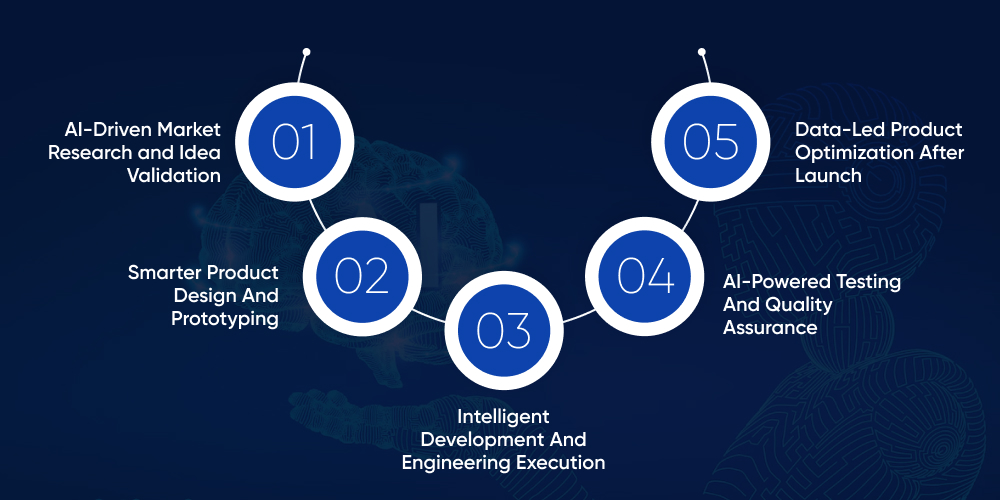
AI-Driven Market Research and Idea Validation
Early-stage decisions often determine a product's commercial fate. Canadian businesses know this pattern well. A promising idea moves forward based on limited data, internal enthusiasm builds, and six months later the market response is muted. AI changes this dynamic by bringing discipline and evidence into the earliest conversations.
Instead of relying solely on surveys or historical reports, AI systems analyze large volumes of behavioral data, customer feedback, and market signals in near real time. Patterns emerge quickly. Demand gaps become visible. Weak ideas surface before budgets are committed.
In practical terms, this means leadership teams can:
- Validate demand before allocating full development budgets
- Compare multiple concepts using predictive performance indicators
- Identify regional or sector-specific preferences across Canada
Fewer products move forward on optimism alone. More progress with a clear commercial rationale. That shift alone saves months and protects capital.
Smarter Product Design And Prototyping
Design decisions are often where cost overruns quietly begin. A feature that looks compelling on paper can introduce usability friction, performance issues, or long-term maintenance overhead once it reaches users. AI helps reduce this risk by bringing evidence into design choices before they harden into code.
Modern teams now use AI-assisted development tools to evaluate user flows, interaction patterns, and interface complexity early in the design phase. Instead of waiting for post-launch feedback, design teams can simulate how real users are likely to behave and where they may hesitate, drop off, or misuse key features.
For business leaders, this translates into practical advantages:
- Faster iteration cycles without expensive rework
- Early identification of usability gaps that impact adoption
- Design choices aligned with actual user behavior, not assumptions
Here’s the catch. Good design is no longer just aesthetic. It is measurable. And when design decisions are grounded in data, products enter development with far fewer unknowns.
Intelligent Development And Engineering Execution
Once enterprise software development begins, complexity compounds quickly. Dependencies multiply, timelines tighten, and small technical decisions start carrying long-term consequences. This is where AI quietly strengthens execution discipline without disrupting engineering velocity.
AI-enabled development environments assist teams by reviewing code patterns, flagging inefficiencies, and identifying potential performance or security risks early. Instead of discovering issues during late-stage reviews, teams receive guidance while work is still in motion. That matters when delivery commitments are tied directly to revenue or client contracts.
For CIOs and technology leaders, the operational impact is tangible:
- Fewer late-stage defects that derail release schedules
- More consistent code quality across distributed teams
- Reduced reliance on manual reviews that slow momentum
At DITS, this approach extends beyond development alone. We integrate AI across software engineering workflows, quality assurance, code governance, and customization efforts, ensuring intelligence is embedded into every solution we build, not layered on afterward.
And when engineering execution becomes more predictable, leadership conversations shift from damage control to growth planning.
AI-Powered Testing And Quality Assurance
Testing is where timelines often slip without warning. Manual test cycles expand, edge cases surface late, and defects appear just when teams believe they are close to release. For executives, this phase tends to feel opaque until something breaks. AI changes that visibility.
AI-driven testing systems continuously scan applications for patterns that indicate failure risk. Instead of running static test scripts, these systems learn from past defects, usage behavior, and release history to prioritize what truly needs attention. High-risk areas are tested first. Low-impact noise is filtered out.
From a leadership perspective, the benefits are practical:
- Faster release cycles without compromising stability
- Earlier detection of defects that would otherwise reach production
- Reduced cost of post-launch fixes and emergency patches
Nobody enjoys surprise escalations days before a launch. AI-led quality assurance lowers that risk by making testing smarter, not heavier. The result is confidence at go-live, not crossed fingers.
Data-Led Product Optimization After Launch
Launch is not the finish line. For most Canadian businesses, it is the moment when real risk begins. User behavior rarely follows forecasts, and even well-tested products reveal friction once they meet real operating conditions. AI helps leadership teams stay ahead of these realities rather than react to them.
Post-launch, AI continuously analyzes usage data, performance metrics, and behavioral signals. It highlights where users slow down, abandon flows, or misuse features. More importantly, it separates isolated issues from systemic ones, allowing teams to focus on changes that actually move business metrics.
From an executive standpoint, this delivers clear advantages:
- Faster identification of features that underperform against revenue or adoption targets
- Data-backed prioritization for enhancement roadmaps
- Reduced dependence on anecdotal feedback or delayed reports
Here’s the insight many teams miss. Products do not fail suddenly. They decline quietly when signals are ignored. AI makes those signals visible early, while corrective action is still cost-effective.
This article examines how AI is reshaping product engineering for Canadian businesses and the benefits of adopting it early.
Planning your next product or platform upgrade? Let’s design an AI-driven roadmap that aligns product vision with business results.
Business Benefits of AI-Enabled Product Development Services
AI delivers value only when it aligns with business outcomes. For executive leadership, the benefits extend beyond technical efficiency and directly influence risk management, capital allocation, and long-term growth. Below are the core advantages that matter at the boardroom level.
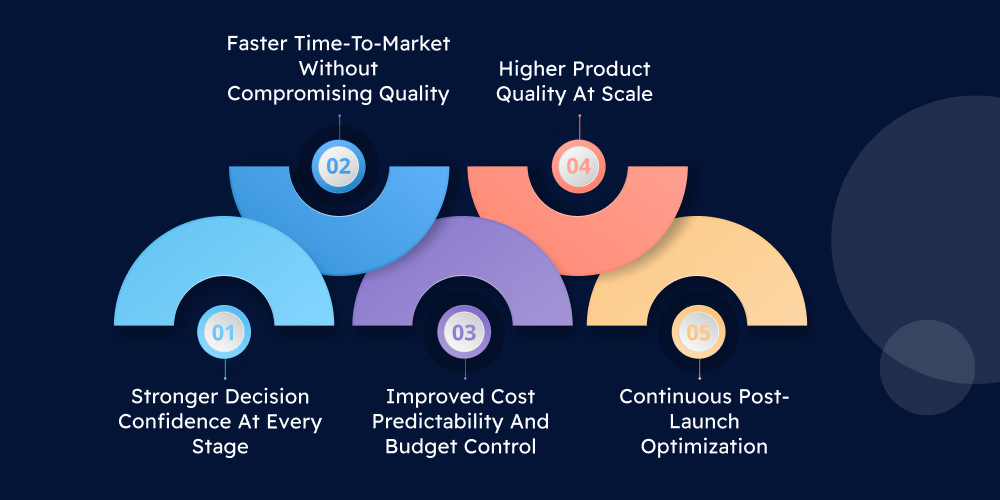
Stronger Decision Confidence At Every Stage
AI replaces assumption-driven planning with evidence-backed insight. Product investments are evaluated using real signals, not optimism or legacy data. This leads to faster approvals, clearer priorities, and fewer initiatives that drift without impact. Leadership teams gain confidence because decisions are defensible and measurable.
Faster Time-To-Market Without Compromising Quality
By reducing rework and surfacing risks early, AI shortens development cycles in a controlled way. Products reach the market sooner, but with fewer unknowns. This balance is critical when launch timing directly affects revenue, partnerships, or competitive advantage.
Improved Cost Predictability And Budget Control
Late-stage changes are among the most expensive in product development. AI minimizes these disruptions by identifying design, engineering, and testing risks before they escalate. As a result, budgets become easier to forecast and cost overruns become far less frequent.
Higher Product Quality At Scale
As organizations grow, maintaining consistency becomes difficult. AI-assisted development and quality assurance enforce standards across teams and locations. Code quality, performance, and reliability improve without increasing management overhead or slowing delivery.
Continuous Post-Launch Optimization
AI enables products to evolve based on real-world usage rather than periodic reviews. Features are refined, performance issues are addressed, and customer experience improves continuously. This drives stronger adoption, higher retention, and longer product lifespan.
Collectively, these benefits reposition product development as a strategic capability rather than a delivery function. The impact is felt not just in operations, but in sustained business value.
Why Choose DITS For Product Development Services
For leadership teams, choosing a development partner is ultimately about trust, execution discipline, and measurable outcomes. DITS is built around those expectations. Our approach to product development services is not transactional. It is outcome-driven, engineered to support business strategy, not just delivery milestones.
First, we bring structure to complexity. From early-stage ideation to scaled platforms, our teams apply strong architectural thinking and disciplined execution. This ensures products are built to evolve, not patched together to meet short-term goals. Many clients engage us specifically for our ability to balance speed with long-term maintainability.
At DITS, AI is embedded across software development workflows, quality assurance, code quality management, and customization. This allows us to reduce rework, surface risks early, and deliver more predictable outcomes. It also enables advanced capabilities such as intelligent automation and AI chatbot development where it adds genuine business value.
Third, we understand executive accountability. Budgets, timelines, and performance commitments are taken seriously. Our teams operate with transparency, clear reporting, and decision-ready insights. This is particularly important for organizations investing in complex software product development services with multiple stakeholders and dependencies.
Finally, we focus on partnership, not handover. A strong partner does not just deliver and exit. We support iteration, scaling, and modernization as business needs shift, whether through advanced AI software development capabilities or structured App modernization services when platforms mature. From optimization to expansion, we support continuous improvement to keep your product aligned with market expectations and drive business growth.
Conclusion
AI has shifted product development from a linear execution model to a continuously informed decision system. For Canadian CEOs, CIOs, and founders, this shift is less about technology and more about control. Control over risk, timelines, costs, and outcomes. When intelligence is embedded across planning, engineering, testing, and post-launch optimization, products are no longer built on assumptions alone. They are shaped by evidence. Organizations that embrace this approach move faster, with fewer surprises and more substantial alignment between product vision and business value. In a competitive market, that advantage compounds quickly, separating leaders from those constantly catching up.
FAQs
How does AI improve product development decision-making?
AI analyzes real-time data, user behavior, and historical outcomes to reduce guesswork, helping leadership teams make faster and more defensible product decisions.
Is AI-based product development suitable for mid-sized Canadian companies?
Yes. AI helps mid-sized firms optimize budgets, reduce rework, and compete effectively without needing enterprise-scale resources.
Does AI replace human product teams?
No. AI augments teams by improving insight, efficiency, and quality, while strategic and creative decisions remain human-led.
Where does AI add the most value in the product lifecycle?
The highest impact appears in early validation, risk detection during development, and continuous optimization after launch.
How long does it take to see business impact from AI-enabled product development?
Many organizations see measurable improvements within the first few development cycles, particularly in time-to-market and cost predictability.

Dinesh Thakur
21+ years of IT software development experience in different domains like Business Automation, Healthcare, Retail, Workflow automation, Transportation and logistics, Compliance, Risk Mitigation, POS, etc. Hands-on experience in dealing with overseas clients and providing them with an apt solution to their business needs.
Recent Posts
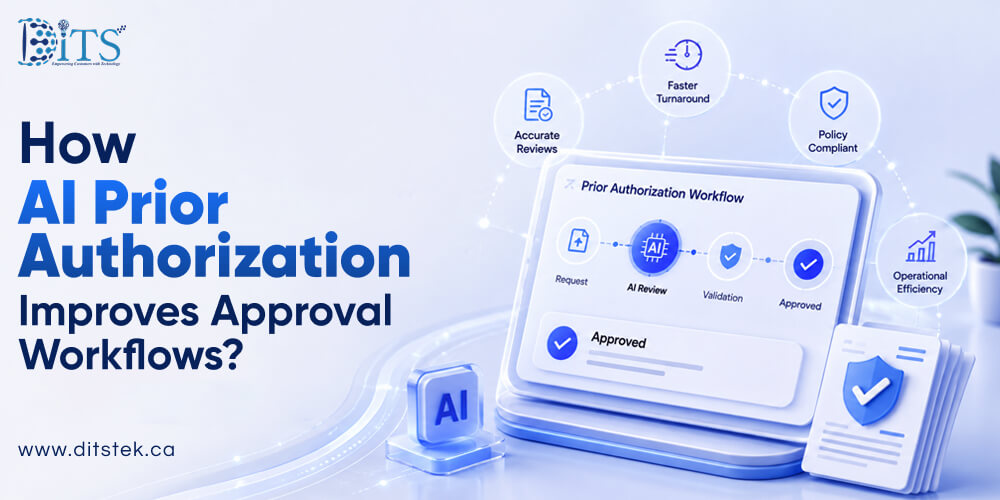
Explore how prior authorization software uses AI to automate workflows, reduce administrative effort, improve request accuracy, streamline approvals, and minimize treatment delays for healthcare organizations.
Discover how AI to improve patient experience in hospitals streamlines scheduling, communication, triage, queue management, and personalized care while enhancing operational efficiency.

Learn how IoT powers smart factories with connected devices, automation, predictive maintenance, and analytics.