How Bespoke MVP Development Services Reduce Product Risk for Canadian Companies
Table Of Content
Published Date :
10 Feb 2026
For Canadian companies, product risk is a critical concern that needs to be addressed before launch. It shows up early, often quietly, in missed timelines, increased costs, and products that fail to gain market traction. Rising development costs and tighter capital allocation have made failed products more expensive than ever. Add to that Canada’s regulatory environment, data protection and compliance regulations, and the margin for error shrinks even further.
Many leadership teams still rely on the “build first, fix later” mindset. But fixing later often costs two or three times more, especially when the market has already moved on. This is where bespoke MVP development services play a practical role, as a structured way to reduce uncertainty, test assumptions, and protect business value before making large-scale commitments.
Product Risk for Canadian Businesses
Product risk in Canada often begins long before a line of code is written. It starts with assumptions and approval of ideas based on internal experience, and pressure to move fast. However, companies later discover that the market had entirely different expectations. That gap between belief and reality is where most product failures quietly take shape.
Common risk areas Canadian companies face include:
- Market misalignment, where solutions are built for problems that customers are no longer prioritizing.
- Overengineering, driven by internal feature wish lists rather than real demand.
- Compliance and data privacy requirements that surface late and force costly redesigns.
- Budget overruns caused by unclear scope and shifting priorities.
- Extended time-to-market erodes competitive advantage.
On top of that, many organizations underestimate the operational impact of getting it wrong. A delayed launch can stall sales pipelines. A compliance issue can freeze deployment. Nobody likes costly surprises, especially when they ripple across multiple departments. Understanding these risks upfront is the first step toward controlling them instead of reacting under pressure.
De-Risk Your Product Before You Scale?
Validate demand, control costs, and uncover risks early with a bespoke MVP built for Canada’s market and regulatory realities.
What Bespoke MVP Development Services Really Mean
Bespoke MVP development is often misunderstood as simply building a smaller version of a product. In reality, it is a deliberate business exercise designed to answer the most critical questions early, before scale locks decisions in place. The key difference lies in intent. Generic MVP frameworks rely on predefined templates and assumptions. Bespoke approaches start with your business context and work backward.
With bespoke MVP development services, the focus is not speed alone, but on accuracy. Features are selected because they validate revenue models, user behavior, or operational feasibility. Everything else is intentionally left out. This approach reduces noise and keeps teams aligned around outcomes that matter to leadership.
How Bespoke MVP Development Reduces Product Risk
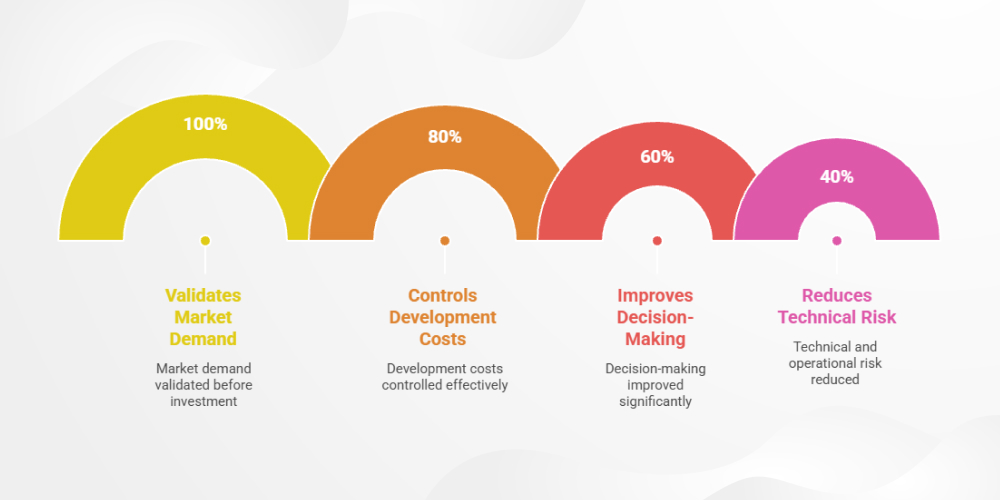
Validates Market Demand Before Full-Scale Investment
One of the biggest advantages of a tailored MVP approach is early validation. Instead of internal assumptions, teams test ideas with real Canadian users in controlled conditions. A limited rollout, often within 8 to 12 weeks, reveals how customers actually behave. Feedback arrives fast, patterns emerge quickly, and weak ideas are exposed before they consume large budgets.
Controls Development Costs
Cost control is built into the process. Features are prioritized based on direct business impact. This keeps development lean and focused.
- Clear scope tied to revenue, adoption, or efficiency goals
- Fewer change requests and less rework
- Predictable spending aligned with board expectations
This discipline only works when decisions are made early and defended consistently. Bespoke MVP development services enforce that discipline.
Improves Decision-Making
Executives can see usage data, drop-off points, and customer reactions. These insights provide clear go-or-no-go signals. Scaling becomes a confident decision, not a gamble made under deadline pressure.
Reduces Technical and Operational Risk
From the start, architecture decisions consider future growth. Systems are designed to scale, integrate, and adapt without major rework. This avoids technical debt that often surfaces months after launch and drains operational budgets.
Industry-Specific Risk Reduction
Bespoke MVP development helps reduce product risks across different industries. MVPs are shaped to fulfill specific requirements of different industries.
Why Industry Context Matters In MVP Strategy
Product risk behaves differently across industries. A validation approach that works for a SaaS platform may fail entirely in healthcare or manufacturing. This is where bespoke MVPs offer real value. They are shaped around operational realities, regulatory exposure, and buyer expectations specific to each sector.
SaaS And B2B Platforms
For SaaS and B2B products, risk typically centers on user adoption and long-term engagement. Bespoke MVPs in this space focus on a single, high-impact user flow, often onboarding or one core workflow. Early usage data shows whether customers understand the value quickly or disengage.
Healthcare, Logistics, And Regulated Industries
In regulated environments, the risk profile shifts toward compliance, data security, and audit readiness. MVPs are designed to validate secure data handling, access controls, and regulatory workflows first. This approach is especially important in Healthcare app development, where late-stage compliance issues can delay launches and significantly increase costs.
Manufacturing And Enterprise Workflow Solutions
Operational disruption is the primary concern in manufacturing and enterprise environments. Bespoke MVPs here often run in parallel with existing systems, testing efficiency gains without interrupting day-to-day operations. This is closely aligned with business workflow automation initiatives, where small, validated improvements reduce resistance and build internal confidence.
By tailoring MVPs to industry-specific risk, organizations avoid expensive missteps and move forward with evidence rather than assumptions.
Turn Assumptions Into Evidence
See how a tailored MVP strategy can help your team test ideas, align stakeholders, and make confident go-or-no-go decisions.
Key Features of Low-Risk Bespoke MVP

Here are some key features that businesses in Canada should consider while considering building an MVP for their business.
Clear Success Metrics and KPIs
A low-risk MVP starts with clarity. Before development begins, leadership teams define what success actually looks like. Safe MVPs begin with clarity. Before building, leaders define real success. This means business results, not vague goals. Examples include hitting a target for new users, cutting manual work, or getting early sales. These clear rules keep the team focused and stop unnecessary features from being added.
User-Centric Design
Design decisions in a bespoke MVP are driven by behavior, not aesthetics. Every screen, flow, and interaction is mapped to a user action that can be tracked and evaluated. This approach often reveals friction points that internal teams overlook. And once those insights surface, prioritization becomes far easier.
Modular Development For Controlled Scaling
Low-risk MVPs are built in modular blocks rather than tightly coupled systems. This allows teams to expand what works and discard what does not without destabilizing the entire product. It also makes future integrations smoother, especially when working with a Custom software development company that understands long-term scalability.
At DITS, this modularity is further strengthened by integrating AI into development, quality assurance, and customization workflows, ensuring consistency and code quality as products evolve.
Common Product Risks Avoided With Bespoke MVP Development
Features Customers Do Not Need
One of the most common and expensive mistakes is building functionality based on internal assumptions rather than user behavior. Bespoke MVPs expose this risk early. When features fail to attract usage during pilot phases, teams gain a clear signal to stop investing further. This prevents months of development effort from being sunk into capabilities that add little or no market value.
Launch Delays Due To Unclear Requirements
Unclear requirements often surface late in traditional builds, forcing redesigns and pushing launch dates. With a bespoke MVP, requirements are intentionally narrow and validated incrementally. Each iteration sharpens understanding, reducing ambiguity over time. The result is fewer surprises and a delivery timeline that leadership can actually rely on.
Poor Stakeholder Alignment Across Teams
Misalignment between business, technology, and operations teams quietly increases risk. Different groups optimize for different outcomes, creating friction and rework. MVP-led development brings all stakeholders around the same evidence. When decisions are backed by real data, alignment improves, and internal discussions become outcome-focused.
These avoided risks often matter more than the features that get built. They protect momentum, budgets, and credibility at the executive level.
How To Choose Right Bespoke MVP Development Partner In Canada
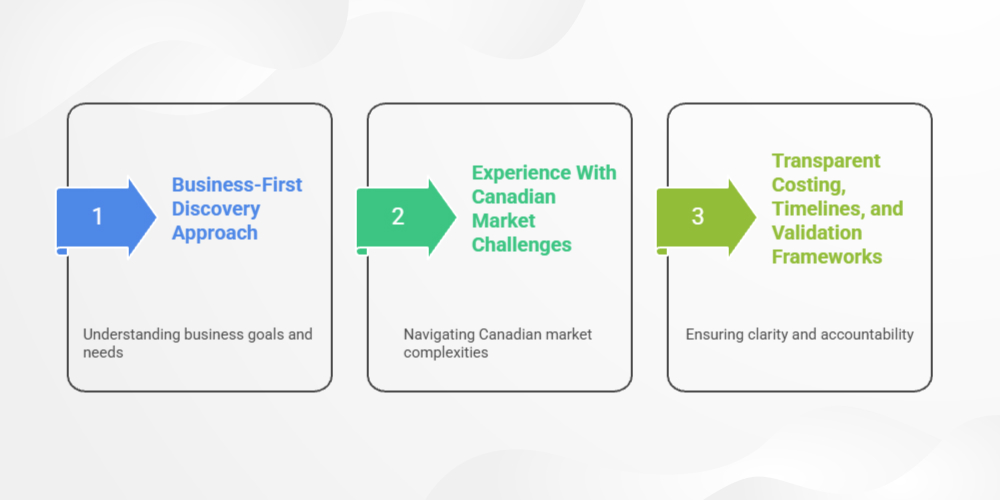
Business-First Discovery Approach
The first sign of a reliable partner is how they start. Strong MVP partners begin with discovery conversations focused on business goals, risk areas, and success metrics. This phase should challenge assumptions, not simply document them. If a partner avoids difficult questions early, the risk usually surfaces later in cost overruns or misaligned outcomes.
Experience With Canadian Market Challenges
Canada’s business environment brings its own set of constraints. Regulatory requirements, procurement cycles, data residency concerns, and stakeholder governance all influence how products should be built and validated. A partner with experience delivering MVP development services in this context understands how to balance speed with compliance and innovation with risk control.
Transparent Costing, Timelines, and Validation Frameworks
The right partner provides clear timelines, phased budgets, and checkpoints tied to outcomes. This transparency allows leadership teams to make informed decisions at every stage. At DITS, this process is further strengthened by integrating AI into software development, quality assurance, and code maintenance, helping teams maintain consistency and adapt quickly as insights emerge.
Choosing the right partner often determines whether an MVP reduces risk or quietly introduces more of it.
Build What the Market Will Actually Use
Reduce wasted spend and late-stage surprises by validating your product with real users before full-scale investment.
Conclusion
For Canadian companies, reducing product risk is about making smarter decisions earlier. Markets shift quickly, customer expectations evolve, and regulatory pressure continues to rise. In this environment, waiting for certainty before acting often creates more risk than it avoids.
A well-executed MVP strategy reframes product development as a learning process rather than a one-time launch event. It allows leadership teams to test assumptions, validate demand, and control investment before scaling commitments. This is where bespoke MVP development services become a strategic asset, not just a development approach.
Companies that treat MVPs as risk management tools consistently make better growth decisions. They enter markets with confidence, align teams around data, and protect capital where it matters most.
FAQs
How Does Bespoke MVP Development Reduce Product Risk?
Bespoke MVPs reduce risk by testing the most critical assumptions early, before large budgets are committed. Instead of building a full product based on internal opinions, companies validate demand, usability, and feasibility with real users. This approach surfaces gaps quickly, allowing teams to pivot, refine, or stop with minimal financial exposure.
Is Bespoke MVP Development Suitable For Established Canadian Enterprises?
Yes, and often more so than for startups. Established organizations face higher stakes, stricter governance, and greater scrutiny from stakeholders. A bespoke MVP allows enterprises to experiment responsibly, validate new ideas within controlled boundaries, and protect existing operations while exploring growth opportunities.
How Long Does It Take To Build A Bespoke MVP?
Most bespoke MVPs are delivered within 8 to 12 weeks, depending on scope and validation goals. The timeline focuses on speed with purpose, ensuring that what gets built delivers actionable insights rather than unnecessary features.
What Is Typical Cost Range For Bespoke MVP Development In Canada?
Costs typically range from CAD 40,000 to CAD 120,000. The variation depends on complexity, integration needs, and validation depth. While this may seem significant, it is often a fraction of the cost of building and correcting a full-scale product that misses market expectations.

Dinesh Thakur
21+ years of IT software development experience in different domains like Business Automation, Healthcare, Retail, Workflow automation, Transportation and logistics, Compliance, Risk Mitigation, POS, etc. Hands-on experience in dealing with overseas clients and providing them with an apt solution to their business needs.
Recent Posts

Explore how prior authorization software uses AI to automate workflows, reduce administrative effort, improve request accuracy, streamline approvals, and minimize treatment delays for healthcare organizations.

Discover how AI to improve patient experience in hospitals streamlines scheduling, communication, triage, queue management, and personalized care while enhancing operational efficiency.

Learn how IoT powers smart factories with connected devices, automation, predictive maintenance, and analytics.