Challenges Canadian Legal Practices Face Without IT Consulting Law Firms
Table Of Content
Published Date :
19 Jan 2026
Canadian legal practices operate in an environment with tight deadlines and low client trust. Yet many firms still rely on fragmented systems, outdated infrastructure, and internal teams to manage their IT needs. It works in the beginning, but not in the long term.
As caseloads grow and regulatory pressure tightens, things like missed filings, security gaps, and unexpected downtime start showing up. These are operational risks that directly affect revenue and reputation. This is where IT consulting for law firms becomes less of a support function and more of a strategic necessity.
Without structured guidance, law firms often react to problems, and that reactive approach costs far more than most managing partners expect. In this blog, we’ll break down the real challenges Canadian legal businesses face without professional IT consulting and why these issues tend to surface at the worst possible time.
Assess Your Firm’s IT Risk Today!
Get a structured IT assessment tailored for Canadian law firms. Identify security gaps, compliance risks, and scalability issues before they impact your cases or clients.
Challenges Legal Practices Face Without IT Consulting Law Firms
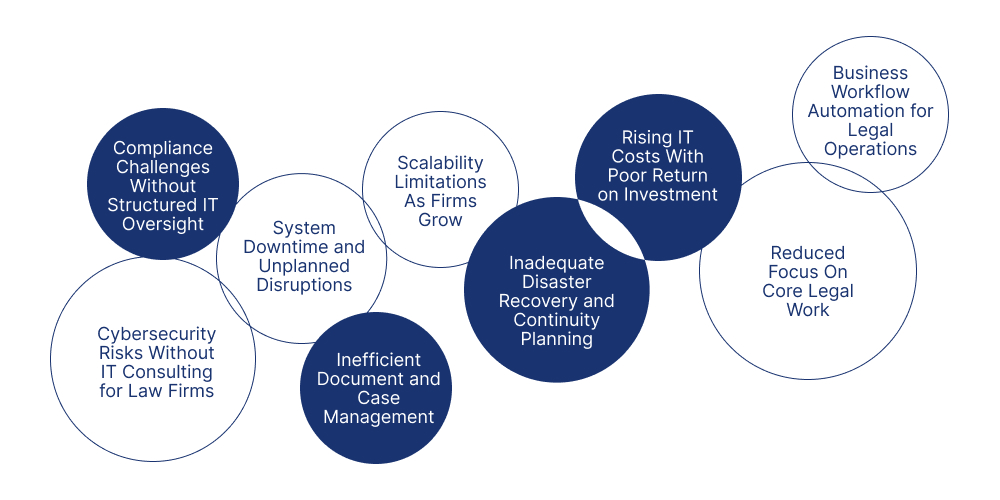
Cybersecurity Risks Without IT Consulting for Law Firms
Legal practices hold some of the most sensitive data in any industry. It includes information like client identities, financial records, case strategies, and settlement details. All of it sits on systems that are quietly targeted every day. Here’s the catch. Most breaches don’t happen because firms ignore security, but because security is handled in steps rather than fully.
Without structured IT oversight, many Canadian firms rely on basic antivirus tools, outdated firewalls, or ad hoc fixes after an incident occurs. That reactive setup leaves gaps in data and systems security.
And when a breach happens, the damage isn’t just technical.
- Client trust erodes quickly
- Regulatory scrutiny increases
- Billable hours disappear into crisis management
This is where experienced IT consulting law firms make a difference, shifting security from damage control to prevention. The firms that ignore this usually learn the hard way.
Compliance Challenges Without Structured IT Oversight
Canadian law firms operate under strict regulatory expectations around data privacy, record retention, and client confidentiality. On paper, most firms understand these obligations. In practice, compliance often falls apart at the system level.
Without centralized IT governance, document storage spreads across local drives, email inboxes, and third-party tools. Access controls remain loosely defined. Audit trails are incomplete or missing altogether. And when a compliance review or client inquiry arises, teams scramble to piece together information that should have been readily available.
Moreover, regulatory requirements evolve. Systems don’t update themselves. Someone has to assess risk, adjust configurations, and validate controls regularly. Without professional guidance, those tasks get postponed.
This is where professional IT consulting services provide real value, by translating compliance requirements into enforceable, everyday system controls that hold up under scrutiny.
System Downtime and Unplanned Disruptions
Downtime usually shows when the case management system won’t load, or minutes before a filing deadline when the document server freezes. For Canadian legal practices, even an hour offline can derail schedules that took weeks to coordinate.
Without proactive IT management, many firms run on fragile setups. Servers operate at full capacity with no redundancy. Monitoring is minimal, so small performance issues quietly grow into full-outages. By the time someone notices, the damage is already done.
The cost is not just technical.
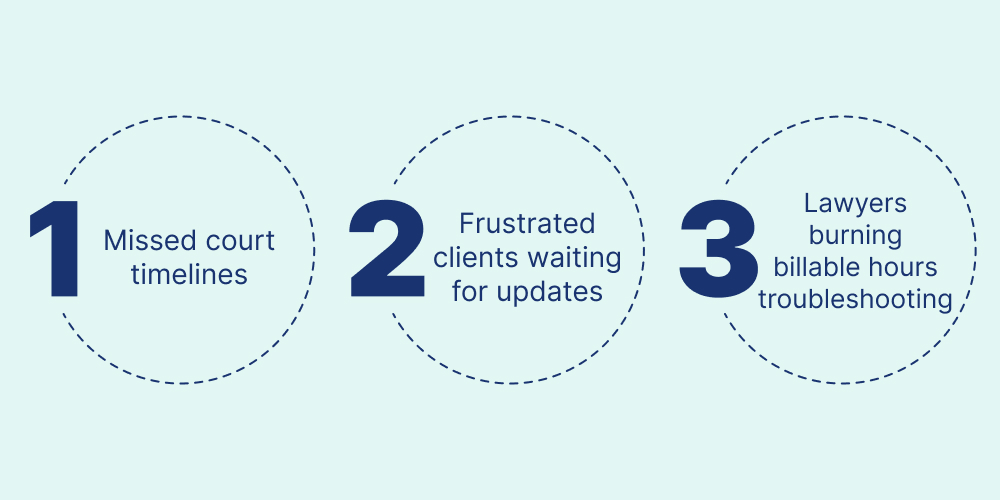
- Missed court timelines
- Frustrated clients waiting for updates
- Lawyers burning billable hours troubleshooting
Firms often assume downtime is unavoidable. It isn’t. It’s usually the result of poor planning and reactive decision-making. When systems are designed without resilience in mind, disruption becomes part of daily operations.
Inefficient Document and Case Management
In many Canadian legal practices, case files sit on local servers, shared drives, inboxes, and personal folders built over years. It feels manageable until someone needs the right version, fast.
Without a structured system, version control quickly breaks down. Searching for a single document can take ten minutes instead of ten seconds. Over a month, that time loss quietly adds up to missed billables and rising frustration.
The bigger issue is risk. When documents aren’t properly indexed, secured, and tracked, firms expose themselves to accidental disclosures and audit challenges.
Scalability Limitations As Firms Grow
Many Canadian legal practices expand by adding new lawyers, opening satellite offices, or supporting hybrid work. The systems underneath, however, often stay the same.
Email servers struggle with higher volumes. Case management tools slow down. Remote access becomes unreliable. Scaling without planning leads to higher costs, and systems that break under pressure. Firms end up spending more to address short-term issues than to invest in long-term stability.
This is where structured IT consulting for law firms changes the equation by aligning technology with growth plans rather than reacting after things go wrong.
Inadequate Disaster Recovery and Continuity Planning
Most law firms assume their data is safe because backups exist somewhere. But when an actual incident hits, a server failure, a ransomware attack, or even a prolonged power outage, assumptions collapse fast.
Files don’t restore properly. Recovery takes days instead of hours.
Without a tested disaster recovery plan, Canadian legal practices expose themselves to prolonged downtime and data loss. Business continuity plans, if they exist, often live in outdated documents no one has reviewed in years.
The impact goes beyond operations.
- Active cases stall
- Clients lose confidence
- Regulatory exposure increases
Firms that treat continuity planning as a checkbox usually pay the price when conditions are least forgiving.
Rising IT Costs With Poor Return on Investment
At first glance, managing IT internally seems cost-effective. No need for third-party vendors and more control. But over time, the numbers tell a different story. Canadian legal practices without structured oversight often spend more, not less, on technology.
Costs creep in through emergency fixes, last-minute hardware purchases, and premium support fees when systems fail. No one has a clear view of what’s essential and what needs change or upgradation.
These expenses rarely translate into better performance or reliability. Firms pay to keep things running, not to make them better. Without a clear roadmap, IT spending becomes reactive and unpredictable, which is the opposite of what financial leaders want.
Strategic planning aligns technology investments with actual business outcomes, not guesswork. Without it, firms end up funding inefficiency year after year.
Build a Stable, Secure IT Foundation for Your Law Firm!
Work with DITS to align your technology with legal workflows, compliance needs, and long-term growth. Let’s design systems that support your practice, not slow it down.
Reduced Focus On Core Legal Work
When IT issues pile up, they don’t stay confined to the back office. They spill directly onto lawyers’ desks. Senior associates reset passwords. Admin teams chase down access issues instead of supporting case preparation. All of it is expensive.
Over time, this distraction becomes normalized. Teams accept slow systems, manual workarounds, and recurring glitches as part of the job. But clients still expect speed, accuracy, and responsiveness. The pressure builds quietly, until service quality starts to slip.
Legal talent is hard to find and harder to retain. When professionals spend hours dealing with operational friction, morale takes a hit. Focus drifts. And leadership loses visibility into where time and effort are really going.
Technology should stay out of the way, not demand constant attention. When it doesn’t, firms pay twice: once in lost productivity, and again in missed opportunities.
Business Workflow Automation for Legal Operations
Legal work is complex by nature. The processes around it don’t need to be. Yet many Canadian law firms still rely on manual handoffs, email-based approvals, and repetitive administrative tasks that quietly drain time every single day.
This is where business and workflow automation deliver immediate, practical value. By automating routine processes such as client onboarding, document routing, approval workflows, billing triggers, and deadline reminders, firms reduce human error and speed up execution without adding headcount.
The benefits show up quickly.
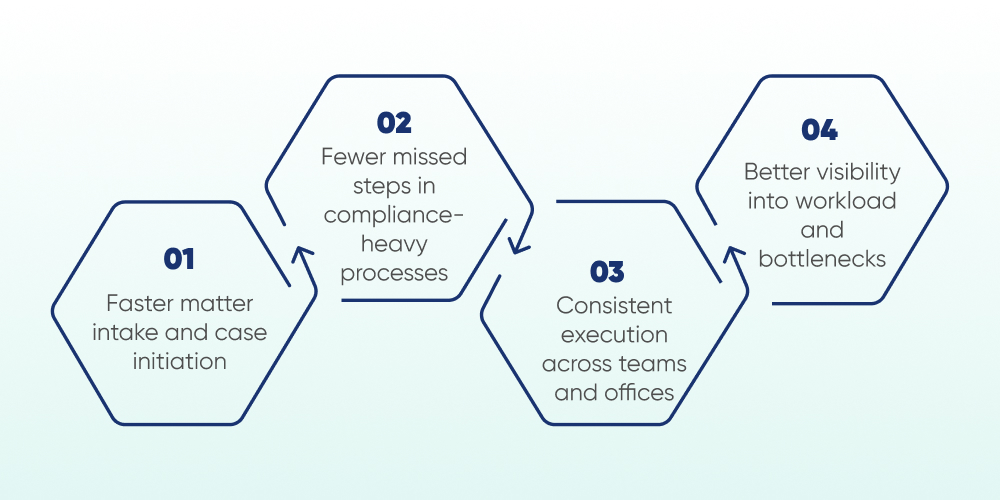
- Faster matter intake and case initiation
- Fewer missed steps in compliance-heavy processes
- Consistent execution across teams and offices
- Better visibility into workload and bottlenecks
Automation also creates breathing room for lawyers and staff, allowing them to focus on higher-value legal work instead of chasing tasks across systems. At DITS, we integrate intelligent automation into legal software using AI-driven logic for smarter routing, quality checks, and customization, ensuring workflows adapt as firms grow rather than breaking under pressure.
Why Choose DITS For IT Consulting Services for Law Firms
DITS works with legal practices that expect technology to be predictable, secure, and aligned with how legal work actually flows. Our approach starts with understanding how Canadian law firms operate day to day, from matter intake and document handling to compliance obligations and deadline-driven workflows.
Our team has hands-on experience supporting law firms across Canada, helping them modernize legacy systems, stabilize infrastructure, and build software tailored to legal operations. Every engagement begins with a structured assessment that identifies operational risk, security gaps, and scalability constraints before solutions are proposed.
DITS brings deep expertise in software development, AI, and IT consulting under one roof. We use AI throughout development, quality assurance, code maintenance, and customization to improve reliability, reduce defects, and accelerate delivery. This allows legal firms to adopt advanced technology without added complexity or risk.
Most importantly, we focus on long-term stability. Our consulting model prioritizes compliance readiness, performance consistency, and controlled growth, giving legal leadership clear visibility and confidence in their technology decisions.
Conclusion
Technology problems in legal practices rarely appear all at once. They surface gradually, through small delays, rising costs, missed warnings, and growing frustration across teams. Left unchecked, those issues compound into operational risk that directly affects client trust, compliance posture, and long-term profitability.
For firms planning growth, modernization, or tighter risk management, now is the right time to reassess how technology supports the business. With the right foundation, IT becomes a quiet enabler instead of a constant concern. And that shift alone can redefine how a legal practice performs, competes, and scales in today’s demanding environment.
Frequently Asked Questions
What challenges do Canadian law firms face without professional IT consulting?
Canadian law firms often struggle with data security gaps, compliance risks, frequent system downtime, and rising IT costs when technology is managed reactively. Without structured IT consulting, these issues tend to surface during critical deadlines, creating operational and reputational risk for the firm.
How does IT consulting for law firms improve operational efficiency?
IT consulting for law firms focuses on aligning technology with legal workflows. This includes stabilizing infrastructure, improving document management, reducing downtime, and introducing automation where it makes sense. The result is smoother daily operations and fewer disruptions to billable work.
Why is industry-specific IT expertise important for law firms in Canada?
The Canadian legal industry has strict requirements around data privacy, client confidentiality, and compliance. IT consultants who understand legal operations can design systems that meet regulatory expectations while supporting secure collaboration, remote work, and growth.
How does DITS support Canadian law firms with IT consulting services?
DITS provides tailored IT consulting services for law firms by assessing existing systems, identifying risks, and designing technology strategies aligned with legal operations. Our team combines experience in legal IT, software development, and infrastructure planning to help firms improve stability, security, and scalability.
What makes DITS IT consulting services different for legal practices?
DITS brings together IT consulting, custom software development, and AI-driven quality assurance to support law firms. We use AI to maintain code quality, improve system reliability, and customize solutions, ensuring technology adapts to the firm’s needs rather than forcing operational change.

Dinesh Thakur
21+ years of IT software development experience in different domains like Business Automation, Healthcare, Retail, Workflow automation, Transportation and logistics, Compliance, Risk Mitigation, POS, etc. Hands-on experience in dealing with overseas clients and providing them with an apt solution to their business needs.
Recent Posts

Explore how prior authorization software uses AI to automate workflows, reduce administrative effort, improve request accuracy, streamline approvals, and minimize treatment delays for healthcare organizations.

Discover how AI to improve patient experience in hospitals streamlines scheduling, communication, triage, queue management, and personalized care while enhancing operational efficiency.

Learn how IoT powers smart factories with connected devices, automation, predictive maintenance, and analytics.