10 Benefits of AI in EHR Systems for Canadian Clinics and Healthcare Providers
Table Of Content
Published Date :
04 Jun 2026
Key Takeaways
- AI-powered EHR systems help Canadian clinics reduce administrative burden by automating documentation, streamlining workflows, and allowing healthcare teams to spend more time on patient care.
- AI improves clinical decision-making by identifying patient risks, highlighting care gaps, tracking chronic conditions, and surfacing important health information at the right time.
- Smarter EHR platforms enhance care coordination by connecting patient records, referrals, lab results, follow-ups, and care plans into a more accessible and organized workflow.
- AI-driven automation supports patient engagement through appointment reminders, follow-up notifications, personalized care recommendations, and improved communication between clinics and patients.
- Billing assistance, coding support, analytics dashboards, and operational reporting help clinics improve revenue cycle management while giving healthcare leaders better business visibility.
- Successful AI-enabled EHR solutions combine clinical efficiency, patient safety, regulatory compliance, and scalable technology infrastructure to support long-term healthcare growth and better patient outcomes.
Canadian clinics are under real pressure now. Patient volumes are rising, physicians are spending more time on documentation, and administrative work keeps pulling clinical teams away from care. A recent CMA and CFIB report found that doctors in Canada collectively spend about 20 million hours per year on administrative work, paperwork, and bureaucratic tasks instead of direct patient care. That’s not a small workflow issue; it’s a business problem.
This is where the benefits of AI in an EHR system start making sense. An AI enabled record system can help clinics organize patient data, cut down on that manual charting, catch care gaps early, support follow ups, and give healthcare leaders more day to day operational sight. For Canadian providers dealing with long wait times, staffing limits, and higher patient expectations, AI in EHRs can turn routine clinical data into quicker choices and smoother care delivery.
What are AI-Powered EHR Systems?
An AI powered EHR system is not simply a digital patient file with a few clever features tacked on top. A standard EHR keeps patient information, visit notes, prescriptions, lab reports, allergies, treatment plans, and billing details all in one place. That part is already helpful. Yet it still leans a lot on people to type, search, make sense of, and actually act on what is inside.
AI changes that whole middle layer of work.
Instead of having clinicians scroll through years of notes, the system can condense the most relevant history right before a consultation. Instead of making the staff manually verify every follow up gap, it can flag patients who might need screening, medication review, or long term chronic care monitoring. And instead of treating documentation like an extra chore after each appointment, AI can assist in producing more structured notes from voice dictation, templates and earlier records.
Common capabilities usually include:
- AI-assisted clinical documentation
- Predictive patient risk alerts
- Smart search across patient records
- Automated billing and coding suggestions
- Personalized care recommendations
- Workflow support for reception, nursing, and physician teams
- Follow-up and reminder automation
The real value is not that AI “thinks” for clinicians. It doesn’t, and it shouldn’t. The value is that it removes the noise around care delivery, so healthcare teams can spend less time hunting for information and more time making informed decisions.
Want Better Patient Care Through AI Driven EHR Systems?
Implement intelligent healthcare platforms that automate routine tasks, improve data accuracy, and strengthen patient engagement effectively.
Why Canadian Clinics Need Smarter EHR Systems
Canadian clinics already collect plenty of patient data through visits, lab reports, prescriptions, billing records, referrals, and patient portals. The problem is not data shortage. It’s usability.
In many clinics, staff still spend too much time searching notes, checking follow-ups, repeating intake details, and fixing documentation gaps. Physicians feel this most when they move from one patient to the next with only a few minutes to review history.
Smarter EHR systems help by making information easier to find, summarize, and act on.
They can support:
- Faster documentation
- Better follow-up tracking
- Early risk alerts
- Referral and appointment coordination
- Cleaner reporting for clinic leaders
- Safer access control and privacy management
For Canadian providers dealing with high demand and limited staff capacity, AI in EHR systems can reduce everyday friction without changing how care teams prefer to work.
10 Benefits of AI in EHR System for Canadian Clinics and Healthcare Providers
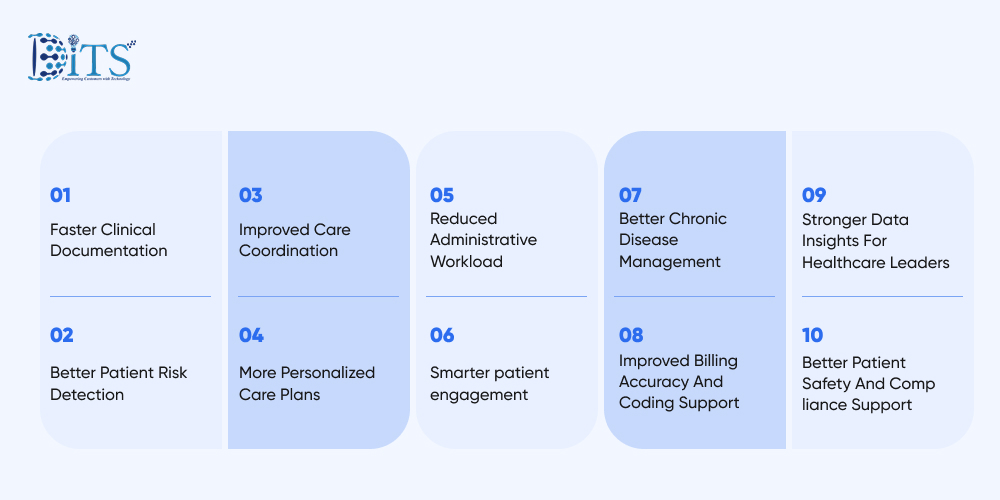
AI is becoming useful in healthcare because it solves practical problems, not because it sounds advanced. For clinics, the value sits in small daily improvements: fewer missed follow-ups, faster notes, cleaner billing details, better patient visibility, and less pressure on already busy teams.
The benefits of AI in EHR system become clearer when viewed through clinic operations. A good system does not replace clinical judgment. It supports it by organizing information, reducing repetitive work, and helping providers act before minor gaps turn into bigger issues.
For Canadian healthcare leaders, this matters because margins, staffing, patient access, and compliance all connect back to workflow quality. When the EHR works smarter, the clinic usually works better too.
1. Faster Clinical Documentation
Documentation is one of the biggest drains on clinic time. A doctor finishes the appointment, then spends a few extra minutes cleaning up notes, adding small details, checking the codes, and making sure the record is complete enough for the next follow up or billing. Multiply that by 25 or 30 patients a day and the load becomes kinda hard to ignore.
AI can make this lighter. With voice-to-text support, smart templates, auto-summaries, and visit note suggestions, an EHR can help providers record clinical information faster without starting from a blank screen every time.
For a Canadian clinic, this means:
- Less after-hours charting
- Faster patient visits
- More consistent notes
- Fewer missing details
- Lower documentation fatigue
The goal is not to rush care. It’s to stop documentation from stealing time that should belong to care.
2. Better Patient Risk Detection
AI can help care teams notice risks that are easy to miss on a busy clinic day. A physician might not have the time to look over every lab trend, any medication change, a missed appointment, and an old diagnosis before each visit. The EHR has all the data, but the signal is often buried, like it disappears in the noise.
With AI, the system can scan patient history and flag concerns such as climbing glucose levels, medication conflicts, forgotten screenings, recurring emergency visits, or unusual lab patterns. For clinics working with long term patients this can be extra helpful.
Like for example, a patient with hypertension comes in just for a routine prescription refill. The system may spot that the last few readings were gently increasing, their follow up was overdue, and a related lab test never got finished. Those kinds of alerts help the provider move earlier, not just react later.
This is one of the most practical benefits of AI in electronic health records. It gives clinicians better context before the patient’s condition becomes harder, and more expensive, to manage.
3. Improved Care Coordination
Care coordination often breaks down in small, ordinary moments. A lab result is reviewed late. A specialist note is hard to find. A patient repeats the same history to three different people. Nobody means for care to feel fragmented, but it happens when teams work across disconnected steps.
An AI powered EHR system can help coordination go smoother, sort of by putting the key information together before the provider even needs to look. Like it can summarize recent visits, point out pending tests, show the referral status , and even help the care teams see what has shifted since the last appointment.
Better coordination can help clinics reduce:
- Repeated tests
- Missed follow-ups
- Delayed referrals
- Incomplete patient history
- Gaps between virtual and in-person care
For healthcare leaders, the impact is simple. When teams spend less time piecing information together, they can spend more time moving care forward.
4. More Personalized Care Plans
Every patient record is like a story, but in a hectic clinic that story is not always easy to make sense of. For example, two patients may share the same diagnosis, yet their risk score, medication routines, lab movement, lifestyle details, and even the follow up timing can be quite different.
AI can make this part easier for clinicians because it can sort through history quicker than a person who is juggling everything else. It can look for patterns, then surface care prompts that fit the individual, based on what is actually in their file. Say a patient has diabetes, then it might flag a medication check, a foot exam reminder, extra nutrition support, or closer monitoring, since their latest numbers are drifting the wrong way.
Personalized care support may include:
- Preventive screening reminders
- Medication adherence insights
- Chronic disease care prompts
- Patient-specific follow-up suggestions
- Lifestyle-related risk indicators
The provider still makes the final decision. That part should never be outsourced to software. But when an EHR brings the right details forward at the right time, the consultation becomes more focused, and patients feel less like they are being moved through a standard checklist.
5. Reduced Administrative Workload
Clinic teams lose this surprising amount of time on work that seems kinda small, when you look at it by itself. You know, appointment reminders, intake form checks, referral sorting, billing details, follow-up messages, plus the constant patient queries… they each pull attention away from the higher-value tasks that actually move care forward.
AI can help with these workflows directly inside the EHR, by doing the routine steps more intelligently, not just “processing” but understanding the context a bit better. It can classify patient messages, flag incomplete forms, suggest a next action, and even help staff prioritize tasks by urgency, instead of everyone triaging the same thing over and over. That’s basically where EHR automation becomes really useful for clinics that want smoother operations, without immediately adding more admin staff.
A practical example is patient intake. Instead of asking staff to manually review every form, the system can highlight missing insurance details, medication updates, allergy changes, or symptoms that need attention before the visit begins.
6. Smarter Patient Engagement
Patients don’t always need a phone call. Sometimes they need a nudge, a plain instruction, a follow-up message, or quick access to their own health information. And when clinics try to do all of this completely by hand, the front desk ends up as the main bottleneck, you know, the pressure point.
AI-enabled EHR systems can help patient engagement with automated nudges, portal updates, message routing and more targeted follow-up communication. For instance, someone who just finished lab work might receive a secure notice to schedule a review visit, and another patient could get a reminder about an overdue screening, pretty simple.
This kind of support helps clinics stay in touch without swamping staff. It also boosts patients’ confidence since they are not left sort of stuck, wondering what comes next.
For Canadian healthcare providers, stronger engagement isn’t only about convenience. It can lower no-shows, increase follow-up adherence, and make care feel more coordinated from the patient’s side.
7. Better Chronic Disease Management
Chronic care is the place where little delays can turn real serious, kind of fast. A missed follow up, an ignored lab trend, or a medication issue might not feel urgent today, but six months later it can turn into a pricey intervention for the patient and for the clinic… and nobody really sees it coming at the time.
AI can still help clinicians handle long term conditions with more consistency. For people dealing with diabetes, hypertension, asthma, heart disease, or mental health concerns, the EHR can watch patterns and flag care gaps before they get tougher to manage.
Some useful capabilities, may look like:
- Trend tracking for vitals and lab results
- Follow up reminders for high risk patients
- Care gap alerts
- Risk scoring from patient history
- Patient specific dashboards for providers
This is one of the stronger benefits of AI in electronic health records, because ongoing chronic disease care relies on continuity. The system supports clinics keeping patients in view between visits, not only when they’re parked in the exam room.
8. Improved Billing Accuracy and Coding Support
Billing issues often start with small documentation gaps. A missing detail in the visit note, an unclear diagnosis, or incomplete service information can create delays, rework, and avoidable revenue leakage.
AI can support billing teams by reviewing clinical documentation and suggesting relevant codes, missing fields, or claim-related inconsistencies before submission. It doesn’t remove the need for human review, but it gives staff a cleaner starting point.
For Canadian clinics, this can help with:
- More complete visit documentation
- Fewer manual coding checks
- Faster billing review
- Reduced administrative back-and-forth
- Better revenue cycle visibility
Nobody likes chasing corrections after the fact. When billing support is built into the EHR workflow, clinics can catch issues earlier and keep financial operations more predictable.
9. Stronger Data Insights for Healthcare Leaders
Clinic leaders need more than patient records, they kinda need visibility too. Like really, which services are growing, where no shows are quietly hurting revenue, which providers are getting overloaded, and which patient groups need extra follow up soon.
The use of AI in healthcare can take EHR data and turn it into useful business insights, instead of leaving administrators to pull reports, manually, at month end. A good system can show patient volume trends , common diagnoses, appointment gaps, referral delays, billing patterns, and care demand, across different locations.
That sort of visibility helps management make better choices about staffing, service planning, patient outreach , and even technology investment. And for clinics that are growing, stronger analytics can also back smarter expansion planning, especially when leaders are comparing demand across various regions, or specialties , without guessing.
That’s one reason many providers now look at ehr software development canada as a strategic investment, not just a technical upgrade.
10. Better Patient Safety and Compliance Support
Patient safety kinda depends on the details being visible at the right moment. A missed allergy, a duplicate medication, a delayed lab result, or even an incomplete history can create serious risk, even when the care team is really experienced.
AI can help support safer decisions by flagging unusual patterns , medication conflicts, abnormal test results, and gaps in clinical information. It can also help maintain audit trails, role-based access, and secure workflows that match Canadian privacy expectations .
For providers, this is where AI has to be handled carefully. Speed is useful , but trust matters more. The system should assist clinicians, not drown them in needless alerts or recommendations that are vague.
Good design matters here.
A safe AI-powered EHR should provide:
- Clear alerts
- Explainable recommendations
- Secure access controls
- Proper consent handling
- Audit-ready activity logs
- Human review for clinical decisions
Used well, AI becomes a safety net. Not a replacement for judgment, but a second layer of attention when teams are busy.
Key Features To Include In AI-Powered EHR System
Every clinic does not need the same EHR setup. A family practice, multi-specialty clinic, diagnostic centre, and virtual care provider will all have different workflows. Still, some features create value across most healthcare environments.
| Feature | Business Value for Clinics |
| AI clinical documentation assistant | Reduces note-taking time and improves record consistency |
| Predictive analytics dashboard | Helps identify risks, care gaps, and patient trends |
| Patient portal | Improves communication, access to records, and follow-up |
| E-prescribing support | Reduces prescription errors and speeds up medication workflows |
| Lab and imaging integration | Gives providers faster access to diagnostic information |
| Appointment and referral management | Improves scheduling, tracking, and care coordination |
| Billing and coding support | Reduces documentation gaps and billing delays |
| Secure data sharing | Supports collaboration across care teams |
| Role-based access control | Protects sensitive patient information |
| Reporting and compliance tools | Helps leaders monitor operations and meet privacy requirements |
When clinics are swapping out outdated systems, this is also a pretty good time to think about legacy app modernization. A lot of providers dont really need to toss everything completely. Often the wiser move is to enhance what’s already running—adjust existing workflows, and then layer in AI where it actually fits, instead of ripping up the whole operation all at once.
A cloud-based EMR and EHR platform can also assist growing healthcare groups with access control, scalability, reporting, and multi location operations, in a smoother way. The main point is to shape the solution around real clinic workflows, not around some generic software template, even if it looks neat on paper.
How DITS Can Help Canadian Healthcare Providers Build AI-Enabled EHR Solutions
AI in healthcare software shouldn’t feel like some extra module that got bolted on just because it’s trendy . Instead it really should help with a live operational pain point, whether that pain is sluggish documentation, missed follow ups, scattered patient data or limited reporting visibility.
DITS helps healthcare companies plan , design, and build EHR solutions that actually match their clinical and administrative rhythms. That can mean custom EHR software development, AI integration into existing systems, patient portal creation, healthcare workflow automation, analytics dashboards, third party integrations, and a secure architecture for sensitive health information.
If providers are also planning healthcare app development while they modernize their EHR, DITS can additionally support connected patient facing tools like appointment booking, secure messaging, medication reminders, digital forms, and follow up management.
At DITS, we use AI in our own software process too, for things like software development, quality assurance, code quality maintenance, and customization. But more importantly we weave AI into each solution we ship when it brings real business value. With that direction , healthcare teams can go past surface level automation and build tools that are easier to operate, simpler to keep up, and ready to scale.
For Canadian clinics exploring AI in healthcare, a smart place to begin is usually not a huge overhaul effort. It starts with one clearly defined workflow issue. Get it right, review the outcomes , then broaden from there.
Need Smarter Electronic Health Record Solutions Today?
Build AI-enabled EHR platforms that support faster documentation, clinical decision-making, and improved healthcare operational efficiency across organizations.
Final Thoughts
The real value of AI in EHR systems is not about making clinics look more advanced. It is about helping care teams work with less friction and better information.
The benefits of AI in healthcare EHR system become visible in daily operations: faster notes, fewer missed follow-ups, cleaner billing, better chronic care tracking, stronger reporting, and safer patient management. These are not abstract improvements. They affect patient experience, staff workload, revenue stability, and leadership decision-making.
For Canadian healthcare providers, the smartest path is to start with the workflows causing the most pressure. Documentation. Referrals. Billing. Chronic disease follow-up. Patient engagement. Once the pain point is clear, AI can be added with purpose instead of guesswork.
That is how technology earns its place in a clinic. Quietly, practically, and with measurable impact.
FAQs
What’s AI in EHR systems?
AI in EHR systems means using artificial intelligence inside electronic health record platforms, to sift through patient data, do the everyday busywork, assist with documentation, spot medical risks, and support clinicians with quicker decisions. it’s like a quiet layer in the background.
How can AI improve EHR systems for Canadian clinics?
AI can help by cutting down manual charting, flagging patients who might need attention, backing up follow-ups, improving billing accuracy, and giving clinic leaders a clearer view of how things are running day to day. For Canadian clinics, that typically means less workload, while care quality stays where it should be.
Can AI powered EHR systems help reduce physician burnout?
Yes , they can, if the setup is done properly. A big contributor to burnout is administrative pressure, and a lot of that is the after-visit documentation. AI assisted notes, brief summaries, and task automation can take off some of that weight so physicians don’t end up spending so much time on repetitive tasks
Is AI in EHR safe for patient data?
Well it can be, as long as the whole system is built around strong privacy controls, secure access, audit trails, consent management, plus some kind of human review at key points. For Canadian providers, compliance and data governance should not be an afterthought, it really needs to be part of the design from day one, even at the start.
Can small clinics in Canada benefit from AI-enabled EHR software?
Yes, and honestly, they might benefit more than larger teams sometimes. Small clinics usually have fewer people, and workflows can be tighter, so AI for scheduling, reminders, documentation assistance, follow-ups, and reporting can feel like a good shortcut without turning everything into extra complexity.
How can DITS help with AI-powered EHR development?
DITS can support Canadian healthcare providers with EHR planning, AI integration, patient portal development secure data architecture, automation workflows, analytics dashboards, and EHR software development canada projects shaped around real clinic operations, not just theory on a slide, you know.

Nidhi Thakur
With more than 19 years of experience - I represent a team of professionals that specializes in the healthcare and business and workflow automation domains. The team consists of experienced full-stack developers supported by senior system analysts who have developed multiple bespoke applications for Healthcare, Business Automation, Retail, IOT, Ed-tech domains for startups and Enterprise Level clients.
Recent Posts
Explore how prior authorization software uses AI to automate workflows, reduce administrative effort, improve request accuracy, streamline approvals, and minimize treatment delays for healthcare organizations.
Discover how AI to improve patient experience in hospitals streamlines scheduling, communication, triage, queue management, and personalized care while enhancing operational efficiency.

Learn how IoT powers smart factories with connected devices, automation, predictive maintenance, and analytics.