How Agentic AI Applications in Manufacturing Improve Efficiency in Canada
Table Of Content
Published Date :
16 Apr 2026
Key Takeaways
- Manufacturing uses agentic AI systems to make decisions in real time.
- The system uses AI technology to enhance operational speed and efficiency while maintaining system reliability.
- Production scheduling now operates as a flexible dynamic system.
- The system experiences major reductions in operational downtime.
- The implementation of AI automation on production lines results in higher production efficiency.
- The system experiences fewer operational constraints.
- Supply chains experience improved ability to handle changes.
- Companies that adopt new technologies before their competitors establish market dominance.
Introduction
The Canadian manufacturing sector has long been a cornerstone of the national economy, but today, it faces a complex web of challenges: skilled labor shortages, fluctuating supply chains, and mounting pressure to reduce operational expenses.
The manufacturing sector has used artificial intelligence as a tool to improve efficiency since it started, but the production process now moves towards practical application through Agentic AI, which serves as the newest technical advancement.
Agentic AI systems enable users to create independent decision-making systems which can handle complex tasks while solving problems that need immediate solutions.
This blog breaks down where agentic AI applications in manufacturing create value, how they improve efficiency, and what it takes to implement them successfully in the Canadian manufacturing industry.
Why Canadian Manufacturers are Adopting Agentic AI
Across Canada, manufacturing leaders are facing a difficult equation. Output expectations are rising, yet resources are tightening. And traditional systems? They are struggling to keep up.
A plant manager in Ontario recently shared a familiar challenge. Orders were fluctuating weekly, labor availability was inconsistent, and legacy systems could not respond fast enough. The result was missed timelines and rising operational stress. This is exactly where agentic AI in manufacturing starts to shift the equation.
Several factors are accelerating adoption:
- The current labor market crisis has developed into a permanent situation. Finding skilled workers has become more difficult because training programs require multiple months and sometimes years to complete.
- The organization experiences increasing operational expenses which affect energy costs and logistics expenses. The organization now experiences financial losses from small operational inefficiencies which have developed into major cost problems.
- Organizations need to make decisions based on real-time information because it has become a critical need. The existing static planning models of the organization cannot handle unexpected operational interruptions.
- Digital transformation efforts receive support from government programs which drive manufacturing companies to implement advanced technological solutions.
Many organizations have already automated its processes through investments yet their systems function as separate entities. The systems complete their assigned duties without extending their capabilities for additional work.
Agentic AI changes that. It connects data sources and interprets contextual information while executing tasks without requiring human control. The introduction of this layer leads to a transformation because operational processes become more efficient through organized management.
Turn Manufacturing Complexity into Real-Time Efficiency
Unlock smarter production with agentic AI systems that adapt, decide, and optimize in real time.
Key Areas Where Agentic AI Applications in Manufacturing Improve Efficiency
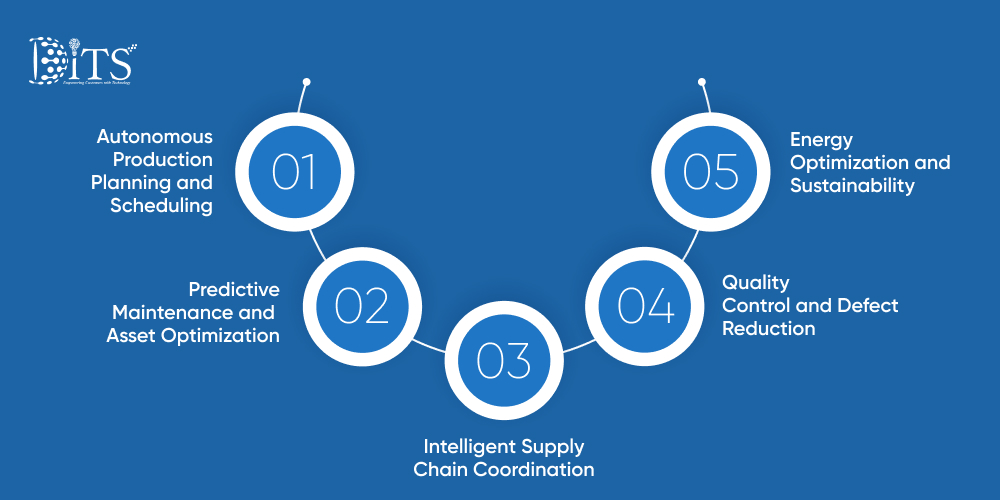
This process enables organizations to transform their abstract ideas into tangible results. Once deployed correctly, agentic systems start influencing day-to-day operations in ways that are difficult to ignore.
1. Autonomous Production Planning and Scheduling
Agentic systems maintain continuous schedule updates, which depend on current machine status and available workforce and the sequence of production orders. The manufacturing a sector can achieve better operational efficiency through three alternatives instead of using fixed production strategies.
- Reallocate resources dynamically
- Minimize idle time across production lines
- Improve throughput without increasing headcount
Production lines that employ AI automation achieve operational cost reductions when their scheduling efficiency improves by 5 to 10 percent.
2. Predictive Maintenance and Asset Optimization
Agentic AI provides equipment supervision through its continuous monitoring system. The system identifies potential equipment failures through its advanced detection capabilities. The system provides both alerts and recommended actions for users.
- The system predicts equipment failures with a time range between days and weeks.
- The system enables users to plan their maintenance during periods which have minimal impact.
- The system enables organizations to prolong their equipment operational periods.
AI-powered production optimization reaches its effective use stage. The system allows maintenance teams to move from emergency response work to scheduled maintenance activities.
3. Intelligent Supply Chain Coordination
The Agentic systems operate through their real-time assessment of supplier performance and inventory levels and demand shifts. The system executes decisions immediately without waiting for the weekly assessment process to complete.
- Adjust procurement strategies automatically
- Reduce overstocking and stockouts
- Improve lead time accuracy
Many organizations are now exploring Agentic AI in supply chain management to create more resilient and responsive networks. The outcome is simple. Fewer disruptions. Better control.
4. Quality Control and Defect Reduction
The AI systems which operate with agentic capabilities, perform ongoing monitoring of production parameters. The systems identify anomalies at the moment of their occurrence instead of waiting for inspection to occur.
- The production process requires early detection of defects which will help maintain product quality.
- The process requires organizations to work on reducing both rework and scrap materials.
- The process requires organizations to establish uniformity in their production results.
The implementation of AI-driven manufacturing systems enables organizations to achieve continuous quality assessment throughout their production process.
5. Energy Optimization and Sustainability
The agentic systems follow the energy usage patterns which occur throughout different machines and work shifts and operational activities. The systems discover hidden operational weaknesses through their assessment.
- The process requires organizations to determine machine requirements for both their busy and silent periods.
- The process eliminates energy waste because it maintains production levels.
- The organization requires its operations to follow environmental, social, and governance requirements.
The solution helps Canadian manufacturing companies fulfill their environmental obligations while achieving better financial results.
Real-World Use Cases in Manufacturing
Let’s step into a few real scenarios across Canada where these systems are quietly reshaping operations.
Automotive Sector: Smart Assembly Lines
In Ontario’s automotive belt, production lines are becoming far more adaptive. Instead of fixed sequences, agentic systems adjust workflows based on real-time conditions.
If a component delivery is delayed, the system reshuffles production priorities instantly.
- Assembly lines keep moving despite disruptions
- Output consistency improves across shifts
- Downtime caused by dependencies is reduced significantly
And here’s the kicker. Even a 2-hour delay avoided per week can save thousands in operational costs.
Food Processing: Automated Quality Checks
Agentic AI continuously monitors variables such as temperature, humidity, and processing time. When deviations occur, corrective actions are triggered immediately.
- Real-time quality validation instead of post-process inspection
- Reduced waste and fewer rejected batches
- Faster compliance reporting
This is also where AI transforming product development starts to play a role. Insights gathered during production help refine recipes, packaging, and shelf-life strategies.
Heavy Industries: Predictive Maintenance at Scale
Agentic systems analyze equipment data across multiple facilities. They identify patterns that humans might miss.
- Predict failures across distributed assets
- Optimize maintenance schedules across plants
- Reduce emergency repair costs
Some organizations have reported up to 20–25% reduction in unplanned downtime after implementing such systems over a 12-month period.
Across all these use cases, one pattern stands out. Efficiency gains are not coming from one big change. They are coming from hundreds of small, intelligent decisions made every hour.
And once that system is in place, operations start running with a level of predictability that wasn’t possible before.
Drive Faster Decisions Across Your Production Floor
Empower your manufacturing systems to respond instantly to changes in demand, supply, and operations. With agentic AI, eliminate delays, reduce inefficiencies, and stay ahead in a competitive market.
Business Benefits of Agentic AI In Manufacturing
At some point, every leadership team asks the same question. Does this actually move the needle?
With agentic systems, the answer tends to show up faster than expected. Not always dramatic at first, but consistent. And then the gains begin to stack.
Key Business Outcomes:
| Area | Impact On Operations |
| Operational Efficiency | Improved throughput without adding extra resources |
| Cost Control | Reduction in waste, downtime, and manual interventions |
| Decision Speed | Faster responses to disruptions and demand changes |
| Workforce Productivity | Teams focus on higher-value tasks instead of repetitive coordination |
| Scalability | Systems adapt as production volumes increase |
What This Looks Like in Practice
- Production cycles become shorter because decisions are made in real time
- Costs reduce not through cuts, but through smarter operations
- Managers spend less time firefighting and more time planning
Here’s something many companies don’t expect. The biggest gains often come from removing small inefficiencies. A few minutes saved per process. A few errors avoided per shift. Over a year, that compounds into measurable financial impact.
Best Practices for Successful Implementation of Agentic AI in Manufacturing
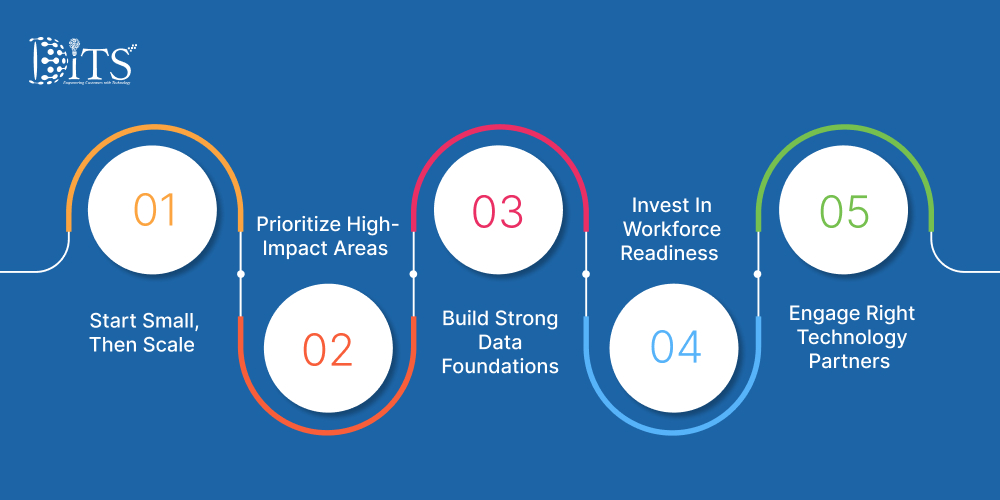
The implementation of intelligent systems looks promising yet most projects experience delays during their execution phase. The system fails to function not because the technology fails but because the method used lacks proper definition.
Start Small, Then Scale
Choose a single use case to begin your project. The team uses predictive maintenance at one facility to assess results while maintaining normal operational processes. The process becomes more organized when organizations prove their value.
Prioritize High-Impact Areas
Choose a single use case to begin your project. The team uses predictive maintenance at one facility to assess results while maintaining normal operational processes. The process becomes more organized when organizations prove their value.
Build Strong Data Foundations
The organization should not transform every process at this time. The team should begin their work in areas where they can demonstrate direct financial benefits through improved operational performance. The two fields of production scheduling together with supply chain coordination provide businesses with increased financial benefits that become easily identifiable.
Invest In Workforce Readiness
Change happens through technology implementation. The operational teams require training on system functionality along with their daily task execution. The organization requires training together with change management processes to achieve sustained success.
Engage Right Technology Partners
This is where experienced AI consulting providers become important. The appropriate partner does not stop at system implementation. They create solutions which match business needs while delivering results which can be evaluated through their use.
Why Choose DITS For Agentic AI Manufacturing Solutions
The DITS approach goes beyond deployment because it establishes technological alignment with the operational practices of manufacturing businesses.
Deep Expertise in AI Integration for Industrial Environments
Manufacturing systems require multiple machines and legacy systems and data sources to work together for their operation. DITS ensures smooth AI integration throughout various environments by creating intelligent systems that work with current business operations without causing disruptions.
Custom-Built Solutions Aligned with Manufacturing Workflows
Off-the-shelf solutions often fail to address specific operational challenges. DITS develops tailored systems that align with production processes, supply chain structures, and business priorities. Agentic AI applications in manufacturing deliver practical outcomes which companies can measure because they operate as intended.
Strong Focus on Scalability, Security, And Performance
Manufacturing operations function as essential services which require continuous operation without interruptions or system breakdowns.
The system provides scalable solutions which uphold the same operational efficiency and data protection standards as production increases. The process becomes essential when operations spread out to various locations throughout their facilities.
AI Embedded Across Development Lifecycle
At DITS, AI functions as a central component which developers use throughout their entire software building process.
- AI-assisted development improves speed and accuracy
- Intelligent testing systems enhance the efficiency of quality assurance procedures.
- The system continuously tracks code quality while making improvements.
- The process of customization now proceeds with greater speed and accuracy.
Our solutions are constructed to provide operational efficiency and dependable performance that meets your business objectives for the future.
Conclusion
The current state of manufacturing efficiency needs complete system solutions which operate as adaptive learning systems that provide instantaneous responses to operational needs.
The transformation of manufacturing processes through agentic AI applications shows their value as complete automation systems. The technology enables more effective planning process while decreasing operational barriers and delivering higher levels of system adaptability compared to existing solutions.
Canadian manufacturers have a clear path to success. The companies that implement their plans through controlled testing which they expand according to their targets have started to achieve better results in productivity and cost management and faster decision making.
The situation has a hidden problem. Technology implementation does not ensure success for organizations. Technology will succeed when organizations use it to meet their business objectives through their established procedures and workforce.
Organizations that achieve optimal balance between two opposing forces will attain two benefits. The organization will enhance operational performance while establishing new standards for future manufacturing processes.
FAQs
What are agentic AI applications in manufacturing?
Agentic AI applications in manufacturing refer to intelligent systems that can make decisions, adapt to changing conditions, and execute tasks without constant human input. The systems use continuous learning together with data analysis to enhance their operational activities, which include production planning and maintenance work and quality control processes.
How is agentic AI different from traditional automation?
Traditional automation systems operate according to fixed rules to perform specific tasks that they repeat again and again. Agentic AI systems use real-time data analysis to create context-relevant solutions while they evolve their operational methods in response to changing conditions. This system enables manufacturers to enhance their operational efficiency through faster responses to production interruptions.
Is agentic AI suitable for small and mid-sized manufacturers in Canada?
The adoption process has expanded beyond its initial focus on large enterprises. Small and mid-sized manufacturers can begin their operations through targeted use cases such as predictive maintenance or scheduling optimization when they implement the correct implementation plan.
How can DITS agentic AI software development support manufacturing businesses?
DITS Agentic AI software development builds customized solutions that match manufacturing operations. DITS provides complete support to businesses, starting from the integration of intelligent systems into their production facilities until they achieve their desired business results through performance and capacity optimization.
Why should businesses consider DITS agentic AI software development for long-term growth?
DITS Agentic AI software development creates enduring value through its method which uses artificial intelligence throughout the software development process from initial design to final monitoring. The process includes three stages development and quality assurance and continuous optimization to create solutions which maintain their ability to grow and their operational dependability while meeting changing business requirements.

Dinesh Thakur
21+ years of IT software development experience in different domains like Business Automation, Healthcare, Retail, Workflow automation, Transportation and logistics, Compliance, Risk Mitigation, POS, etc. Hands-on experience in dealing with overseas clients and providing them with an apt solution to their business needs.
Recent Posts
Explore how prior authorization software uses AI to automate workflows, reduce administrative effort, improve request accuracy, streamline approvals, and minimize treatment delays for healthcare organizations.
Discover how AI to improve patient experience in hospitals streamlines scheduling, communication, triage, queue management, and personalized care while enhancing operational efficiency.
Learn how IoT powers smart factories with connected devices, automation, predictive maintenance, and analytics.