Average Cost of Digital Transformation in Canada
Table Of Content
Published Date :
25 Mar 2026
Key Takeaways
- Average cost of digital transformation in Canada typically ranges from $50,000 to $800,000+
- Cost of digital transformation increases with integrations, compliance, and customization needs
- Phased implementation helps control budget and reduce risks
- Hidden costs like training and data migration can impact overall investment
- Industry type significantly influences cost structure and timelines
- Choosing the right technology partner improves cost efficiency
Digital transformation that was once a topic of discussion in boardroom meetings has now become an operational necessity across Canada. Logistic firms in Toronto and healthcare providers in Vancouver are already experiencing this shift. But one question keeps coming up in executive meetings. What is the average cost of digital transformation?
The cost of digital transformation in Canada ranges between $50,000 and $800,000 depending on business size, system complexity, and integration requirements. And that’s just the visible part. Hidden variables such as integrations, compliance, and scaling often reshape budgets midway.
For companies operating in Canada, the challenge is not just budgeting but understanding where the investment actually goes and how to control it without slowing progress.
This blog shares the key factors that influence average cost of digital transformation and tips to optimize that cost by partnering with the right development team.
What Digital Transformation Means for Canadian Businesses
For most Canadian companies, digital transformation is less about adopting new technology and more about fixing what is already slowing them down. A manufacturing firm might struggle with disconnected production data, a retail chain may face delays due to outdated inventory systems. These are not technology problems but operational bottlenecks.
At its core, transformation involves aligning systems, processes, and data to work together seamlessly. This includes:
- Replacing outdated platforms through legacy application modernization services
- Automating repetitive workflows
- Integrating data across departments
- Moving infrastructure to scalable environments
Some businesses take a phased approach, starting with one department. Others go all in, redesigning entire operations. Both paths work, but the investment and complexity differ significantly.
Companies that treat it as a one-time upgrade often end up spending more later fixing gaps they missed early on.
Average Cost of Digital Transformation in Canada
When it comes to the average cost of digital transformation in Canada, business executives usually expect a benchmark. Something concrete, but in reality, costs stretch across a wide spectrum depending on business size, industry, and transformation depth.
Here is a practical breakdown based on real-world implementations across Canadian markets:
| Business Size | Estimated Investment Range | Typical Timeline | Complexity Level |
| Small Businesses | $50,000 to $120,000 | 3 to 6 months | Basics |
| Mid-Sized Companies | $120,000 to $350,000 | 6 to 12 months | Moderate |
| Large Enterprises | $350,000 to $800,000+ | 12 to 24 months | High |
A mid-sized logistics company, for instance, may invest around $200,000 to unify fleet tracking, automate dispatching, and integrate reporting dashboards. On the other hand, a hospital network could easily cross $500,000 due to compliance-heavy systems and integrations tied to digital transformation in healthcare.
But numbers alone don’t tell the full story. The real cost of digital transformation depends on how deeply systems are interconnected and how many moving parts need to be aligned.
According to McKinsey, companies that approach digital transformation with structured planning can reduce implementation costs by up to 30 percent while improving delivery timelines. Deloitte also highlights that organizations with clear transformation roadmaps are significantly more likely to achieve positive ROI within the first year.
That’s why two companies with similar revenue can end up with completely different budgets.
How Much Does Digital Transformation Cost in Canada
The cost of digital transformation in Canada depends on multiple factors including business size, technology stack, and operational complexity. While small businesses may spend under $100,000, enterprise level transformations can exceed $800,000 when advanced integrations and compliance requirements are involved.
Digital Transformation Pricing for Enterprises
Enterprise digital transformation pricing typically depends on scale, AI integrations, and compliance requirements. Large organizations often invest above $350,000 as they require system-wide integration, advanced analytics, and secure infrastructure across multiple departments.
Are You Overspending on Digital Transformation Efforts?
Uncover hidden cost drivers and identify where your budget may be leaking across systems, integrations, and operational inefficiencies.
Key Cost Drivers Influencing Digital Transformation Investment
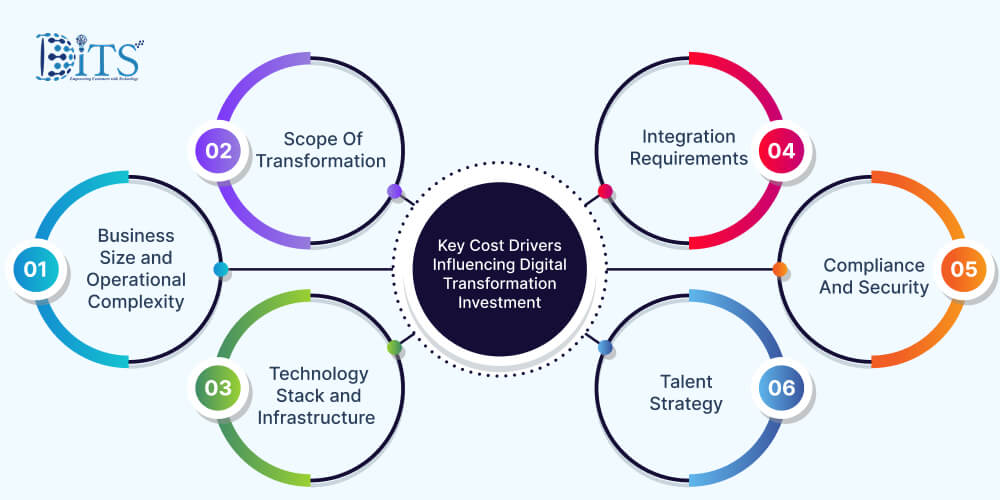
Understanding cost without context leads to poor planning. The real insight comes from knowing what drives the numbers up or down.
Business Size and Operational Complexity
Organisations with multiple departments, locations, and workflows naturally require more integration effort. A company operating across Toronto, Calgary, and Ottawa will face higher coordination and system alignment costs than a single-location business.
Scope Of Transformation
Some companies only digitize one process, such as inventory management. Others redesign their entire ecosystem. The wider the scope, the higher the investment.
Technology Stack and Infrastructure
Choosing between custom-built systems and pre-built platforms significantly impacts cost. Custom solutions offer flexibility but require higher upfront investment.
Integration Requirements
Existing systems rarely work in isolation. Integrating CRMs, ERPs, and third-party tools often becomes one of the most expensive components.
Compliance And Security
Industries such as healthcare and finance in Canada require strict regulatory compliance. This increases development time, testing, and documentation costs.
Talent Strategy
Building in-house teams versus partnering with a vendor for digital transformation consulting changes both cost and execution speed. Many companies prefer external partners to avoid long hiring cycles.
Cost Breakdown by Digital Transformation Components
Breaking down investment areas helps executives see where the budget actually flows. It also highlights where optimization is possible.
Software Development and Custom Platforms
This includes CRM systems, ERP platforms, and internal tools tailored to business operations. Companies working with an AI software development company often invest more upfront but gain efficiency in automation and analytics.
Cloud Infrastructure and Migration
Moving systems to cloud environments improves scalability but involves migration planning, data transfer, and security configuration.
Data Management and Analytics
Building dashboards, reporting systems, and centralized data platforms ensures better decision-making but requires structured data pipelines.
Automation and Workflow Optimization
This is where business workflow automation starts delivering real value. Repetitive tasks such as approvals, reporting, and scheduling get streamlined, reducing manual effort significantly.
Ongoing Maintenance and Support
Post-deployment costs are often underestimated. Systems require continuous updates, monitoring, and enhancements to stay relevant.
Interestingly, companies that allocate 15 to 20 percent of their budget for ongoing support tend to avoid long-term operational disruptions.
Estimated digital transformation cost based on business size
Businesses can estimate their transformation budget based on operational scale:
- Companies with under 50 employees usually invest between $50,000 and $120,000
- Businesses with 50 to 250 employees typically spend between $120,000 and $350,000
- Enterprises with over 250 employees often require $350,000 or more depending on complexity
This estimation helps leadership teams align expectations before engaging in detailed planning.
Hidden Costs Businesses Often Overlook
Nobody plans for hidden costs, yet they show up in almost every transformation initiative.
- Employee training and onboarding slowdowns
- Temporary productivity drops during system transitions
- Data migration errors requiring rework
- Scaling costs when user adoption increases faster than expected
- Vendor dependency leading to higher long-term expenses
A retail company in Montreal once delayed its rollout by three months simply because staff training was underestimated. The technology worked perfectly. Adoption did not.
That’s the part most budgets fail to capture.
What Should Your Transformation Budget Actually Look Like?
Get a tailored cost estimate based on your business size, industry, and transformation goals without relying on generic benchmarks.
Industry Wise Cost Considerations of Digital Transformation in Canada
Different industries approach transformation with different priorities, which directly impacts cost structures.
- Healthcare organisations face higher costs due to compliance requirements and integration with clinical systems. This is why digital transformation in healthcare often involves longer timelines.
- Manufacturing companies focus heavily on operational efficiency, often integrating IoT to monitor equipment and production lines in real time.
- Retail and eCommerce businesses invest more in customer experience platforms, inventory synchronization, and omnichannel systems.
- Logistics companies prioritize real-time tracking, route optimization, and predictive analytics to improve delivery performance.
Each sector brings its own complexity, and therefore, its own cost curve.
Digital transformation cost in Canada vs United States
Digital transformation costs in Canada are generally lower compared to the United States due to differences in development costs and operational structures. However, compliance requirements and enterprise scale projects can bring Canadian costs closer to US benchmarks in regulated industries such as healthcare and finance.
| Factor | Canada | United States |
| Average Cost Range | $50,000 to $800,000+ | $70,000 to $1,000,000+ |
| Development Cost | Moderate | High |
| Compliance Impact | High in healthcare and finance | Very high across industries |
| Talent Cost | Lower compared to US | Higher due to market demand |
Is Your Business Ready for Cost-Effective Transformation?
Evaluate your current systems, workflows, and readiness to ensure your transformation journey delivers measurable ROI from day one.
Why Choose DITS For Digital Transformation Services in Canada
Choosing the right partner often determines whether transformation delivers results or becomes an expensive experiment.
DITS brings a structured approach, combining strategy, development, and integration under one roof. With experience across industries, including healthcare, logistics, and manufacturing, the focus remains on building solutions that align with real business needs.
What sets DITS apart is the use of AI across development processes. From software development and quality assurance to code optimisation and customisation, AI is integrated into every solution to improve performance and reduce long-term maintenance effort.
For Canadian companies navigating complex transformation journeys, having a partner who understands both cost control and scalability makes a measurable difference.
Want Expert Guidance on Your Transformation Strategy?
Connect with experienced professionals to align your digital transformation roadmap with business goals, cost control, and scalable execution.
Conclusion
The average cost of digital transformation is not just a number. It is a reflection of business priorities, operational complexity, and long-term vision.
Companies that approach it with clarity tend to stay within budget and achieve measurable outcomes. Those that rush in without planning often face delays, cost overruns, and missed opportunities.
The goal is not to spend less. It is to spend wisely. Because in the end, transformation is not about technology. It is about building a business that is ready for what comes next.
The average cost of digital transformation in Canada ranges from $50,000 to $800,000 depending on scope, integrations, and business complexity. Companies that adopt phased implementation and focus on high impact areas tend to achieve better ROI while controlling costs effectively.
FAQs
What is the average cost of digital transformation for a mid-sized business in Canada?
For mid-sized companies, the average cost of digital transformation typically ranges between $120,000 and $350,000. The final investment depends on system complexity, integration needs, and how many business functions are being transformed.
How long does a digital transformation project usually take?
Most projects take anywhere between 6 to 12 months for mid-sized businesses, while larger enterprise transformations can extend beyond 18 months. Timelines depend on scope, internal readiness, and data migration requirements.
Can small businesses in Canada afford digital transformation?
Yes, small businesses can start with focused initiatives such as workflow automation or system upgrades. A phased approach helps control costs while still delivering measurable operational improvements.
How can DITS digital transformation services help reduce overall costs?
DITS digital transformation services focus on building scalable and efficient systems from the start, which reduces rework, minimizes downtime, and avoids unnecessary technology investments. Their structured approach ensures better cost control throughout the transformation journey.
What industries in Canada benefit the most from digital transformation?
Industries such as healthcare, manufacturing, logistics, and retail see significant benefits due to improved efficiency, better data visibility, and enhanced customer experience.
Why should businesses choose DITS digital transformation services over in-house development?
DITS digital transformation services provide access to experienced teams, proven frameworks, and AI-driven development practices, which help accelerate implementation while maintaining high quality and long-term scalability.
What are the biggest risks during digital transformation?
Common risks include poor planning, underestimating integration complexity, lack of employee adoption, and ignoring ongoing maintenance needs. Addressing these early helps prevent costly delays and operational disruptions.
Is digital transformation expensive for startups in Canada?
Digital transformation for startups can be cost effective when approached in phases. Many startups begin with automation and cloud adoption, which keeps initial costs lower while still delivering operational improvements.

Dinesh Thakur
21+ years of IT software development experience in different domains like Business Automation, Healthcare, Retail, Workflow automation, Transportation and logistics, Compliance, Risk Mitigation, POS, etc. Hands-on experience in dealing with overseas clients and providing them with an apt solution to their business needs.
Recent Posts

Explore how prior authorization software uses AI to automate workflows, reduce administrative effort, improve request accuracy, streamline approvals, and minimize treatment delays for healthcare organizations.

Discover how AI to improve patient experience in hospitals streamlines scheduling, communication, triage, queue management, and personalized care while enhancing operational efficiency.

Learn how IoT powers smart factories with connected devices, automation, predictive maintenance, and analytics.