A Complete Breakdown of Patient Portal Software Cost
Table Of Content
Published Date :
02 Apr 2026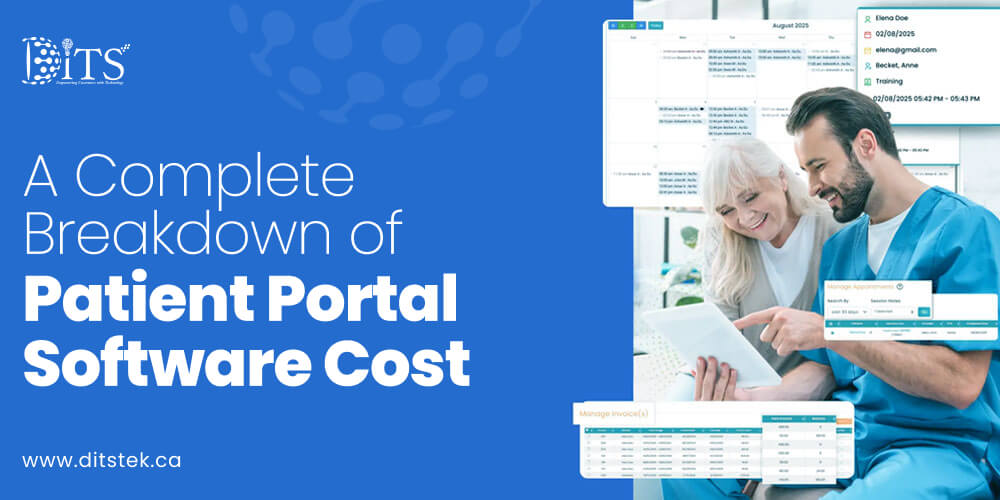
Key Takeaways
- Patient portals are becoming essential for healthcare providers in Canada.
- Costs vary based on features, integrations, and compliance needs.
- Customization significantly increases overall investment.
- Integration with legacy systems adds complexity and cost.
- Compliance requirements cannot be ignored or minimized.
- Design and accessibility impact adoption and efficiency.
- Maintenance and support create ongoing expenses.
- Hidden costs often affect final project budget.
- Build vs buy decision impacts long-term ROI.
- Scalable solutions reduce future system replacement costs.
Healthcare delivery in Canada is shifting faster than most providers anticipated. According to a report by StatsCan, over 50% of patients now have digital access to their health information and services, reflecting a clear move toward connected care systems.
This growing expectation, combined with strict regulatory frameworks and operational pressure, has made patient portals less of an upgrade and more of a necessity. Clinics that once relied on phone calls and manual records are now rethinking their entire engagement model.
While the benefits are clear, understanding the patient portal software cost often becomes the biggest roadblock. Decision makers need the cost clarity before building a patient portal.
This blog breaks it down in practical terms so healthcare providers can evaluate costs, and plan before deciding to invest in a patient portal software.
Business Benefits of Patient Portal Software
Patient portal software empowers healthcare organizations to streamline patient engagement while improving operational efficiency and care outcomes. By centralizing communication, records access, and service interactions into a single digital interface, providers reduce administrative burden and enhance patient satisfaction.
These platforms enable real-time data exchange, support compliance requirements, and create a more transparent care journey. From appointment scheduling to secure messaging and billing access, patient portals bridge gaps between patients and providers, ultimately driving better retention, improved clinical workflows, and scalable healthcare delivery in an increasingly digital-first environment.
Business Benefits:
- Reduces administrative workload through automation of routine tasks
- Improves patient engagement and retention with self-service access
- Enhances revenue cycle via faster payments and billing transparency
- Minimizes no-shows with automated reminders and scheduling tools
- Strengthens data security and compliance with controlled access
- Enables better clinical outcomes through continuous patient interaction
- Supports scalability with centralized digital infrastructure
Ready To Build A Scalable Patient Portal Solution?
Understand the exact roadmap, features, and budget required to build a future-ready patient portal aligned with your healthcare operations.
Factors That Influence Patient Portal Software Cost of Development
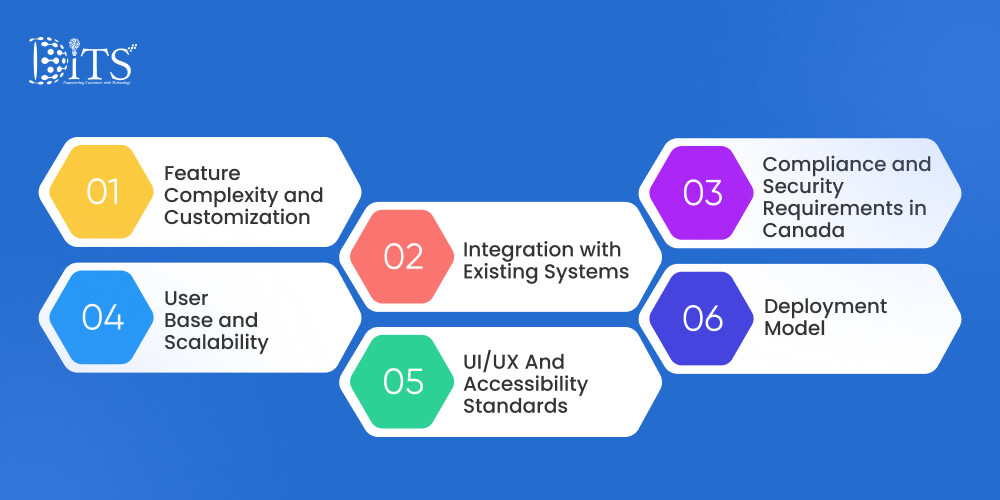
Understanding cost isn’t about a single number. It’s about multiple moving parts that shape the final investment. Two providers may build similar-looking portals, yet their budgets can differ significantly. The reason lies in the underlying decisions.
Let’s break down what actually drives the numbers.
Feature Complexity and Customization
Not all portals are built equal. A basic system with appointment booking and record access will sit at the lower end. Add features like remote monitoring, multi-provider coordination, or personalized dashboards, and the scope expands quickly.
Then comes customization. A hospital network may need workflows tailored to departments, while a clinic may prefer simplicity. More customization means more development hours, which directly impacts the patient portal implementation cost.
Integration with Existing Systems
Most healthcare providers already operate on legacy systems. While integrating a new portal with EMR or EHR platforms several things need to be considered.
- Data synchronization challenges
- API limitations
- Compatibility with older infrastructure
This is where many projects slow down. In fact, organizations investing in legacy app modernization often see smoother portal integration and better long-term scalability.
Compliance and Security Requirements in Canada
Healthcare data in Canada is heavily regulated.
Key considerations include:
- PIPEDA compliance for data privacy
- Provincial regulations like PHIPA in Ontario
- Secure hosting and encryption standards
- Regular audits and monitoring
These requirements add layers of development, testing, and infrastructure costs. Skipping them is not an option, and cutting corners can be far more expensive later.
User Base and Scalability
A portal designed for a single clinic will cost far less than one built for a multi-location healthcare network.
Factors that influence cost here:
- Number of active users
- Volume of data transactions
- Expansion plans
Scalability ensures the system doesn’t break when patient volume doubles. And that foresight often increases upfront investment but reduces long-term risk.
UI/UX And Accessibility Standards
This is where many providers underestimate effort.
In Canada, accessibility and inclusivity are critical:
- Bilingual support in English and French
- Compliance with AODA and WCAG standards
- Simple, intuitive navigation for all age groups
A well-designed interface reduces support requests and improves adoption. Poor design does the opposite. So yes, design decisions do influence the patient portal setup fees more than expected.
Deployment Model
Finally, the deployment approach plays a major role.
- Cloud-based systems offer flexibility and lower upfront infrastructure costs
- On-premise solutions provide more control but require higher initial investment
Cloud adoption is rising rapidly as part of broader digital transformation in healthcare, allowing providers to scale without heavy infrastructure spending.
Each of these factors connects directly to the overall cost. Miss one, and budgeting becomes guesswork. Address them strategically, and the investment starts making sense.
Cost Breakdown by Patient Portal Development Stage
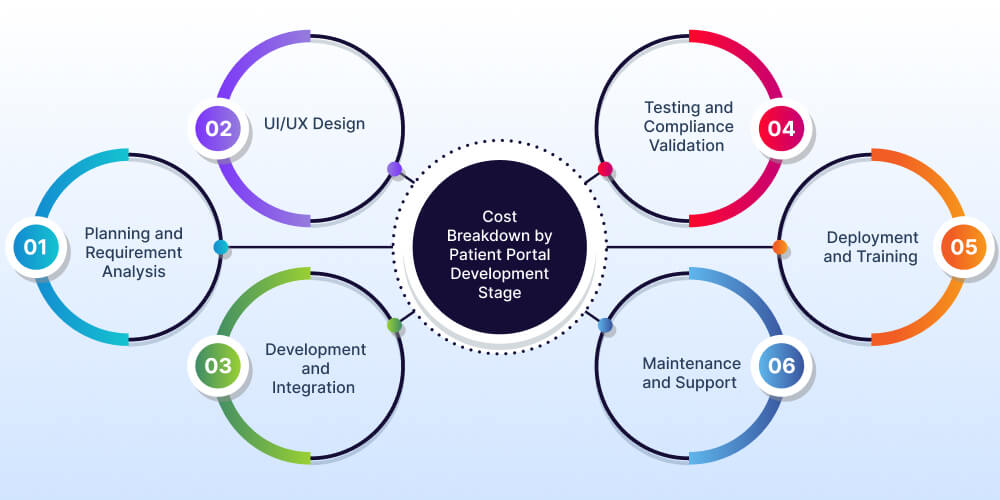
When healthcare providers evaluate budgets, they often focus only on the final number. But the real clarity comes from understanding where the money actually goes. Each stage contributes differently to the overall investment.
At this stage, early decisions around scope and architecture significantly influence the overall patient portal implementation cost, making detailed planning a critical step.
Let’s walk through the lifecycle.
Planning and Requirement Analysis
This is where everything begins. Stakeholders define goals, map workflows, and identify gaps in current systems.
Typical activities include:
- Clinical and administrative workflow mapping
- Identifying integration points with existing systems
- Defining compliance and security requirements
It may seem like a small phase, but poor planning often leads to rework, which quietly inflates the patient portal implementation cost.
UI/UX Design
Design directly impacts how patients and staff interact with the system.
Key focus areas:
- Simplified navigation for patients of all age groups
- Accessibility compliance for inclusive usage
- Mobile responsiveness for on-the-go access
A well-thought-out design reduces training time and improves adoption. A rushed one does the opposite.
Development and Integration
This is where the bulk of the investment sits. Both frontend and backend systems are built, tested, and connected.
Core components include:
- Patient-facing interface development
- Backend logic and database structuring
- Integration with EMR/EHR systems and third-party tools
Many providers partner with a custom software development company at this stage to ensure scalability and compliance are built into the foundation.
Testing and Compliance Validation
Before launch, the system goes through rigorous checks.
This includes:
- Security testing and vulnerability assessments
- Performance testing under real-world conditions
- Compliance validation against Canadian healthcare regulations
Here’s where attention to detail matters. A missed compliance issue can delay deployment or lead to penalties later.
Deployment and Training
Once validated, the system is deployed across the organization.
Key activities:
- Infrastructure setup and system rollout
- Staff onboarding and training sessions
- Initial support during transition
This phase often reveals practical challenges that weren’t visible earlier. And addressing them early makes a big difference.
Maintenance and Support
The journey doesn’t end at launch. In fact, this is where long-term costs begin to take shape.
Ongoing efforts include:
- Regular updates and feature enhancements
- Security patches and monitoring
- Performance optimization
At DITS, we integrate AI in healthcare solutions directly into development and maintenance cycles. AI supports code quality, accelerates testing, and enables smarter customization, ensuring systems evolve without increasing operational complexity.
In many cases, providers aiming for affordable patient portal software focus heavily on initial development costs but underestimate long-term maintenance. And that’s where budgets quietly expand.
Understanding this breakdown helps shift the conversation from cost to value. Because each stage, when executed well, reduces risks and strengthens returns.
Estimated Cost Range for Patient Portal Software in Canada
Now comes the question every decision-maker asks early on. How much will it actually cost?
The answer depends on scope, complexity, and long-term vision. Still, based on industry benchmarks across Canadian healthcare providers, here’s a realistic cost distribution:
| Solution Type | Estimated Cost Range | Typical Use Case |
| Basic Portal | $20,000 – $50,000 | Small clinics with limited features |
| Mid-Level Solution | $50,000 – $120,000 | Growing practices with integrations |
| Enterprise Platform | $120,000 – $300,000+ | Hospitals and multi-location networks |
On top of this, ongoing costs include:
- Monthly maintenance and support: $1,000 – $5,000+
- Cloud hosting and infrastructure
- Periodic upgrades and compliance updates
While these ranges provide a general benchmark, the actual cost of patient portal system depends heavily on integration depth, compliance requirements, and long-term scalability planning.
Here’s the reality many providers discover mid-project. The patient portal software cost isn’t just about development, but how well the system adapts over time.
For example, a mid-sized clinic in Ontario initially budgeted $60,000 for a portal. Once integration, compliance checks, and staff training were factored in, the total investment crossed $90,000.
The takeaway is simple. A lower upfront estimate may look attractive, but without factoring scalability and compliance, it often leads to higher long-term spending.
Hidden Costs Healthcare Providers Should Consider
Building healthcare software goes far beyond initial development budgets. Beneath the surface, several operational and strategic cost factors emerge as the system moves from deployment to real-world usage. These “hidden costs” are often overlooked during early planning, yet they play a critical role in determining long-term ROI, scalability, and compliance readiness. From data migration complexities to ongoing regulatory requirements and third-party dependencies, healthcare providers must account for these variables to avoid budget overruns and implementation delays. Understanding these cost layers early enables better financial planning, smoother adoption, and more sustainable digital transformation.
Data Migration from Legacy Systems
Moving patient records from older systems isn’t as simple as exporting and importing files. Data formats differ, records may be incomplete, and validation becomes critical.
Providers investing in healthcare app development often underestimate this phase, only to realize later that data cleanup and migration require significant time and effort.
Compliance Audits and Certifications
Building a compliant system is one thing. Proving it is another.
- Third-party audits
- Security certifications
- Ongoing compliance checks
These are recurring costs, not one-time expenses. And in regulated environments, skipping them is not an option.
Third-Party Licensing Fees
Many portals rely on external services:
- Payment gateways
- Communication APIs (SMS, email)
- Cloud infrastructure services
Each integration adds value but also introduces licensing or subscription fees that accumulate over time.
Staff Training and Change Management
Technology adoption requires proper onboarding. Staff need to understand new workflows, patients need guidance, and internal resistance must be managed.
This is where business workflow automation plays a key role. When processes are automated effectively, training becomes easier and operational disruption is minimized.
When these additional factors are considered together, the overall cost of patient portal system often extends beyond initial estimates, especially for providers scaling across multiple locations.
What Will Your Patient Portal Actually Cost You?
Get a tailored cost estimate based on your requirements, integrations, and compliance needs before making any critical investment decisions.
Build Vs Buy: What’s More Cost-Effective?
| Criteria | SaaS Solution | Custom Development |
| Initial Cost | Lower upfront investment | Higher initial investment |
| Implementation Time | Fast deployment (weeks) | Moderate timeline (weeks to months) |
| Customization | Limited to predefined features | Fully tailored to clinical workflows |
| Scalability | Restricted by vendor roadmap | Built to scale with business growth |
| Integration Capability | Often limited or costly add-ons | Seamless integration (EHR, APIs, IoT) |
| Compliance Flexibility | Generic compliance support | Designed for specific regulatory needs |
| User Experience | Standardized UI/UX | Personalized for patients and staff |
| Ownership & Control | Vendor-dependent | Full control over system, data, & roadmap |
| Recurring Costs | Ongoing licensing & subscription fees | Lower long-term maintenance costs |
| Long-Term ROI | Declines due to limitations | Increases with efficiency and scalability |
This decision often shapes the entire investment strategy. Honestly, there’s no one-size-fits-all answer. It depends on how you balance short-term affordability with long-term control.
Let’s break it down.
Saas Solution
Ready-made platforms are quicker to deploy and usually come with lower upfront costs.
Advantages:
- Faster implementation timelines
- Lower initial investment
- Pre-built compliance features
But there’s a catch. These systems are built for general use, not your specific workflows. Over time, limitations start showing up.
- Limited customization
- Integration constraints
- Recurring licensing costs
What looks affordable initially may become restrictive as your organization grows.
Custom Development
Custom-built portals are designed around your operations, not the other way around.
Why Custom Development Becomes More Profitable
- Eliminates recurring licensing costs, improving cost efficiency over time
- Reduces operational friction by aligning software with real workflows
- Enables seamless scaling without needing system replacement
- Supports advanced integrations (AI, analytics, automation) without constraints
- Provides full ownership, avoiding vendor lock-in and dependency risks
- Enhances patient and staff experience, leading to better retention and outcomes
Yes, the upfront investment is higher. But for providers with long-term growth plans, it often delivers better ROI.
Many organizations partner with a custom software development company to ensure flexibility without compromising compliance or performance.
Long-Term ROI Perspective
Here’s where the real comparison happens.
- Off-the-shelf solutions reduce initial spend but increase dependency
- Custom solutions require higher upfront investment but lower long-term friction
And guess what? Providers who prioritize scalability early often avoid repeated system replacements later.
In the context of overall patient portal implementation cost, the smarter decision is not always the cheaper one. It’s the one that aligns with your operational roadmap.
Why Choose DITS For Patient Portal Software Development?
Choosing a development partner is finding a team that understands healthcare workflows, compliance requirements, and the operational pressure providers face every day.
At DITS, the approach goes beyond standard development. Every solution is designed with a strong focus on scalability, security, and real-world usability.
Here’s what sets the approach apart:
- Deep expertise in healthcare systems and Canadian regulatory frameworks
- Strong focus on building compliant, secure, and future-ready platforms
- Ability to align software architecture with evolving clinical workflows
But here’s where things get more interesting. At DITS, AI is embedded into the development lifecycle itself. From writing cleaner code to automating quality assurance and enabling smarter customization, AI supports faster delivery without compromising reliability.
This also connects directly with broader digital transformation in healthcare, where systems are no longer standalone tools but part of a larger, intelligent ecosystem.
And for providers looking to balance quality with budget, the focus remains on delivering affordable patient portal software without cutting corners on compliance or performance.
In simple terms, it’s not just about building a portal. It’s about building a system that continues to deliver value long after deployment.
Need Expert Guidance Before Building Your Patient Portal?
Connect with specialists to evaluate your requirements, avoid costly mistakes, and plan a compliant, scalable patient portal strategy.
Conclusion
Understanding the true investment behind a patient portal requires making informed, strategic decisions. From feature complexity to compliance, from integration challenges to long-term maintenance, every factor contributes to the final outcome.
What often starts as a simple budgeting exercise quickly turns into a broader discussion around operational efficiency, patient experience, and scalability. And rightly so. Because a well-built portal doesn’t just digitize processes. It transforms how care is delivered and managed.
The key takeaway is clear. Evaluating patient portal software cost in isolation can lead to short-term decisions that don’t hold up over time. Instead, providers should focus on building systems that align with growth plans, regulatory requirements, and evolving patient expectations.
FAQs
What is average cost of patient portal software in Canada?
The cost typically ranges from $20,000 for basic solutions to over $300,000 for enterprise-grade platforms. The final investment depends on features, integrations, compliance requirements, and scalability needs.
How long does it take to develop patient portal?
A standard patient portal can take anywhere between 3 to 9 months. Timelines vary based on complexity, customization, and integration with existing healthcare systems.
Is custom development better than ready-made solutions?
Custom development offers better flexibility, scalability, and alignment with clinical workflows. While it requires higher upfront investment, it often delivers stronger long-term value compared to off-the-shelf solutions.
How do DITS patient portal software development services support healthcare providers?
DITS patient portal software development services focus on building secure, scalable, and compliant solutions tailored to healthcare workflows. The approach ensures seamless integration with existing systems while improving patient engagement and operational efficiency.
What compliance standards must Canadian patient portals follow?
Patient portals in Canada must comply with PIPEDA and relevant provincial regulations such as PHIPA. This includes data encryption, secure storage, access control, and regular compliance audits.
Can DITS patient portal software development services help with system integration?
Yes, DITS patient portal software development services include end-to-end integration support, ensuring smooth connectivity with EMR/EHR systems, third-party APIs, and legacy platforms without disrupting existing operations.

Nidhi Thakur
With more than 19 years of experience - I represent a team of professionals that specializes in the healthcare and business and workflow automation domains. The team consists of experienced full-stack developers supported by senior system analysts who have developed multiple bespoke applications for Healthcare, Business Automation, Retail, IOT, Ed-tech domains for startups and Enterprise Level clients.
Recent Posts
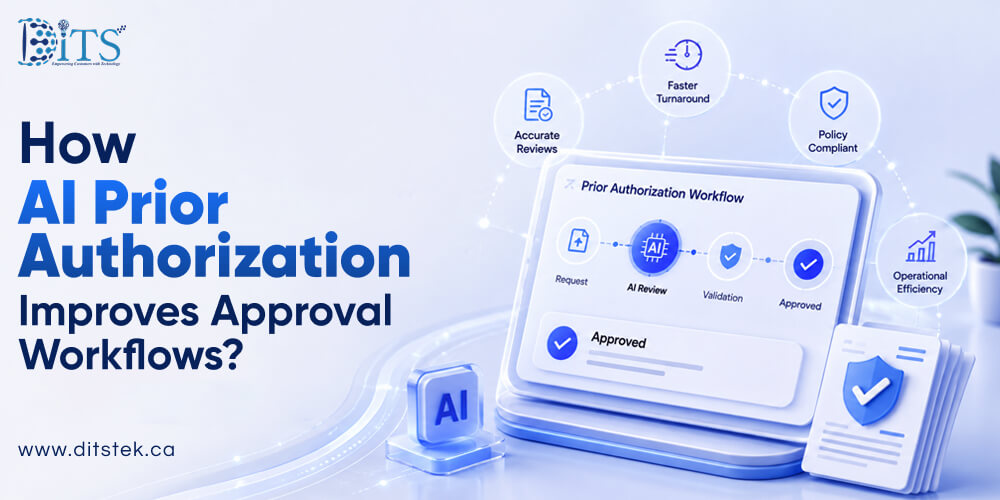
Explore how prior authorization software uses AI to automate workflows, reduce administrative effort, improve request accuracy, streamline approvals, and minimize treatment delays for healthcare organizations.

Discover how AI to improve patient experience in hospitals streamlines scheduling, communication, triage, queue management, and personalized care while enhancing operational efficiency.

Learn how IoT powers smart factories with connected devices, automation, predictive maintenance, and analytics.